
Birth Control Failure Risk Calculator
Rifampin can cause breakthrough ovulation and pregnancy even with perfect birth control adherence. Your hormonal birth control may stop working completely.
Use backup contraception for 28 days after stopping rifampin. Non-hormonal methods are the only safe alternative during treatment.
Rifampin is one of the most common antibiotics used to treat tuberculosis, but for women using hormonal birth control, it can be dangerous. This isn’t a myth or an old wives’ tale-it’s a well-documented, life-changing interaction backed by decades of clinical evidence. If you’re taking rifampin, your birth control pills, patch, or ring may stop working. Not just sometimes. Not just in rare cases. Rifampin can cause breakthrough ovulation, meaning you could get pregnant even if you take your pill perfectly every day.
Why Rifampin Breaks Birth Control
Rifampin doesn’t just interact with birth control-it actively destroys its effectiveness. It does this by turning on a powerful enzyme system in your liver called cytochrome P450. Specifically, it ramps up CYP3A4, the same enzyme that breaks down estrogen and progestin. When this happens, your body clears the hormones from your system way too fast. Studies show that when rifampin is taken with combined hormonal contraceptives, estrogen levels drop by 42% to 66%. Progestin levels? They crash by 30% to 83%. That’s not a small change. That’s enough to stop ovulation suppression.Think of it like this: your birth control works because there’s a steady, low dose of hormones in your bloodstream every day. Rifampin turns your liver into a factory that’s burning through those hormones before they can do their job. Even if you take your pill at the same time every day, your body just can’t keep up. And because there’s no known minimum effective level for progestin in the blood, doctors can’t say exactly how much is too little. All they know is: when rifampin is in the mix, ovulation can happen.
It’s Not Just Rifampin-But Almost Everyone Else Is Safe
This is where things get confusing. You’ve probably heard that all antibiotics can mess with birth control. That’s not true. Rifampin is the only antibiotic with solid, repeatable proof of causing contraceptive failure.Studies have looked at azithromycin, amoxicillin, tetracycline, and even erythromycin. In every case, there was no drop in hormone levels. No increase in breakthrough bleeding. No rise in pregnancy rates. A 2018 review of 16 studies found zero evidence that non-rifamycin antibiotics affect hormonal contraception. So if you’re on penicillin for a sinus infection or doxycycline for acne? You’re fine. Keep taking your pill.
But rifampin? It’s in a league of its own. Even its cousin, rifabutin, is less risky. One study found no ovulation in women taking rifabutin and birth control together. Rifampin? It’s been linked to multiple pregnancies in clinical practice. One infectious disease specialist reported seeing three pregnancies directly tied to this interaction in his 20-year career. And women on forums like Birth Control Support Network are sharing stories of getting pregnant despite perfect pill adherence-because they were on rifampin for TB.
What Happens When You Get Pregnant on Birth Control and Rifampin?
It’s not just about the risk. It’s about the consequences. Many women don’t realize they’re pregnant until they’re several weeks along. If you’re on rifampin and become pregnant, you’re now dealing with a drug that’s known to cause birth defects in animal studies and may affect fetal development in humans. The CDC says the risk of pregnancy when combining rifampin and hormonal contraceptives is significantly higher than the normal 0.3% failure rate. No one knows the exact number, but it’s enough that health agencies worldwide treat this as a serious safety issue.One woman on a support forum wrote: "I was on Ortho Tri-Cyclen while taking rifampin for TB treatment and got pregnant despite perfect pill adherence." Her OB/GYN confirmed it. No other explanation. Just rifampin.
What Should You Do? The Only Real Solution
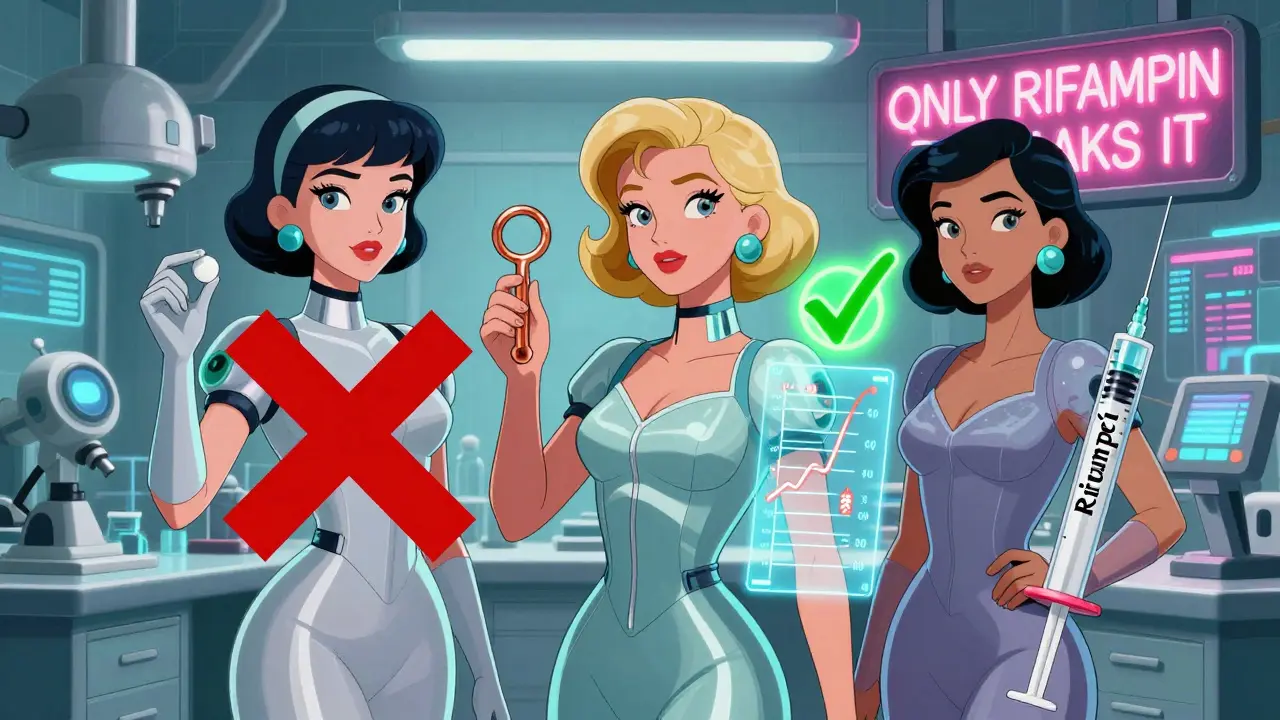
There’s no workaround. No trick. No way to "outsmart" this interaction. The only safe approach is to use a backup method while you’re on rifampin-and for a full 28 days after you stop.The CDC, WHO, and the American Academy of Family Physicians all agree: use condoms, a copper IUD, or another non-hormonal method. Why 28 days? Because rifampin doesn’t just work while you’re taking it. It keeps your liver enzymes revved up for weeks after you stop. Even if you feel fine, your body is still clearing hormones faster than normal.
If you’re on rifampin for tuberculosis and you’re sexually active, talk to your doctor about switching to a non-hormonal method. A copper IUD lasts up to 12 years and isn’t affected by liver enzymes. Progestin implants like Nexplanon? Also safe. They don’t rely on the liver to stay effective. And unlike the pill, you don’t have to remember to take them daily.
Why Don’t Pharmacies Warn You?
It’s frustrating. You pick up your rifampin prescription, and the pharmacist doesn’t say a word. Why? Because the warning is buried in the FDA-approved label. It says: "Decreased effectiveness of oral or other steroid contraceptives." But that doesn’t mean it’s printed on the bottle or shouted at the counter.Doctors don’t always bring it up either. Many assume you know. Or they think you’re not sexually active. Or they assume you’re using an IUD already. But if you’re on the pill, patch, or ring, you need to hear this: rifampin makes it useless.

What About Higher-Dose Pills?
Some doctors suggest switching to a higher-estrogen pill-like one with 50 mcg of ethinyl estradiol instead of 30 mcg. But here’s the problem: there’s no solid evidence this works. One study showed a slight increase in estrogen levels, but it didn’t prevent ovulation. The risk of blood clots also goes up with higher estrogen. So while it sounds logical, it’s not a reliable fix.What’s Changing in 2026?
Researchers are still trying to figure out why some women are more affected than others. Early data from Harvard suggests that genetic differences in CYP3A4 enzyme activity might explain why some people get pregnant on rifampin while others don’t. But right now, that testing isn’t available outside of research labs.The American College of Obstetricians and Gynecologists is updating its guidelines later this year. But until then, the advice hasn’t changed: if you’re on rifampin, your hormonal birth control is not safe. Period.
What to Do Right Now
If you’re currently taking rifampin:- Use condoms every time you have sex.
- Or ask your doctor about a copper IUD or progestin implant.
- Don’t rely on timing, withdrawal, or natural methods.
- Keep using backup contraception for 28 days after your last rifampin dose.
If you’re thinking about starting rifampin:
- Tell your doctor you’re using hormonal birth control.
- Ask what non-hormonal options are available.
- Don’t assume your pharmacist will warn you. You have to ask.
This isn’t about being paranoid. It’s about being informed. Rifampin saves lives. But it can also end a planned pregnancy-or start an unplanned one. You deserve to know the real risk. And now you do.
Does rifampin affect all types of birth control?
No. Rifampin only affects hormonal birth control that relies on estrogen and/or progestin-like the pill, patch, and ring. It does not affect non-hormonal methods like the copper IUD, diaphragm, or condoms. Progestin-only implants (like Nexplanon) are also safe because they release hormones directly into the bloodstream and aren’t broken down by liver enzymes the same way.
How long does the interaction last after stopping rifampin?
The enzyme-inducing effect of rifampin can last up to 28 days after your last dose. Even if you feel fine, your liver is still metabolizing hormones faster than normal. That’s why health guidelines recommend using backup contraception for a full month after stopping rifampin. Waiting less than 28 days puts you at risk for unintended pregnancy.
Can I just take two pills a day to make up for it?
No. Doubling your pill dose won’t fix the problem. Rifampin doesn’t just reduce hormone levels-it speeds up how fast your body clears them. Taking more pills won’t stop your liver from breaking them down. It also increases your risk of side effects like nausea, headaches, and blood clots. The only safe solution is a non-hormonal backup method.
Are there any birth control options that are safe with rifampin?
Yes. The copper IUD (Paragard) is completely unaffected by rifampin because it doesn’t use hormones. Progestin implants like Nexplanon are also safe-they release hormones directly into the bloodstream and bypass the liver’s enzyme system. Depo-Provera injections may still be affected, so they’re not recommended. Always talk to your doctor before switching methods.
Why is rifampin still used if it causes birth control failure?
Because it’s one of the most effective drugs for treating tuberculosis, which is a life-threatening infection. TB kills over a million people each year worldwide. Rifampin is critical in curing the disease, especially in combination with other antibiotics. The risk of pregnancy is serious, but the risk of untreated TB is far greater. That’s why doctors recommend using a backup contraceptive method instead of stopping rifampin.





trudale hampton
March 20, 2026 AT 03:46Just wanted to say this is one of the clearest explanations I’ve ever read on this topic. I’ve been on rifampin for TB and didn’t realize how serious this was until now. Thanks for laying it out like this - no fluff, just facts. I’m getting a copper IUD this week. 👍
Desiree LaPointe
March 21, 2026 AT 00:02Oh wow. Another person who thinks ‘hormonal birth control’ is some sacred, unbreakable ritual. Let me guess - you also think your morning coffee is safe from caffeine tolerance because you ‘take it perfectly every day’? 🤦♀️
Newsflash: biology doesn’t care about your routine. Rifampin doesn’t ‘break’ birth control - it just outsmarts it. And yes, that’s why we have science. And yes, you’re still responsible for knowing how your body works. If you think doubling your pill dose fixes it, maybe you should’ve paid attention in high school bio. 🤷♀️
Timothy Olcott
March 21, 2026 AT 10:48YOOOOO THIS IS WILD 😱 I just got prescribed rifampin and was like ‘ehhh I’ll just keep my pill’ 😅 Turns out I’m basically playing Russian roulette with my uterus 🤯
Went to the clinic and they were like ‘oh yeah we don’t usually say this’ 😒
Got the copper IUD installed TODAY. Best decision ever. My ovaries are thanking me. 💪🇺🇸
Jackie Tucker
March 21, 2026 AT 16:42How is it that a drug that saves lives from a disease that kills millions is also the one that casually undermines reproductive autonomy? The irony is almost poetic. Or perhaps, tragically capitalist: we optimize for survival, not consent.
But let’s be real - the system doesn’t warn you because if women knew how fragile their control really was, they might stop trusting it. And then? Where’s the profit?
Still. Copper IUDs are the unsung heroes here. They don’t ask for permission. They just work.
Thomas Jensen
March 22, 2026 AT 08:45Okay but what if the FDA label is wrong? What if this is all a cover-up for Big Pharma wanting people to buy more pills? I read a guy on TruthSocial who said rifampin was designed by the government to reduce population growth in rural areas. He had a chart. With arrows.
Also, my cousin’s neighbor’s dog had a reaction to antibiotics once. So I’m not taking chances. I’m using 3 condoms and a tinfoil hat. 🤡
matthew runcie
March 23, 2026 AT 22:35Thanks for this. I’m on rifampin right now and didn’t know about the 28-day window. Just switched to a copper IUD yesterday. Felt weird at first but now I’m just glad I don’t have to think about it anymore.
Also, props to the doc who actually brought it up. Not everyone does.
shannon kozee
March 24, 2026 AT 19:45Progestin implants are safe. Copper IUD is safer. Don’t overthink it. Talk to your provider. Do it now.
Shaun Wakashige
March 24, 2026 AT 20:59lol i just took 2 pills today lmao