
Buying prescription drugs without insurance sounds like a dream-lower prices, no copays, no paperwork. But is it really cheaper? For some medications, yes. For others, you could end up paying more. And it’s not just about the sticker price. It’s about what’s available, how long it takes to find the deal, and whether your specific meds are even sold online.
What Are Direct-to-Consumer Pharmacies?
Direct-to-consumer (DTC) pharmacies sell generic drugs straight to you, no insurance needed. You pay cash, and they give you the price upfront. No middlemen. No pharmacy benefit managers (PBMs) hiding rebates and markups. Companies like Mark Cuban Cost Plus Drug Company, Amazon Pharmacy, Costco, Walmart, and Health Warehouse run these services. They advertise big savings-sometimes over 90% off retail prices. But here’s the catch: those savings don’t apply to every drug.
These pharmacies work on a simple model: cost + fixed markup. Mark Cuban’s company, for example, adds just 15% to the wholesale price of the drug. That’s it. No secret contracts. No confusing tiered pricing. It sounds fair. And for some drugs, it is.
When DTC Pharmacies Save You Big Money
If you’re taking expensive generic drugs-think ones that cost hundreds of dollars a month under traditional insurance-you could save hundreds. A 2024 study in the Journal of General Internal Medicine looked at the 50 most costly generic drugs in Medicare Part D. For those, DTC pharmacies saved patients an average of $231 per prescription. That’s a 76% drop in price. Some drugs dropped from $400 to under $100.
Amazon Pharmacy had the lowest price on nearly half of these expensive generics. Mark Cuban Cost Plus Drug Company came in second. For drugs like insulin glargine, metformin extended-release, or certain thyroid meds, the savings were real. If you’re uninsured or have a high-deductible plan, this matters.
But here’s the twist: one in five of these high-cost generics weren’t available at any DTC pharmacy. That means if your doctor prescribes one of those, you’re back to square one-insurance or nothing.
For Common Generics, the Savings Are Tiny
Now, let’s talk about the everyday drugs: antibiotics, blood pressure pills, cholesterol meds, pain relievers. These are the ones most people take regularly. For these, the savings look different.
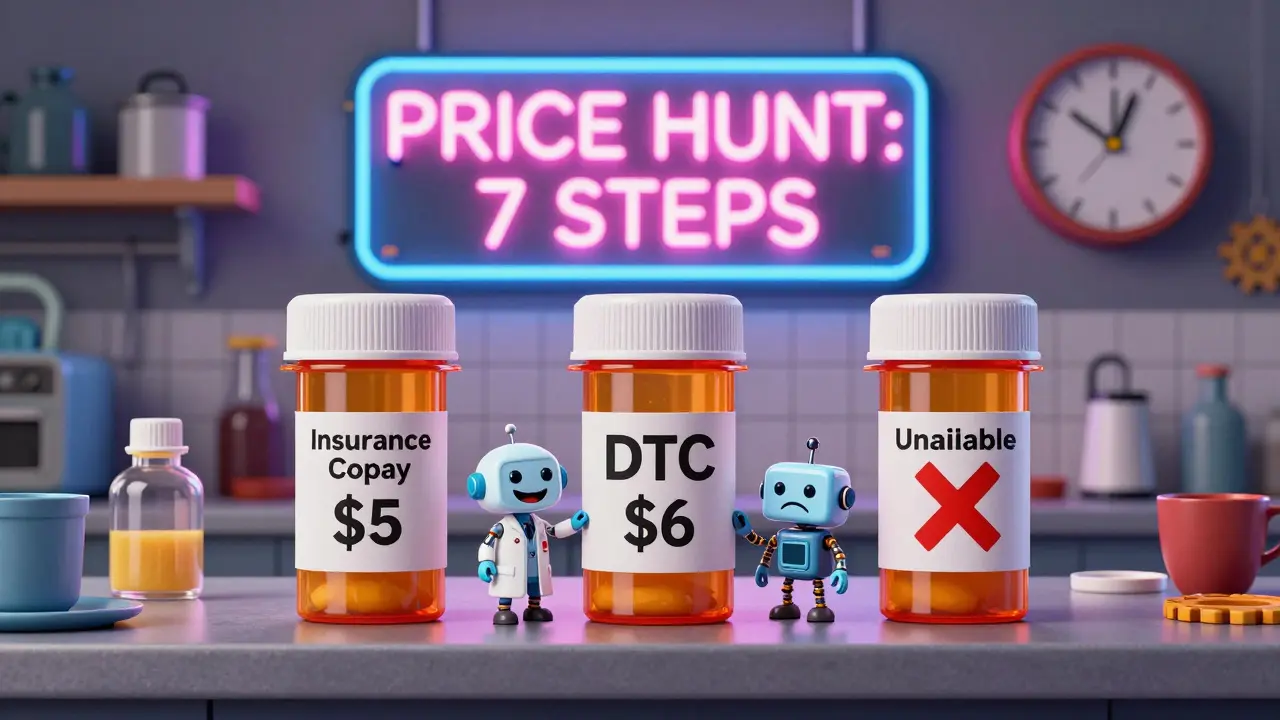
The same study found that for common generics, the average savings at DTC pharmacies was just $19 per prescription. That’s a 75% drop in price-but from $25 down to $6. Compare that to what you’d pay with insurance: $5 to $10 at Walmart or Costco with their $4 lists. Suddenly, the savings aren’t so impressive.
Costco was the cheapest for 31% of common generics. Amazon and Walmart tied for second. Mark Cuban’s pharmacy? Only 10% of the time. If you’re already using a cash-pay retail pharmacy, switching to a DTC site might not save you anything.
Why Your Insurance Might Still Be Better
Here’s the part most people don’t talk about: if you have insurance, your out-of-pocket cost might already be lower than what you’d pay at a DTC pharmacy.
A 2023 study by CVS Health’s research team looked at 79 neurological generic drugs-meds for epilepsy, Parkinson’s, migraines, and more. They found that Mark Cuban’s pharmacy carried only 33 of them. Of those 33, only two were cheaper than what insured patients paid out-of-pocket. The rest? More expensive.
Why? Because insurance plans negotiate deep discounts with PBMs. Even if the list price is high, your copay is locked in at $5, $10, or $15. DTC pharmacies don’t have those deals. They can’t compete on price for drugs that insurers already have under contract.
And it’s not just neurological drugs. The same pattern shows up with diabetes meds, antidepressants, and asthma inhalers. If your plan covers them, you’re often better off using your pharmacy card-even if it’s a big chain like CVS or Walgreens.
The Hidden Cost: Time and Effort
Saving money sounds great-until you realize you have to spend hours doing it.
There’s no single website that compares all DTC pharmacies, retail stores, and your insurance copay in one place. To find the best deal, you need to:
- Check your insurance copay first
- Search Amazon Pharmacy
- Check Mark Cuban Cost Plus Drug Company
- Look at Costco’s online prices
- Compare Walmart’s cash price
- See if Health Warehouse has it
- Repeat for every single medication you take
That’s not just inconvenient. It’s exhausting. Especially if you’re managing three or four chronic conditions. And if you miss one? You could pay $50 extra on a refill.
Researchers call this a "time-consuming process with financial tradeoffs." And they’re right. The savings only matter if you have the time-and the patience-to hunt them down.
What’s Missing? Availability
Not all drugs are sold online. Even the big players don’t carry everything.
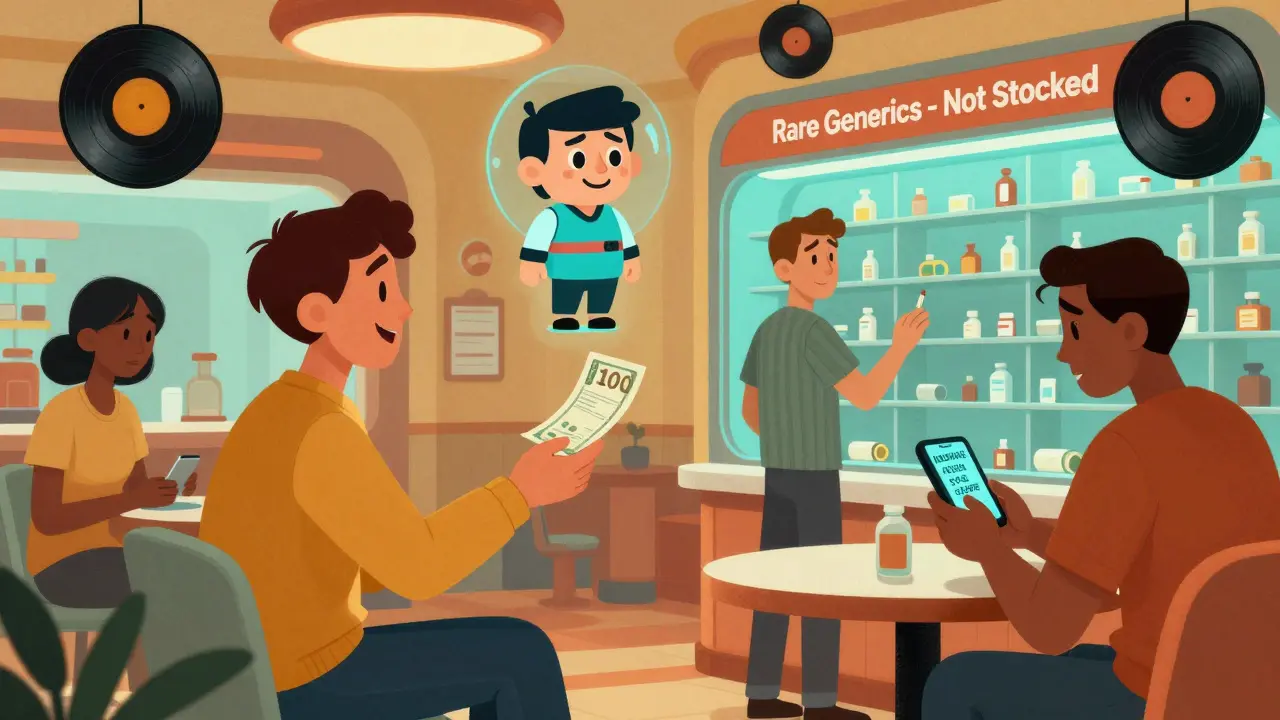
For example, some rare generics used for autoimmune diseases or hormone therapies simply aren’t stocked by DTC pharmacies. They’re too low-demand. Too expensive to warehouse. Too complicated to ship.
If your doctor prescribes one of these, you’ll have to go back to a local pharmacy. And if your insurance doesn’t cover it? You’re stuck paying full retail-sometimes over $300 for a 30-day supply.
This gap isn’t small. One-fifth of the most expensive generics in the U.S. aren’t available through any national DTC pharmacy. That’s a serious barrier for people who need those meds to survive.
Who Benefits Most?
Who wins with DTC pharmacies?
- The uninsured: If you pay full price at the pharmacy, DTC options can cut your bill in half-or more.
- People with high-deductible plans: If you haven’t met your deductible, paying cash upfront might be cheaper than your $100 copay.
- People taking expensive generics: If your drug costs over $200/month, DTC pharmacies often win.
Who loses?
- Insured people taking common generics: Your $5 copay at Walmart is probably cheaper than ordering online.
- People on specialty meds: If your drug isn’t stocked, you’re out of luck.
- Anyone who doesn’t have time to shop: If you’re busy, tired, or overwhelmed, the hassle isn’t worth the $5 savings.
What Should You Do?
Here’s a simple plan:
- Ask your pharmacist: "What’s my cash price?" and "What’s my insurance copay?" Write both down.
- If your cash price is under $20, you probably don’t need DTC.
- If your cash price is over $100, check Amazon, Mark Cuban, and Costco.
- If your drug isn’t available at any DTC site, stick with your insurance.
- Use GoodRx or SingleCare as a quick comparison tool-but don’t trust them blindly. Always verify with the pharmacy’s website.
Don’t assume DTC is always cheaper. Don’t assume insurance is always better. The truth is messy. But if you take five minutes to compare, you’ll know exactly where to buy your next refill.
The Bigger Picture
DTC pharmacies aren’t a revolution. They’re a patch. They fix part of a broken system-but not all of it.
They give people without insurance a fighting chance. They force big pharmacies to be more transparent. They show that drugs don’t need to cost $500 just because a PBM says so.
But they’re not the answer for everyone. And they won’t replace insurance. Not yet. Not without better tools, wider availability, and real-time price comparisons.
Right now, the best strategy isn’t choosing between DTC and insurance. It’s using both-wisely.
Are direct-to-consumer pharmacies cheaper than insurance?
It depends. For expensive generic drugs-like certain thyroid or diabetes meds-DTC pharmacies often save you hundreds of dollars. For common generics like blood pressure or cholesterol pills, your insurance copay ($5-$15) is usually cheaper than ordering online. Always compare your insurance price with the cash price at Amazon, Costco, and Mark Cuban Cost Plus Drug Company before deciding.
What if my medication isn’t available on DTC sites?
One in five of the most expensive generic drugs aren’t sold by any major DTC pharmacy. If your drug isn’t listed on Amazon, Mark Cuban, or Costco, you’ll need to use your insurance or pay retail at a local pharmacy. Don’t waste time searching-check availability first.
Is Mark Cuban Cost Plus Drug Company always the cheapest?
No. For expensive generics, Amazon Pharmacy is often the cheapest. For common generics, Costco wins most of the time. Mark Cuban’s site has lower prices on some drugs, but carries fewer options overall. It’s not the best for everyone-just for some.
Can I use GoodRx with DTC pharmacies?
GoodRx shows retail prices, not DTC prices. You can use it as a starting point, but don’t rely on it. DTC pharmacies like Amazon and Mark Cuban don’t always appear on GoodRx. Always check the pharmacy’s own website for the final price.
Do DTC pharmacies ship to all states?
Most do, but not all. Some states have strict pharmacy licensing rules. Amazon Pharmacy and Mark Cuban Cost Plus Drug Company ship nationwide, but Health Warehouse and others may not. Always confirm shipping availability before ordering.
Is it safe to buy meds online without insurance?
Yes-if you use licensed, U.S.-based pharmacies. Amazon, Costco, Walmart, and Mark Cuban Cost Plus Drug Company are all legitimate and regulated. Avoid websites that don’t require a prescription or offer "discounted" pills from overseas. Stick to well-known names with clear contact info and pharmacy licenses listed.
Next Steps
If you’re paying cash for prescriptions, start by listing all your medications. Then check your insurance copay for each. If any cost over $100, compare them on Amazon, Mark Cuban, and Costco. If you’re on insurance and your copay is high, ask your pharmacist if a cash price would be cheaper. Sometimes, even with insurance, paying cash saves money.
There’s no one-size-fits-all solution. But if you take control of the process-instead of letting your pharmacy or insurer decide-you’ll almost always pay less.

Rosalee Vanness
January 13, 2026 AT 23:32Okay, I just spent three hours comparing prices for my thyroid med, my blood pressure pill, and my antidepressant-because apparently, saving $5 on a 30-day supply is worth the emotional toll of navigating five different websites, each with their own glitchy interface and hidden shipping fees. I cried once. Not because I was sad-because I realized I’m basically a human price comparator now, and my life has become a spreadsheet with extra steps. But hey, I saved $147 on the thyroid med. So… victory? Maybe? I’ll take it.
mike swinchoski
January 14, 2026 AT 07:31You people are idiots. Insurance is for losers. If you can’t afford $10 for a pill, you shouldn’t be taking it. Just stop being weak and get a job. DTC is the future. End of story.
Angel Tiestos lopez
January 15, 2026 AT 12:06broooooo 🤯 i just realized we’re living in the age of pharmaceutical capitalism where your meds are basically a game of ‘find the cheapest website before your brain explodes’ 😅 i mean… is this what freedom looks like? a 47-minute google search for metformin? 🥲 i miss when pharmacies just gave you the pill and said ‘here you go, champ.’ now i need a flowchart and a therapist.
Acacia Hendrix
January 16, 2026 AT 11:32The fundamental flaw in this entire discourse is the conflation of retail cash pricing with value-based pharmacoeconomic outcomes. DTC models operate under a cost-plus paradigm that ignores the economies of scale, risk-pooling mechanisms, and formulary negotiation efficiencies inherent in PBM-integrated insurance systems. Consequently, while marginal savings may appear statistically significant for high-cost generics, the marginal utility of time investment and opportunity cost for the average patient renders these savings economically negligible. Moreover, the absence of clinical decision support, adherence monitoring, and drug interaction alerts in DTC platforms introduces significant clinical risk vectors that are systematically unaccounted for in consumer-centric narratives.
Adam Rivera
January 17, 2026 AT 13:37Hey, I just switched my insulin to Mark Cuban’s site and saved $210/month. I’m not rich, but I’m alive. That’s all that matters. If you’re stressed about spending 10 minutes checking prices, imagine spending 10 minutes worrying if you can afford your next refill. This isn’t a luxury-it’s survival. Thanks for the article, it helped me finally get off the hamster wheel.
Priyanka Kumari
January 18, 2026 AT 16:36This is such an important discussion! I’ve been helping my elderly neighbor compare prices since she doesn’t trust online pharmacies. We checked Amazon, Costco, and even called local pharmacies to confirm cash prices. She was paying $120 for her diabetes med through insurance-turns out, Walmart’s cash price was $38. We cried together. It’s not about ideology-it’s about dignity. Everyone deserves access without humiliation. Thank you for writing this clearly. I’ll share it with my community group.
Avneet Singh
January 19, 2026 AT 09:44Again, the DTC narrative is a neoliberal distraction. The real issue is pharmaceutical monopolies and the absence of universal price controls. You’re all just optimizing within a broken system. Meanwhile, the industry laughs as you waste hours comparing $6 vs $11 for lisinopril. Fix the system, not your Google tabs.
vishnu priyanka
January 20, 2026 AT 00:40man i love how america turned medicine into a survival game show. ‘will you find the cheapest insulin before your kidneys give out?’ 🎮💸 i’m just here for the memes and the 3am price checks. also-why does no one talk about how hard it is to find a pharmacy that ships to rural areas? i live in the middle of nowhere and even amazon took 5 days. my cat’s more reliable than my meds.
Alan Lin
January 20, 2026 AT 20:43Let me be clear: this isn’t about savings. It’s about dignity. People are being forced into a predatory, fragmented system where their health is contingent on their ability to navigate corporate labyrinths. The fact that a 72-year-old with arthritis must spend hours online to afford her blood pressure medication is not a market success-it is a moral failure. The system is designed to exhaust, not to heal. And if you’re still advocating for ‘just compare prices,’ you’re part of the problem.
Scottie Baker
January 21, 2026 AT 23:22Ugh I’m so tired of this. I got my antidepressants from Amazon for $8. My insurance wanted $105. I didn’t even have to leave the house. I just clicked ‘buy’ while crying in my pajamas. Now you people wanna argue about ‘time investment’? I don’t have time. I have anxiety. I have bills. I have a life that doesn’t include playing pharmacy roulette. So yeah, I’m using DTC. And I’m not sorry.
Anny Kaettano
January 22, 2026 AT 09:23As someone who works in mental health, I see the human cost daily. People skipping doses because they can’t afford the copay. DTC pharmacies aren’t perfect, but they’re a lifeline. For those with high-deductible plans or no insurance, this isn’t convenience-it’s continuity of care. We need to stop pretending insurance is the hero here. Sometimes, the hero is a website that charges 15% over wholesale. Let’s celebrate that.
James Castner
January 23, 2026 AT 23:56The structural inequities in pharmaceutical access are not solved by market-based alternatives-they are merely obscured by them. DTC pharmacies expose the absurdity of the current system, yet they do not dismantle it. They are a temporary patch on a ruptured dam. The true path forward lies in policy: price caps, public manufacturing, and universal coverage. Until then, we are left with a fragmented, exhausting, and morally compromised patchwork where the most vulnerable are forced to become expert consumers of their own survival. We must not mistake efficiency for justice.
Milla Masliy
January 25, 2026 AT 07:47My mom’s on 7 meds. I made a spreadsheet. Amazon won on 3, Costco on 2, insurance on 1, and Mark Cuban was cheapest on one… but didn’t ship to our state. So we’re stuck with insurance for half. It’s ridiculous. But we did it. We’re not giving up. This isn’t just about money-it’s about keeping her alive. Thank you for validating how exhausting this is. We’re not lazy. We’re just trying to survive.
Damario Brown
January 25, 2026 AT 13:09lol so you spent 3 hours saving $50? congrats. meanwhile i’m on medicaid and pay $0. you people are so obsessed with ‘hustle culture’ that you’ve turned healthcare into a side hustle. the real problem? you’re not demanding systemic change. you’re just doing the work of the system for free. pathethic.
sam abas
January 27, 2026 AT 11:01Wait, so you’re telling me that the article says DTC isn’t always cheaper… but the title is ‘How Much You Really Save’? That’s clickbait. And you know what? I don’t even trust this article anymore. Also, Mark Cuban’s site is a scam. I ordered my metformin and it took 11 days. And the bottle looked like it was shipped from a garage. I’m not buying from them again. Also, why does everyone ignore that some DTC sites don’t accept returns? That’s not a pharmacy-that’s a gamble.