
Cholesterol Management Calculator
Calculate Your Cardiovascular Risk
Your Cardiovascular Risk Assessment
Your Risk Score
Based on your inputs
Recommendation
Expected Benefits:
Medication Comparison
Statins
LDL Reduction
30-50% reduction
Side Effects
- 32% of users report muscle soreness or weakness
- 18% report brain fog or memory issues
- May increase risk of hemorrhagic stroke in certain groups
PCSK9 Inhibitors
LDL Reduction
50-61% reduction
Side Effects
- Only 21% report muscle symptoms
- 41% report injection anxiety
- No increase in stroke risk
When it comes to lowering bad cholesterol, two drugs dominate the conversation: statins and PCSK9 inhibitors. Both work to cut LDL cholesterol - the kind that clogs arteries - but they’re as different as a daily pill and a monthly injection. One’s been around for decades, cheap and proven. The other is newer, pricier, and delivers sharper drops in cholesterol. But which is better for you? And what are the real trade-offs when it comes to side effects and long-term outcomes?
How Statins Work - and Why So Many People Take Them
Statins hit the market in 1987 with lovastatin, and since then, they’ve become the go-to for millions. They work by blocking an enzyme in your liver called HMG-CoA reductase. That’s the same enzyme your body uses to make cholesterol. Less production means less cholesterol in your blood. Simple, right?
Most statins - like atorvastatin, rosuvastatin, and simvastatin - are taken once a day as a pill. Generic versions cost as little as $4 to $10 a month. That’s why over 40 million Americans are on them. They’re not just cheap; they’ve been shown in dozens of large studies to reduce heart attacks, strokes, and death from heart disease. For most people, especially those with a history of heart problems or diabetes, statins are the first and best step.
But they’re not perfect. About 5 to 10% of people experience muscle pain or weakness - sometimes mild, sometimes bad enough to stop taking the drug. That’s called statin-associated muscle symptoms. Some report brain fog or trouble sleeping. Rarely, liver enzymes rise, but serious liver damage is extremely uncommon. And here’s a twist: research from UCLA in 2023 found statins slightly raise the risk of hemorrhagic stroke in certain groups, especially those with high blood pressure or a history of bleeding in the brain.
PCSK9 Inhibitors: The New Kid on the Block
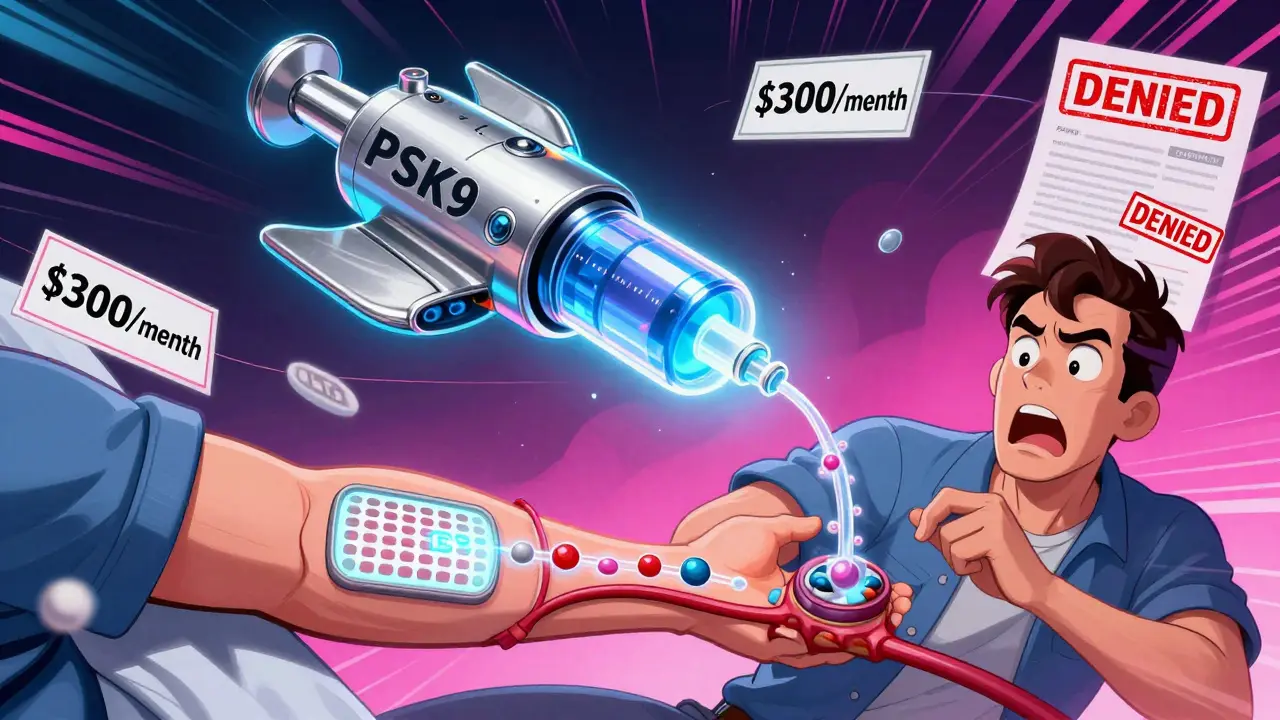
PCSK9 inhibitors - alirocumab and evolocumab - came onto the scene in 2015. They don’t touch cholesterol production. Instead, they block a protein called PCSK9 that normally destroys LDL receptors on liver cells. More receptors mean more LDL pulled out of the blood. It’s like clearing the road so more cars (LDL particles) can be removed.
These drugs are injected under the skin, either every two weeks or once a month. You can’t swallow them. They’re not metabolized by the liver the way statins are, so they don’t interact with other meds the same way. That’s a big plus for people on multiple prescriptions.
And the numbers? They’re impressive. In clinical trials, PCSK9 inhibitors lower LDL cholesterol by 50% to 61%. That’s often more than even the strongest statins can do. In the FOURIER trial, evolocumab cut LDL by 59%. In ODYSSEY, alirocumab dropped it by 61%. When combined with a statin, some patients saw LDL fall over 75%.
Side Effects: What You Actually Feel
Let’s talk about what people actually experience - not just the clinical trial data.
For statins, the most common complaint isn’t liver damage or diabetes risk - it’s muscle pain. On Drugs.com, 32% of negative reviews mention persistent muscle soreness, cramps, or weakness. Some people say they can’t climb stairs or carry groceries. Memory complaints show up in 18% of negative reviews. Most of these symptoms go away when you stop the drug, but that doesn’t make them any less real for the person living through them.
PCSK9 inhibitors? Muscle pain is rare. In fact, 79% of users on Drugs.com say they don’t have it - a big reason why people switch from statins. But they have their own issues. Injection anxiety is real. Forty-one percent of users report fear or discomfort around giving themselves shots. Some get redness or itching at the injection site. And yes, the cost is a nightmare for many. Even with insurance, copays can hit $300 a month. One Reddit user wrote, “I dropped my PCSK9 inhibitor because my insurance denied it for the third time.”
Here’s something surprising: PCSK9 inhibitors don’t increase stroke risk. In fact, across 36 trials, no link was found to hemorrhagic stroke - unlike statins. For people with high blood pressure or a history of brain bleeds, this could be a deciding factor.
Outcomes: Do They Save Lives?
Lowering LDL is good, but does it mean fewer heart attacks and deaths? The answer is yes - for both.
Statins have the longest track record. Decades of data show they cut heart attack risk by 25-35% and stroke risk by 20-30% in high-risk people. They also reduce the need for stents or bypass surgery.
PCSK9 inhibitors don’t just lower numbers - they change outcomes. The 2019 JAMA Cardiology study followed patients with existing heart disease. Those on evolocumab plus a statin had 27% fewer heart attacks, strokes, or heart-related deaths over two years compared to those on statin alone. That’s not a small win.
But here’s the catch: PCSK9 inhibitors are usually added to statins, not used alone. So it’s hard to say if the benefit comes from the PCSK9 inhibitor alone or the combo. Still, the data is clear: when statins aren’t enough, adding a PCSK9 inhibitor saves lives.
Who Gets Which Drug?
Not everyone needs a PCSK9 inhibitor. Doctors don’t start with them because of cost, access, and the fact that statins work for most.
PCSK9 inhibitors are typically reserved for:
- People with familial hypercholesterolemia - a genetic condition that spikes LDL from birth
- Those who’ve had a heart attack or stroke and still have LDL above 70 mg/dL on maximum statin therapy
- Patients with statin intolerance - muscle pain so bad they can’t stay on the drug
- Very high-risk patients with diabetes plus multiple other risk factors
For the average person with high cholesterol but no heart disease, a statin is still the smart first move. For the 1.2 million Americans who can’t reach their LDL goals or can’t tolerate statins, PCSK9 inhibitors are life-changing.
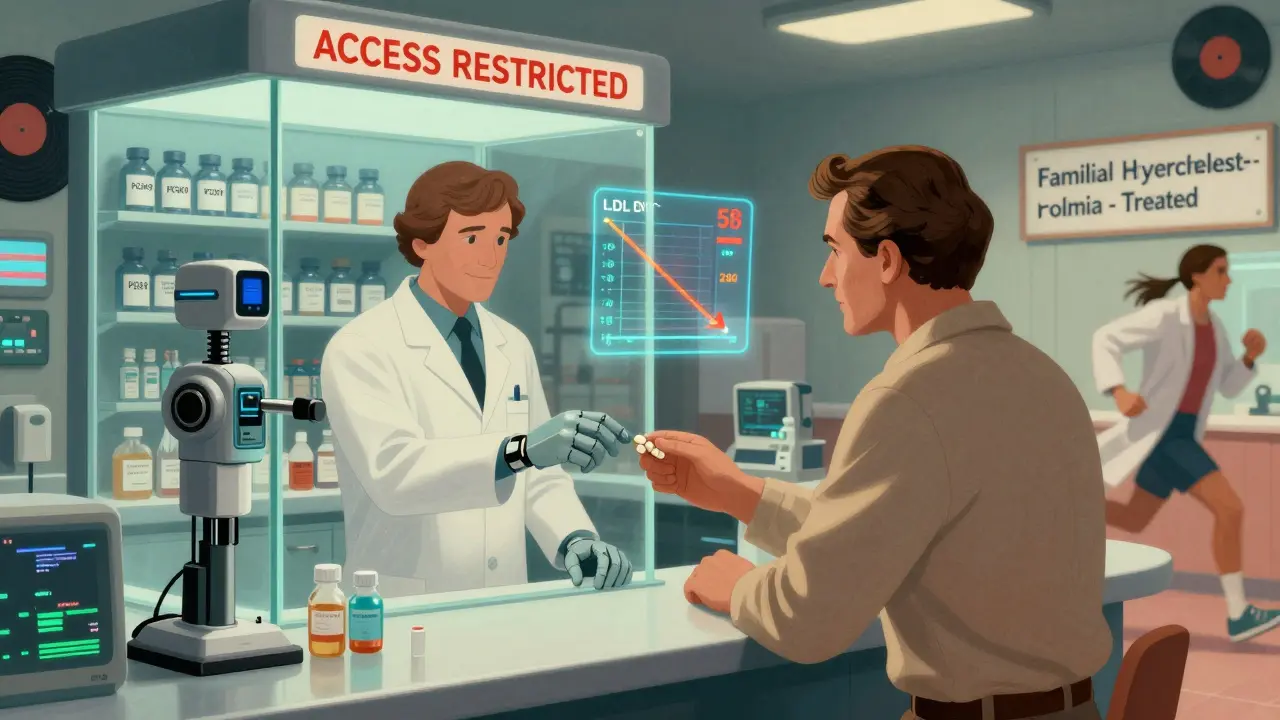
One patient from the FH Foundation saw his LDL drop from 286 mg/dL on high-dose rosuvastatin to 58 mg/dL after adding alirocumab. He went from fearing a heart attack to running marathons again.
Cost and Access: The Hidden Barrier
Cost is the biggest reason PCSK9 inhibitors aren’t used more. A year’s supply runs $5,000 to $14,000. Generic statins? $48 to $120 a year.
Insurance companies know this. In the U.S., 87% require proof you tried and failed on statins before approving a PCSK9 inhibitor. You need lab results showing your LDL is still too high, or documentation of muscle pain that forced you off statins. Prior authorization can take weeks. Some patients give up.
But things are shifting. Drugmakers now offer copay assistance. Some insurers have lowered their thresholds. And in 2024, the ACC updated guidelines to allow PCSK9 inhibitors for patients with LDL over 100 mg/dL and very high-risk features - even without full statin failure. That’s opening doors.
What’s Coming Next?
The future of cholesterol drugs isn’t just about more injections. Inclisiran (Leqvio), approved in 2021, is a twice-yearly shot. It silences the PCSK9 gene at the RNA level. No daily or biweekly shots - just two per year. Early data shows it lowers LDL by 50% with minimal side effects.
Even more exciting: oral PCSK9 inhibitors are in Phase II trials. Merck’s MK-0616 reduced LDL by 60% in mid-2024 trials. If approved, this could be the game-changer - the power of PCSK9 inhibition without needles.
And while statins remain the foundation, newer ones like pitavastatin have better safety profiles and fewer drug interactions. The field isn’t standing still.
Real Talk: Which One Should You Choose?
If you’re healthy, have high cholesterol, and no heart disease - start with a statin. It’s cheap, safe, and proven.
If you’ve had a heart attack, stroke, or have familial hypercholesterolemia - and your LDL is still too high on statins - talk to your doctor about adding a PCSK9 inhibitor. The benefit is real.
If you can’t tolerate statins - muscle pain, fatigue, brain fog - and you’re at high risk for heart disease, PCSK9 inhibitors may be your best option. Many patients say it’s the first time in years they’ve felt normal again.
And if cost is a barrier? Ask about patient assistance programs. Ask if your insurance has a preferred brand. Ask if inclisiran might be an option. Don’t just accept “no” - push for alternatives.
There’s no one-size-fits-all. But there is a right choice for you - based on your risk, your tolerance, and your life.
Can PCSK9 inhibitors replace statins completely?
In most cases, no. PCSK9 inhibitors are usually added to statins, not used alone. Statins have proven benefits beyond just lowering cholesterol - they reduce inflammation and stabilize artery plaques. PCSK9 inhibitors are powerful for LDL reduction, but they don’t yet have the same breadth of long-term data on overall survival. For patients who can’t take statins at all, PCSK9 inhibitors can be used alone - but that’s rare and usually only when no other option works.
Do PCSK9 inhibitors cause weight gain or diabetes?
No. Unlike some statins, which can slightly raise blood sugar levels in predisposed individuals, PCSK9 inhibitors show no link to weight gain or new-onset diabetes in clinical trials. In fact, some studies suggest they may have a neutral or even slightly favorable effect on metabolic markers. This makes them a better option for people with prediabetes or metabolic syndrome.
How long do you need to take PCSK9 inhibitors?
Long-term. Cholesterol doesn’t disappear once you start treatment. If you stop PCSK9 inhibitors, your LDL will rise again within weeks. Most patients take them indefinitely - just like statins. The 5-year data from trials like FOURIER and ODYSSEY show continued safety and effectiveness. These aren’t short-term fixes; they’re lifelong tools for high-risk patients.
Are there natural alternatives to these drugs?
Diet and exercise help, but they rarely lower LDL enough for high-risk patients. Red yeast rice contains a natural statin-like compound, but it’s unregulated and carries the same risks as prescription statins. Plant sterols and soluble fiber can lower LDL by 5-10%, which is helpful as a supplement - not a replacement. For people with genetic cholesterol disorders or heart disease, drugs are still essential. No supplement has proven it can prevent heart attacks like statins or PCSK9 inhibitors.
Can I switch from statins to PCSK9 inhibitors on my own?
Absolutely not. Stopping statins suddenly can cause your LDL to spike, increasing your risk of heart events. Switching requires careful planning. Your doctor needs to check your current cholesterol levels, assess your risk, and make sure you qualify for insurance coverage. Never stop or switch without medical supervision - even if you’re frustrated with side effects.





Stephen Rock
January 21, 2026 AT 04:10Statins are just pharmaceutical band-aids. We've been sold a lie that cholesterol is the enemy. The real issue? Inflammation from processed food and chronic stress. But hey, if you wanna pop a pill and call it a day, be my guest. 🤷♂️
Amber Lane
January 22, 2026 AT 12:56My dad switched to PCSK9 after statins wrecked his muscles. He’s back to gardening. No more pain. Just a monthly shot. Life changed.
Ashok Sakra
January 24, 2026 AT 01:05I take statin and my leg hurt so bad I cry at night. My wife say I need PCSK9 but it cost too much. Why doctor not give me free medicine? I work hard!
Andrew Rinaldi
January 25, 2026 AT 09:11It’s fascinating how we treat medicine like a binary choice-either/or. But biology isn’t that neat. Maybe the real answer isn’t statin vs. PCSK9, but personalized risk profiles, lifestyle, and listening to the patient’s lived experience. Both tools have value. Context is everything.
Gerard Jordan
January 26, 2026 AT 16:57PCSK9 inhibitors are a game-changer for people who can’t tolerate statins 😊 My cousin went from 220 LDL to 55 in 3 months-no muscle pain, no brain fog, just vibes. And yes, the cost sucks, but patient programs exist. Don’t give up! 💪❤️
michelle Brownsea
January 28, 2026 AT 10:40I find it deeply irresponsible that so many people treat cholesterol like a trivial number. Statins reduce mortality by 25-35%. PCSK9 inhibitors? They reduce it by 27%. But you’re all here arguing about injections and cost, while ignoring the fact that 40% of Americans have LDL over 130-and most don’t even know it. This isn’t a lifestyle blog. This is life-or-death medicine.
Roisin Kelly
January 29, 2026 AT 20:00Statins cause diabetes? PCSK9 is just Big Pharma’s way to make you pay $10k/year for a shot? I’ve seen the studies-they’re funded by the drug companies. And don’t even get me started on the ‘injection anxiety’ being a real issue. They just want you dependent. Wake up.
Malvina Tomja
January 30, 2026 AT 16:32Let’s be real. If you’re on a statin and your muscles feel like wet cardboard, you’re not ‘tolerating’ it-you’re suffering. PCSK9 isn’t a luxury. It’s a necessity for people who’ve been failed by the system. The fact that insurance makes you jump through hoops to get it is a moral failure.
Samuel Mendoza
February 1, 2026 AT 07:35Inclisiran? Twice a year? Sounds like a marketing gimmick. If you need a drug that lasts months, you probably shouldn’t be on any drug. Just eat less sugar.
Glenda Marínez Granados
February 1, 2026 AT 09:05So we’re now treating cholesterol like it’s a villain in a Marvel movie? 🙄 Next they’ll patent a serum that ‘destroys plaque’ with laser beams. Meanwhile, people are still eating Pop-Tarts for breakfast. The real cure? Stop pretending medicine can fix bad habits.
Yuri Hyuga
February 1, 2026 AT 09:12This is why I love medical science-evolving, nuanced, and deeply human. Statins are the foundation. PCSK9 inhibitors are the upgrade. And now? We’re getting oral options and gene-silencing therapies. It’s not about choosing sides-it’s about empowering patients with options. Keep pushing for access. Keep asking questions. You deserve better care.
MARILYN ONEILL
February 1, 2026 AT 21:59My doctor said I need PCSK9 because I have familial hypercholesterolemia. But my insurance said no until I tried three statins. I tried them. I cried. I couldn’t walk. They still said no. So I paid $1,200 out of pocket for one month. Now I’m running again. Don’t let bureaucracy kill you.