
When a doctor prescribes a biosimilar - a copy of a complex biologic drug like Humira or Enbrel - the billing process isn’t as simple as handing a patient a generic pill. Unlike traditional generics, which are chemically identical to their brand-name counterparts, biosimilars are highly similar but not exact copies. That difference changes everything when it comes to how providers get paid and how claims get processed under Medicare Part B.
How Biosimilars Are Coded Differently Than Generics
Biosimilars don’t use the same coding system as small-molecule generics. You won’t find them listed under standard J-codes like J0120 for methotrexate. Instead, each FDA-approved biosimilar gets its own unique HCPCS code - either a temporary Q-code or a permanent J-code. For example, Inflectra, a biosimilar to Remicade, has its own code: J1745. Renflexis, another infliximab biosimilar, has J1747. This change didn’t happen overnight.Before 2018, all biosimilars for the same reference product shared one code. That meant if two biosimilars were on the market, they were paid the same blended rate - even if one cost 30% less. That system created a problem: manufacturers had no financial incentive to bring lower-priced options to market. If a cheaper biosimilar entered, it dragged the average down, and everyone got paid less. The 2018 shift to product-specific codes fixed that. Now, each biosimilar’s payment is tied to its own Average Selling Price (ASP), not the group average.
How Medicare Pays for Biosimilars
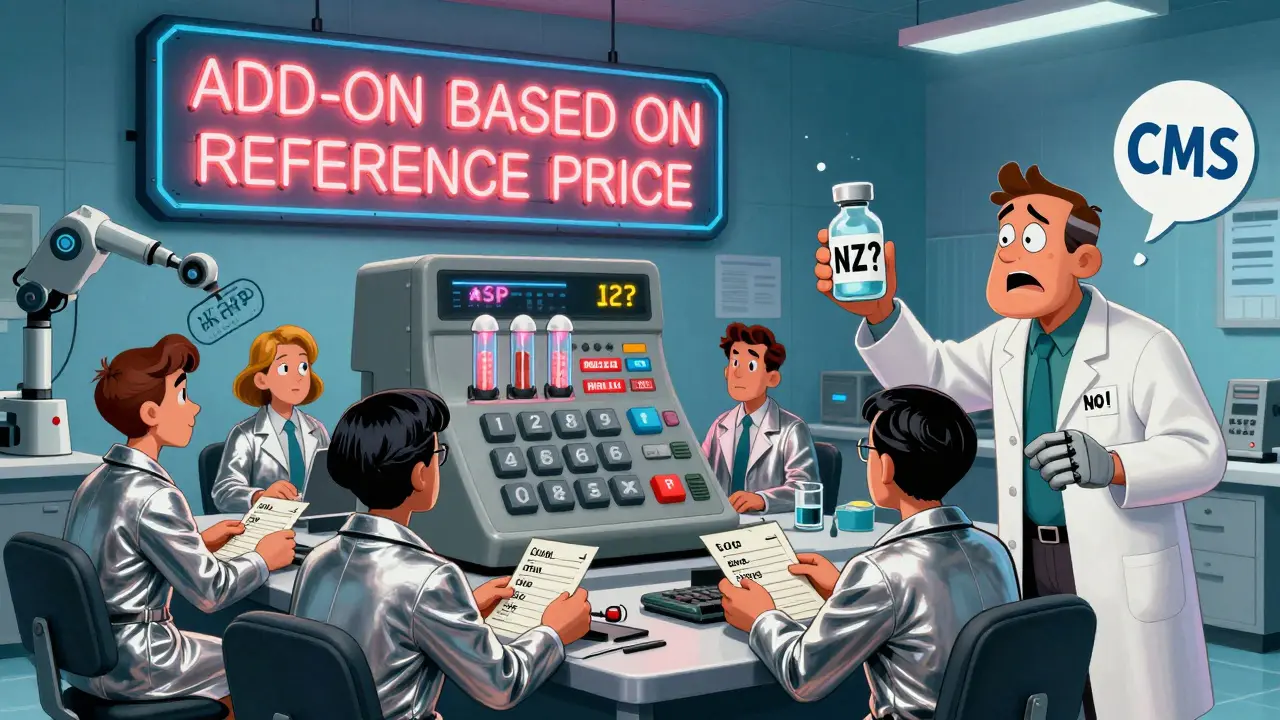
Medicare Part B pays for physician-administered drugs at 106% of the product’s ASP. That’s 100% of the drug’s price plus a 6% add-on. For biosimilars, the add-on is calculated using the reference product’s ASP - not the biosimilar’s. This is where things get tricky.Let’s say Remicade (the reference product) costs $2,500 per dose. Its ASP is $2,400. The add-on is 6% of $2,400 = $144. So Medicare pays $2,400 + $144 = $2,544 per dose.
Now take Inflectra, which sells for $2,000. Its ASP is $1,900. But Medicare doesn’t use that $1,900 to calculate the 6% add-on. It still uses Remicade’s $2,400 ASP. So the add-on is still $144. Medicare pays $1,900 + $144 = $2,044.
On the surface, that looks fair - the provider gets paid less for the cheaper drug. But here’s the catch: the provider’s profit margin is smaller. The $144 add-on is the same whether they give Remicade or Inflectra. So for every dose of Inflectra, the provider earns $300 less in drug cost, but only $500 less in total reimbursement. That $300 difference is the drug cost savings - but the provider keeps only $144 of it. The rest goes to the clinic’s overhead.
That’s why many providers still default to the reference product. The financial incentive to switch isn’t strong enough. A 2020 analysis by Dr. Mark Trusheim at MIT found that this structure actively discourages biosimilar use. Providers earn more per dose from the more expensive drug - not because they’re paid more, but because the add-on is tied to the reference product’s higher price.
The JZ Modifier: A New Layer of Complexity
On July 1, 2023, CMS added another requirement: the JZ modifier. This code must be added to claims for infliximab and its biosimilars when no drug is discarded - meaning the entire vial is used. If even one drop is left over, the modifier shouldn’t be used.This sounds simple. But in practice, it’s not. A single vial of infliximab contains 100 mg. A patient might need 75 mg. That leaves 25 mg unused. If the provider doesn’t document that the leftover was discarded properly - and if they accidentally use the JZ modifier - the claim gets denied.
A 2022 survey of gastroenterology practices found that after the JZ modifier rolled out, billing staff spent 30% more time verifying vial usage and documenting discarded amounts. One clinic reported going from 12 claim denials per month to 38. Training became mandatory. Pharmacists now double-check every vial before administration.
What Happens When Multiple Biosimilars Are Available?
When the first biosimilar enters the market - say, Inflectra for Remicade - CMS pays 106% of the Wholesale Acquisition Cost (WAC) for the first six months, until enough real-world sales data is collected to calculate an accurate ASP. After that, payment switches to 106% of the actual ASP.When the second biosimilar arrives - like Renflexis - it doesn’t get the WAC grace period. It immediately uses the existing payment structure. That means the second entrant has less time to build sales volume before being locked into a payment rate based on its own ASP. This can make market entry harder for smaller manufacturers.
As of October 2023, there are 32 FDA-approved biosimilars in the U.S., covering 12 reference products. But adoption rates lag behind Europe. In the U.S., biosimilars make up about 35% of the market for mature products like infliximab. In Germany or the U.K., that number is 75-85%. Why? One big reason: reimbursement.
European countries use reference pricing or tendering systems. They set one payment rate for all drugs in a class - regardless of brand. That forces providers to choose the cheapest option. In the U.S., providers still have financial reasons to stick with the more expensive drug.
Real-World Billing Challenges Providers Face
Providers don’t just need to know the codes. They need systems to make sure they’re using them right.- Outdated codes cause 22% of initial claim denials. CMS updates its pricing files quarterly. If your billing software isn’t synced, you’re billing wrong.
- Medicare Advantage plans don’t always follow Medicare Part B rules. Some pay 100% of ASP, others 103%. Providers have to check each plan’s contract.
- Commercial insurers often have their own rules - and rarely publish them in advance.
A 2022 survey of 217 cancer centers found that 68% had billing confusion during the 2018 code transition. Forty-two percent had claims denied in the first six months. The fix? Dual verification: a pharmacist checks the drug administered, and a billing specialist confirms the code before submission. Practices that did this cut claim errors from 15% to under 3%.
Manufacturers like Fresenius Kabi now offer free coding guides. Their 2023 guide for STIMUFEND® was rated “helpful” by 87% of providers. But CMS’s own documentation? Only 58% of providers said it was enough to solve real-world problems.

What’s Next for Biosimilar Reimbursement?
There’s growing pressure to fix the system. The Medicare Payment Advisory Commission (MedPAC) has proposed a “consolidated billing” model - where all drugs in a class (reference + biosimilars) get paid the same rate: 106% of the volume-weighted average ASP. That would remove the incentive to use the expensive drug.Another idea: eliminate the reference product’s ASP from the biosimilar add-on. Instead, pay biosimilars 106% of their own ASP. Avalere Health estimates this would boost biosimilar use by 15-20 percentage points.
CMS is currently reviewing these options. An Advanced Notice of Proposed Rulemaking in February 2023 asked for public feedback. A decision could come by 2025. If adopted, it could finally align U.S. reimbursement with the goal of lowering drug costs - not just tracking them.
For now, providers are stuck in a system that works - technically - but doesn’t fully reward cost savings. Until the payment structure changes, biosimilars will keep fighting an uphill battle not because they’re less effective, but because the billing system still favors the original, more expensive drug.
Key Takeaways
- Each biosimilar has its own HCPCS code - no more shared codes after 2018.
- Medicare pays 106% of ASP, but the 6% add-on is based on the reference product’s price - not the biosimilar’s.
- The JZ modifier (since July 2023) requires documentation of no drug waste for infliximab claims.
- Providers earn less profit per dose from biosimilars, which reduces incentive to switch.
- Claim denials are common due to outdated codes, wrong modifiers, or mismatched payer rules.
- Future reforms may consolidate payment to the average ASP across all products in a class.
Are biosimilars covered the same as biologics under Medicare Part B?
Yes, Medicare Part B covers biosimilars the same way it covers their reference biologics - at 106% of the product’s Average Selling Price (ASP). But the way the 6% add-on is calculated differs. For biosimilars, the add-on is based on the reference product’s ASP, not the biosimilar’s, which affects provider reimbursement.
Why do providers sometimes choose the more expensive reference product over a biosimilar?
Even though biosimilars cost less, providers receive the same 6% add-on based on the reference product’s higher price. For example, if Remicade costs $2,500 and Inflectra costs $2,000, the provider still gets $144 in add-on revenue for both. But they only save $500 on the drug cost with the biosimilar - so their net profit per dose is lower. This reduces financial incentive to switch.
What is the JZ modifier and why is it required?
The JZ modifier is required on claims for infliximab and its biosimilars when the entire vial is used and no drug is discarded. It tells Medicare the provider didn’t waste any product. If even a small amount is left over, the JZ modifier must not be used. Failure to use it correctly leads to claim denials and extra billing work.
How often are biosimilar payment rates updated?
CMS updates biosimilar payment rates quarterly, based on the most recent Average Selling Price (ASP) data collected from manufacturers. These updates are published in the Medicare Physician Fee Schedule. Providers must check these updates regularly - using outdated codes or prices is a leading cause of claim denials.
Do Medicare Advantage plans pay the same as traditional Medicare for biosimilars?
No. Medicare Advantage plans are private insurers and can set their own reimbursement rates. While traditional Medicare pays 106% of ASP, Medicare Advantage plans often pay between 100% and 103% of ASP - and sometimes less. Providers must verify each plan’s contract before administering biosimilars to avoid underpayment.
What’s the difference between a biosimilar and a generic drug?
Generics are chemically identical copies of small-molecule drugs and use the same HCPCS code as the brand-name version. Biosimilars are copies of complex biologic drugs made from living cells. They’re highly similar but not identical, so they require unique HCPCS codes and different billing rules. They also go through a different FDA approval process.
Will biosimilar adoption increase in the U.S.?
Adoption is expected to grow slowly under current rules - reaching 45-50% by 2027. But without changes to the reimbursement model - like eliminating the reference product’s ASP from the add-on calculation - adoption will likely plateau below 50%. European countries, with simpler pricing models, see 75-85% adoption. U.S. policy changes could close that gap.






Kiranjit Kaur
December 23, 2025 AT 05:35This is such a mess 😩 I just had to explain this to my cousin who's a nurse in Delhi, and she couldn't believe we pay more to use the expensive drug. Like... why? 🤦♀️
Jim Brown
December 24, 2025 AT 17:54The structural dissonance between therapeutic equivalence and fiscal incentive represents a profound misalignment in the architecture of value-based care. One is compelled to interrogate whether the current paradigm is not merely inefficient, but ethically incoherent.
Sam Black
December 26, 2025 AT 06:52I've seen this play out in my clinic. The JZ modifier alone added 15 hours a week of documentation hell. We switched to dual-check protocols - pharmacist + billing - and denials dropped from 40/month to 3. It's not rocket science, just basic systems thinking.
Jamison Kissh
December 26, 2025 AT 15:38So if the add-on is tied to the reference product’s ASP, does that mean biosimilars are effectively being penalized for being cheaper? It feels like the system rewards inefficiency. Why not just pay 106% of the actual drug cost? That’s what Europe does.
Nader Bsyouni
December 28, 2025 AT 05:02Who even cares about these codes anyway I mean its just money right why do we let bureaucrats dictate how we save lives this is why america is broken
Julie Chavassieux
December 28, 2025 AT 20:38I just... I can't even. After 3 denials last week, my billing team cried. I cried. My cat cried. The vial was 100mg, the patient got 75mg, and now I have to document the 25mg like it's a crime scene. This is not healthcare. This is paperwork terrorism.
Tarun Sharma
December 29, 2025 AT 05:29The current reimbursement model disincentivizes cost-effective alternatives. A structural revision is necessary to align financial outcomes with public health objectives.
Cara Hritz
December 29, 2025 AT 20:10Wait so the JZ modifier is like... a code that says you didnt waste the drug? But what if the nurse just poured it out and lied? I heard someone on TikTok say CMS is just a puppet of Big Pharma and they made up all these codes to keep prices high 😳
Candy Cotton
December 31, 2025 AT 15:27Europe has socialized medicine. That's why they have 85% adoption. We have freedom and innovation here. If providers want to save money, they should stop whining and just switch. This isn't a problem - it's a test of American grit.
Jeremy Hendriks
January 1, 2026 AT 12:52Let me break this down for you: the system is rigged. The 6% add-on is a subsidy to the original drug makers. Biosimilars are cheaper, but the government pays them less profit - so they don't invest. It's capitalism with a backdoor cartel. Wake up.
Ajay Brahmandam
January 2, 2026 AT 15:08Been doing this for 12 years. The 2018 code change was a game-changer. Before that, we were getting paid the same for a $2k drug and a $2.5k drug. Now at least the cheaper one gets its own rate. Still sucks that the add-on is tied to the old one though. We're all just trying to get through the day.
jenny guachamboza
January 3, 2026 AT 13:55I know for a fact that the JZ modifier is just a way for Big Pharma to track who's using biosimilars so they can raise prices later. Also I read somewhere that CMS uses AI to flag providers who switch too often. They're watching us. They know.
Aliyu Sani
January 4, 2026 AT 16:43In Nigeria we just use the cheapest one and bill it as the reference. No JZ, no ASP, no codes. Just give the drug, write the Rx, and move on. This U.S. system is like trying to assemble IKEA furniture with a chainsaw. Over-engineered. Exhausting.
Tony Du bled
January 5, 2026 AT 17:55I work in a rural clinic in Iowa. We switched to biosimilars last year. Saved the clinic $18k in 6 months. But we had to hire a part-time coder just to handle the modifiers. Honestly? Worth it. Just wish CMS would make the rules easier to find.