
Why Your Knee Hurts After a Sports Injury
If you’ve heard a loud pop in your knee during a quick turn or landing, followed by swelling that hits within hours, you’re not alone. Every year, tens of thousands of athletes and active adults face this moment - and the hard questions that come after: Do I need surgery? Will I ever play again? Is this the end of my active life?
The two most common culprits behind this kind of knee trauma are injuries to the anterior cruciate ligament (ACL) and the meniscus. They’re not the same, and they don’t heal the same way. Mixing them up can lead to the wrong treatment - and longer recovery times.
What’s the Difference Between an ACL Tear and a Meniscus Tear?
The ACL is a thick, rope-like ligament that runs diagonally in the middle of your knee. Its job? To stop your shinbone from sliding too far forward and to keep your knee from twisting too much. It’s the anchor during sudden stops, cuts, and jumps.
The meniscus is different. It’s two C-shaped pieces of cartilage - one on the inside (medial), one on the outside (lateral) - that act like shock absorbers between your thigh bone and shinbone. They help distribute weight evenly and reduce friction during movement.
When the ACL tears, you usually feel it right away. About 90% of people hear or feel a pop. Swelling kicks in fast - within two hours in most cases. Your knee might feel unstable, like it’s giving way when you try to pivot. This is called a pivot shift, and it’s a classic sign of a complete ACL rupture.
A meniscus tear often feels different. You might not hear anything. Swelling can take hours or even a full day to appear. The big red flags? Your knee catches, locks, or gets stuck - especially when you try to squat or twist. You’ll likely feel pain right along the joint line, where the meniscus sits. It’s not always instability - it’s mechanical. Something’s physically getting in the way.
When Is Surgery Actually Needed?
Not every ACL or meniscus tear needs surgery. That’s a myth that’s cost people time, money, and unnecessary recovery.
ACL injuries: If you’re under 40 and you play sports that involve cutting, jumping, or pivoting - soccer, basketball, skiing, even tennis - surgery is usually recommended. Studies show that 95% of active people under 40 who skip ACL reconstruction end up with recurring instability, which leads to more damage inside the knee. The standard procedure is reconstruction using your own tissue - either hamstring tendon or patellar tendon. Allografts (donor tissue) are an option, but they carry higher re-tear rates in younger athletes.
Meniscus injuries: Here’s where things get nuanced. Only about 30-40% of meniscus tears need surgery. If the tear is in the outer edge - the red-red zone - where there’s good blood flow, repair is often possible. Healing rates hit 80-90% when done within eight weeks of injury. But if the tear is in the inner zone - the white-white zone - with no blood supply, repair won’t work. In those cases, surgeons remove the damaged piece (meniscectomy), not the whole meniscus.
Here’s the catch: removing even a small part of the meniscus increases your risk of osteoarthritis. Every 10% of meniscus removed raises the risk by 14%. That’s why experts now push hard to preserve as much tissue as possible.
Recovery Timelines: What to Expect
Recovery isn’t just about healing the tissue - it’s about rebuilding strength, balance, and confidence.
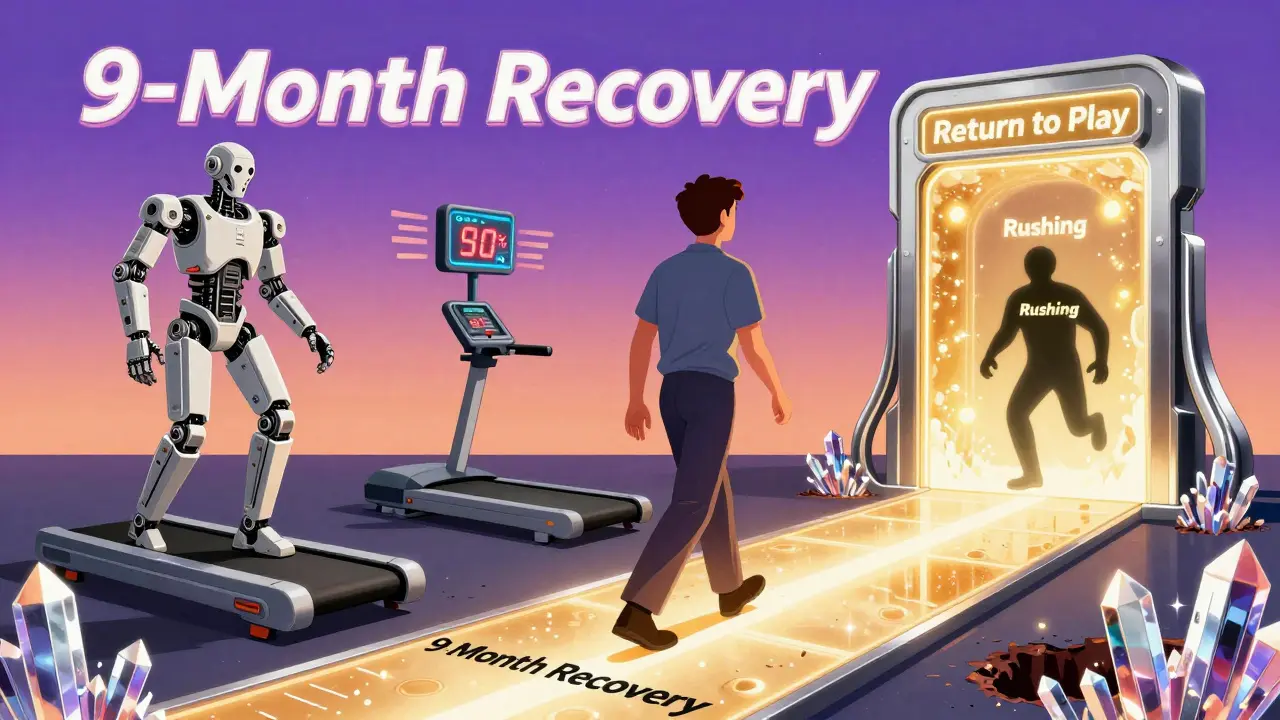
After ACL reconstruction: You’re not cleared to return to sports until at least nine months. Why? Because ligaments don’t regain full strength until then. Studies show athletes who return before nine months have a 22% re-injury rate. At 12 months, that drops to 5%. The rehab is brutal: weeks 0-2 focus on regaining full knee extension and 90 degrees of flexion. By week 6, you’re doing single-leg balance drills. Jogging starts around week 12. Sport-specific drills begin at month 4. By month 9, you’re cleared - if you pass strength tests (90% symmetry on single-leg hop tests) and have no pain or swelling.
After meniscus repair: This is slower than meniscectomy. You’re on partial weight-bearing for six weeks, with your knee locked in a brace between 0 and 90 degrees. Full flexion doesn’t come until week 12. You can’t cut or pivot until six months. Return to sports? 5-6 months minimum. Many patients report a permanent 10-20 degree loss in full knee extension - a trade-off for keeping the meniscus.
After meniscectomy: You’re walking the same day. Light activities? Back in 2-4 weeks. Full recovery? 6-8 weeks. But here’s what no one tells you: 42% of patients still have activity limitations at six months. Pain, stiffness, and swelling can linger. You might need to avoid deep squats or high-impact sports forever.
Costs and Real-World Outcomes
ACL reconstruction costs between $15,000 and $25,000. Meniscus repair runs $9,000-$18,000. Meniscectomy is cheaper - $6,000-$12,000. But cost isn’t just the bill. It’s the time off work, the missed seasons, the physical therapy co-pays.
Success isn’t just about pain going away. It’s about function.
For ACL reconstruction, 82-92% of patients report good to excellent outcomes at two years. But 20-30% develop osteoarthritis within 10 years - even with perfect surgery.
For meniscus repair, satisfaction is lower - only 67% report being happy. Why? Because recovery is long, and swelling can stick around. But those who keep their meniscus are far less likely to need a knee replacement later.
For meniscectomy, satisfaction is higher at 82%, mostly because recovery is fast. But long-term, the risk of arthritis grows with every millimeter of cartilage removed.
What’s Changing in Treatment?
Doctors are shifting. Five years ago, meniscectomy was the default. Now, the trend is toward repair - especially in younger patients. The evidence is clear: preserving the meniscus prevents early arthritis.
For ACL, the big change is in rehab timing. The old rule - wait nine months - still holds. But new data shows returning at eight months increases re-tear risk by 18%. So don’t rush. Even if you feel fine.
Emerging options are promising. Meniscus allografts (donor meniscus transplants) are helping patients who’ve lost large portions. Platelet-rich plasma (PRP) injections during repair are showing 25% higher healing rates in mixed-zone tears. And neuromuscular training programs like FIFA 11+ are cutting ACL injury rates by half in soccer players.
What to Do Right Now
If you’ve injured your knee:
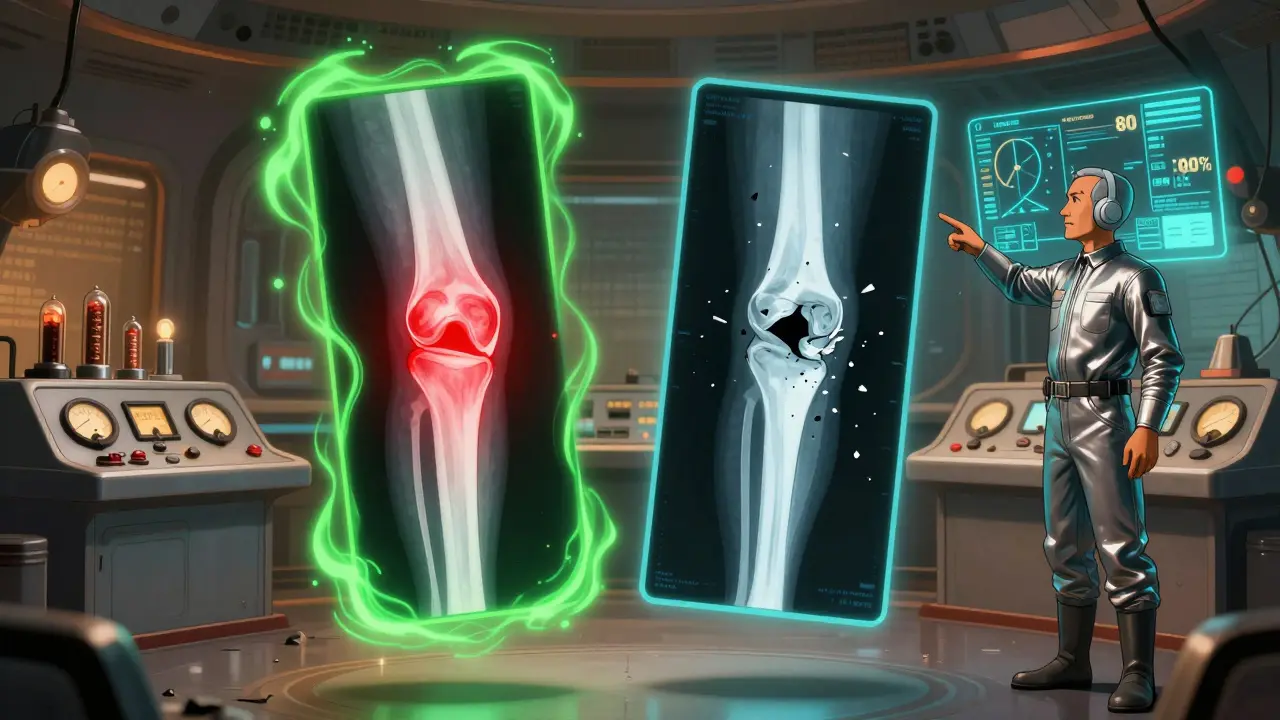
- Get an MRI - don’t rely on X-rays. Meniscus and ACL tears don’t show up on X-rays.
- Don’t assume surgery is automatic. Get a second opinion if your doctor pushes for it right away.
- Start physical therapy now - even before surgery. Strengthening your quads reduces post-op weakness by 65%.
- If you’re over 40 and don’t play high-impact sports, consider non-surgical rehab first. Many can avoid surgery entirely.
- If you’re young and active, prioritize repair over removal for meniscus, and reconstruction over non-surgical for ACL.
Long-Term Outlook: Can You Still Be Active?
Yes - but it depends on what you do.
People with ACL reconstructions often return to running, cycling, hiking, and even tennis - as long as they avoid sudden direction changes. Many never play competitive soccer again, but they don’t need to.
Those who kept their meniscus through repair can often return to more demanding sports. One patient I spoke with returned to recreational volleyball five months after repair. She still wears a knee brace. She doesn’t jump as high. But she’s pain-free.
The biggest mistake? Thinking recovery ends when the brace comes off. Real recovery ends when your strength, balance, and confidence are back - and that takes months, not weeks.
What Happens If You Do Nothing?
Ignoring a torn ACL almost always leads to more damage. The knee becomes unstable. The meniscus gets worn down. Cartilage breaks down. By five years, many people have early arthritis - and they didn’t even need surgery.
Leaving a meniscus tear untreated can lead to locking, chronic pain, and gradual joint degeneration. In older adults, it often just becomes part of the normal aging process. In younger people, it’s a ticking time bomb.
Can a meniscus tear heal without surgery?
Yes - but only if it’s in the outer third of the meniscus, where blood flow reaches the tissue. These are called red-red or red-white tears. About 60-70% of meniscus tears are in the inner white-white zone, where healing is impossible without intervention. For tears in the right zone, rest, physical therapy, and time can allow healing over 6-12 weeks. But if you still have locking, catching, or swelling after three months, surgery is likely needed.
How do I know if I need ACL surgery?
If you’re under 40 and you play sports that involve pivoting, jumping, or quick stops - like soccer, basketball, or skiing - then yes, surgery is strongly recommended. If you’re older, less active, or only do low-impact activities like walking or swimming, you might do fine with physical therapy and a brace. But if your knee gives out during daily activities, or you can’t trust it on stairs or uneven ground, surgery is the better long-term choice.
Is meniscus repair better than removal?
Yes - if the tear is repairable. Removing part of the meniscus increases your risk of osteoarthritis by 14% for every 10% of tissue lost. Repair preserves the shock-absorbing function of the knee. The trade-off? A longer, more restrictive recovery. But if you’re young and active, keeping your meniscus is worth the wait. Only if the tear is in the inner zone or too complex should removal be considered.
How long does it take to return to sports after ACL surgery?
At least nine months. Rushing back before then increases your risk of re-tearing the ACL by more than 18%. Even if you feel strong, your ligament isn’t fully healed until then. You must pass strength tests (90% symmetry on single-leg hop tests), have no swelling, and demonstrate control during cutting and landing drills. Most athletes return between 9-12 months.
Can I prevent these injuries?
Yes - especially ACL tears. Programs like FIFA 11+ (used by soccer teams worldwide) reduce ACL injuries by up to 50% by improving balance, core strength, and landing technique. Strengthening your hamstrings and glutes, practicing controlled landings, and avoiding awkward twisting motions during training make a huge difference. For meniscus tears, avoiding deep squats with heavy weight and wearing proper footwear on uneven surfaces helps.
Final Thought: Don’t Rush the Decision
Knee injuries are common, but they’re not all the same. An ACL tear isn’t a meniscus tear. Surgery isn’t always the answer. Recovery isn’t just about healing - it’s about rebuilding your body’s trust in your knee.
Talk to a sports physiotherapist. Get an MRI. Ask about your tear’s location and your activity goals. And don’t let fear or impatience push you into a decision you’ll regret years later. Your knee will thank you.




Colin Pierce
January 29, 2026 AT 01:51Just had an ACL reconstruction last year-9 months to return to basketball, and holy hell, it was worth every second of PT. Felt like a newborn fawn trying to walk at first, but now I’m back on the court without fear. The key? Don’t skip the hop tests. I failed mine at 7 months and had to redo 6 weeks of rehab. No regrets.
matthew martin
January 30, 2026 AT 10:39Man, I remember tearing my meniscus playing pickup basketball in college. Didn’t even hear a pop-just felt like my knee was full of wet cement. Got the MRI, doctor said ‘remove the flappy bit.’ I did. Back in 6 weeks. But now, at 34, I can’t squat past 90 degrees without a grimace. They don’t tell you the little ghosts that stick around.
Brittany Fiddes
January 30, 2026 AT 19:16Oh please. Americans treat every knee twinge like it’s the end of the world. In the UK, we’ve been playing football on torn meniscus since the 1950s. I played a semi-pro match last year with a Grade 3 ACL tear-just taped it up, took ibuprofen, and carried on. Surgery? That’s for people who can’t handle pain. We’ve got real grit here. Not all of us need to be coddled with PRP injections and 9-month rehab programs.
doug b
February 1, 2026 AT 18:11Biggest mistake I made? Waiting to start PT. Got the MRI, waited 3 weeks ‘to see if it got better.’ Nope. My quad was already wasting. Started PT right after-I swear, 65% less weakness? That’s real. Do the exercises even if your knee feels okay. Your future self will hug you.
Mel MJPS
February 3, 2026 AT 06:00I had a meniscus repair last winter. Six weeks on crutches, brace locked at 90, felt like a robot. But I kept my meniscus. And honestly? I’d do it again. My knee doesn’t click anymore. I still wear a sleeve when I hike. Small price for not being the 40-year-old with a knee replacement.
Phil Davis
February 4, 2026 AT 08:30So let me get this straight-surgery costs $20k, takes 9 months, and you still get arthritis? Meanwhile, I just stopped playing soccer. No surgery. No PT. No debt. Just… life. I’m not saying don’t fix it. I’m just saying maybe don’t glorify the grind like it’s a hero’s journey. Sometimes the bravest thing is walking away.
Irebami Soyinka
February 4, 2026 AT 22:22Y’all in the West think surgery is the only way? In Nigeria, we use herbs, massage, and prayer. My cousin tore his ACL playing football in Lagos-he walked again in 4 months with nothing but ginger paste and a traditional healer. You don’t need a hospital to heal. You need faith. And maybe less plastic surgery culture. 😌🙏
SRI GUNTORO
February 6, 2026 AT 12:05It’s sad how people rush to surgery like it’s a quick fix. You break your knee? Don’t blame the injury-blame your lifestyle. Too much screen time, too little squatting, too much processed food. Your body isn’t broken-it’s neglected. Stop paying doctors to patch you up. Start living right. Your knee doesn’t need a transplant-it needs discipline.
Jeffrey Carroll
February 7, 2026 AT 15:55Thank you for this thorough breakdown. As someone who’s been through both ACL reconstruction and a meniscus repair, I can confirm: patience is the most underrated part of recovery. The medical system pushes for speed. But real healing? It’s slow. It’s boring. It’s daily reps when no one’s watching. And when you finally get back to running? It doesn’t feel like a comeback. It feels like a homecoming.