
Most people who get infected with tuberculosis never get sick. That’s not a myth-it’s science. The bacteria that cause TB, Mycobacterium tuberculosis, can live quietly in your lungs for years, even decades, without causing a single symptom. But if your immune system weakens, those same bacteria can wake up, multiply, and turn into a life-threatening illness. This is the quiet, dangerous duality of tuberculosis: one infection, two very different outcomes.
What Is Latent TB Infection?
Latent TB infection means the bacteria are alive but asleep. Your body has locked them away inside tiny immune cell clusters called granulomas. You feel fine. You don’t cough. You can’t spread it to anyone. But if you take a skin test or blood test (called a TST or IGRA), it will show up as positive. That’s how doctors know you’ve been exposed.
According to the CDC, about one-quarter of the world’s population has latent TB. That’s nearly 2 billion people. Most will never develop active disease. But for 5% to 10% of those infected, the bacteria will reactivate at some point in their lives. The risk jumps dramatically if you have HIV, diabetes, kidney disease, or are on immunosuppressive drugs like steroids or biologics for autoimmune conditions. People with untreated HIV are up to 20 times more likely to develop active TB.
Latent TB doesn’t show up on a chest X-ray. No fever. No weight loss. No night sweats. It’s invisible unless you test for it. That’s why public health programs focus on screening high-risk groups-people who came from countries with high TB rates, healthcare workers, prison inmates, and those living in crowded shelters.
When Latent TB Turns Active
Active TB disease is when the bacteria break free from their immune prisons and start multiplying. They destroy lung tissue, spread through the air, and make you sick. The symptoms don’t come on suddenly. They creep in over weeks: a cough that won’t quit, fatigue that doesn’t lift, night sweats so heavy you need to change your pajamas, and unexplained weight loss-even if you’re eating normally.
If the infection spreads beyond the lungs (called extrapulmonary TB), it can affect your spine, brain, kidneys, or even your bones. But most cases start in the lungs. That’s why a persistent cough lasting more than three weeks is a major red flag. Some people cough up blood. Others feel chest pain when they breathe or cough.
Active TB is contagious. When someone with active lung TB coughs, sneezes, or talks, they send tiny droplets into the air. You don’t need to be right next to them-just sharing the same enclosed space for hours increases your risk. That’s why TB spreads easily in prisons, homeless shelters, and crowded housing.
Diagnosis isn’t just about symptoms. Doctors need proof. A chest X-ray often shows spots or cavities in the lungs. But the gold standard is finding the bacteria in sputum. That’s done through a culture-growing the bacteria in a lab, which takes weeks-or faster molecular tests like NAAT that detect TB DNA in hours.
Drug Therapy for Latent TB
Treating latent TB isn’t about curing symptoms-it’s about prevention. The goal is to kill the dormant bacteria before they wake up. The most common treatment is isoniazid (INH), taken daily for nine months. It’s cheap, effective, and has been used for over 60 years. But sticking to it for that long is hard. People forget. They feel fine. They stop taking it. And that’s how drug resistance starts.
That’s why shorter regimens are now preferred. The CDC and WHO recommend a 3-month course of weekly isoniazid and rifapentine (3HP). It’s taken under direct observation-someone watches you swallow the pills. This improves completion rates from around 60% to over 85%. Another option is rifampin alone for four months. Both are safer for the liver than long-term isoniazid.
Not everyone with latent TB needs treatment. Doctors weigh the risks: your age, your immune status, your exposure history, and your risk of side effects. For example, a healthy 25-year-old who was exposed once might not get treatment. But a 60-year-old with diabetes and recent exposure? Treatment is strongly recommended.

Drug Therapy for Active TB
Active TB is a medical emergency. Left untreated, it can kill. But with the right drugs, it’s curable. The standard first-line treatment is called RIPE therapy: rifampin, isoniazid, pyrazinamide, and ethambutol. These four drugs are taken together for the first two months to smash the bacteria from every angle.
After two months, you drop pyrazinamide and ethambutol. You keep rifampin and isoniazid for another four to seven months. That’s six to nine months total. It’s long. It’s intense. And it’s non-negotiable.
Why so many drugs? Because TB bacteria are sneaky. If you take only one or two, the strongest ones survive and multiply. That’s how drug-resistant TB forms. Multidrug-resistant TB (MDR-TB) doesn’t respond to the two most powerful drugs-isoniazid and rifampin. Treating MDR-TB takes 9 to 20 months, uses more toxic drugs, and costs up to 100 times more.
Directly Observed Therapy (DOT) is the standard of care. A nurse, community health worker, or even a family member watches you take every pill. This isn’t about control-it’s about saving lives. Studies show DOT cuts treatment failure and drug resistance by half.
Side effects are real. Isoniazid can damage your liver. Rifampin turns your urine orange. Pyrazinamide can cause joint pain. That’s why regular blood tests are required. If you feel nauseous, yellow-eyed, or unusually tired, tell your doctor immediately.
Why TB Still Kills Millions
Despite having effective treatments for over 70 years, TB killed 1.3 million people in 2022, according to the WHO. Why? Because access isn’t equal. In low-income countries, people wait weeks to get tested. Diagnostic tools are scarce. Medications run out. DOT programs are underfunded.
Even in wealthy countries like the U.S., TB clusters in marginalized communities. Foreign-born individuals make up over 70% of cases. Homelessness, incarceration, and poverty create perfect conditions for spread. And stigma keeps people silent. Many don’t go to the doctor because they fear being isolated or deported.
The biggest missed opportunity? Not treating latent TB. Every untreated latent case is a ticking bomb. If we screened and treated just 10% of the world’s latent infections, we could prevent hundreds of thousands of active cases every year.
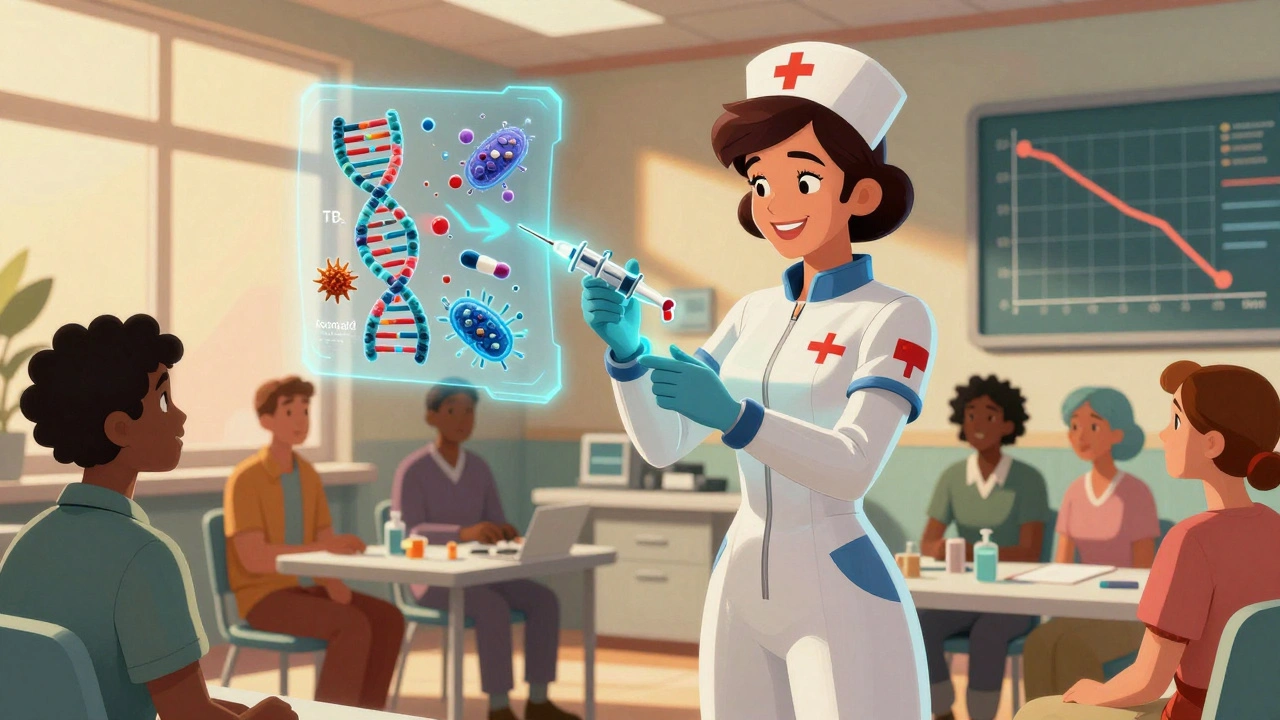
What’s New in TB Care?
Science is catching up. New tests can now detect latent TB with more precision, distinguishing between recent infection and old exposure. Researchers are testing shorter active TB regimens-four months instead of six-with promising early results. A new drug called pretomanid, approved in 2019, is now part of treatment for MDR-TB, cutting therapy time from 18 to 6 months.
There’s also hope in vaccines. The BCG vaccine, used since the 1920s, protects children from severe forms of TB but doesn’t stop lung infection in adults. New candidates are in phase 3 trials, and early data suggests some may reduce infection rates by up to 50%.
But the biggest breakthrough isn’t a drug or a vaccine. It’s recognizing that TB isn’t just a medical problem-it’s a social one. You can’t cure TB without housing. You can’t stop transmission without food security. You can’t end stigma without education.
What You Need to Know
If you’ve been exposed to someone with active TB, get tested. Even if you feel fine. A simple skin or blood test can save your life.
If you’re diagnosed with latent TB, take your medicine. Don’t wait until you feel sick. The bacteria won’t warn you.
If you have active TB, follow your treatment plan. No skipping doses. No stopping early. Your life-and the lives of those around you-depend on it.
Tuberculosis is not a disease of the past. It’s a disease of inequality. And it’s still here. But it’s not unstoppable. With testing, treatment, and compassion, we can end it.


Elizabeth Grace
December 3, 2025 AT 17:02I had latent TB and didn't even know it until my job required a screening. I thought I was fine-no cough, no fever, nothing. Then the blood test came back positive and I was freaked out. Turns out, my grandma had it back in the 80s and never told anyone. Scary how silent this thing is.
Steve Enck
December 5, 2025 AT 03:12The epistemological framework underpinning TB latency reveals a profound ontological dissonance between biological persistence and immunological surveillance. The granuloma, far from being a mere containment structure, functions as a necropolitical apparatus wherein the host's immune system becomes complicit in the perpetuation of pathogenic stasis. To treat latent TB is not merely to administer antibiotics-it is to intervene in a co-evolutionary dialectic between microbe and host that defies reductionist medical paradigms.
Jay Everett
December 6, 2025 AT 22:42Bro, I love how TB is basically the ultimate stealth mode organism 😎 One minute you're chilling, next minute your lungs are hosting a rave with bacteria and you're coughing up a lung. But seriously-3HP regimen changed my life. Took it with my cousin who’s a nurse, and we did it weekly with snacks and Netflix. Got through it easy. Don’t let the 9-month INH scare you-shorter is better. Also, rifampin turns your pee orange like a damn sunset 🍊
मनोज कुमार
December 8, 2025 AT 11:02Latent TB screening is useless in rural India. No access to IGRA. No DOT. No follow up. People die because system fails not because they don't care. Treatment cost too high. Government lies about eradication. End of story
Joel Deang
December 10, 2025 AT 01:18omg i just learned that TB can be silent?? like a ghost in your lungs?? 😱 i had a roommate in college from bangladesh and she got tested every year like clockwork. i thought it was just extra cautious but now i get it. also why does rifampin turn your pee orange?? is that normal?? like is your body just like 'here have some sunset juice'?? 🍊
Roger Leiton
December 10, 2025 AT 14:23This is one of those topics that should be taught in high school. Like, we learn about the flu every year but TB? Almost no one knows how it works. The fact that 2 billion people have it and most don't even know? Wild. I'm gonna share this with my cousin who's in med school. She’s gonna lose her mind over the 3HP regimen. Also, DOT is genius. Why don’t we do this for everything? Like, imagine if we had someone watch you take your antidepressants… maybe fewer people quit?
Laura Baur
December 10, 2025 AT 22:27It’s profoundly irresponsible that we still treat latent TB as a secondary concern. The entire public health infrastructure is built on reactive measures rather than proactive eradication. We are not merely failing the vulnerable-we are actively enabling a biological time bomb by neglecting screening programs. The WHO’s statistics are not data-they are moral indictments. And let’s be honest, the stigma attached to TB is not incidental; it is systemic, rooted in classism, xenophobia, and the refusal to acknowledge that disease does not discriminate-it only reveals who we choose to protect.
dave nevogt
December 12, 2025 AT 05:48I’ve worked in homeless shelters for over a decade. I’ve seen TB creep in quietly-no one coughs at first. Just tired. Just quiet. Then one day, someone’s in the ER with a hole in their lung. We’ve got the tools. We’ve got the meds. But we don’t have the will. People don’t get treated because they’re afraid of being kicked out of their shelter. Or because they’re undocumented. Or because they’ve been told for years that TB is 'someone else’s problem.' It’s not. It’s ours.
Paul Keller
December 12, 2025 AT 06:33Let’s not sugarcoat this: TB is a disease of poverty. Not biology. Not bad luck. Systemic neglect. The fact that we can cure it in six months but still let people die in slums and prisons is a reflection of our values. We spend billions on space telescopes but can’t fund a nurse to watch someone swallow a pill. That’s not a medical failure. That’s a moral collapse.
Shannara Jenkins
December 14, 2025 AT 03:25Hey-just wanted to say if you’re reading this and you’ve been told you have latent TB: you’re not alone. I was terrified too. But I took the 3HP and now I’m free from that shadow. It’s not fun, but it’s worth it. And if you’re struggling with side effects or just feeling overwhelmed, talk to someone. Your clinic has social workers. Your local health dept has outreach teams. You don’t have to do this alone. 💪
Alicia Marks
December 14, 2025 AT 12:08Just take the pills. Seriously. It’s that simple.
Jack Dao
December 14, 2025 AT 14:58Wow. So we're supposed to believe that 2 billion people are walking time bombs? That’s statistically absurd. The CDC is just using fear to justify funding. Most of these 'latent' cases are false positives from BCG vaccination. And why are we treating people who feel fine? That’s medical overreach. Let nature take its course. If your immune system can’t handle it, maybe you weren’t meant to survive.
Arun kumar
December 14, 2025 AT 21:22in india we have so many tb cases but no one talk about it. my uncle died from it 5 years ago. no one tested him till he couldnt breath. then it was too late. why dont we do free screening in villages? why always wait for death?
Zed theMartian
December 15, 2025 AT 21:23Let’s be real-TB is just nature’s way of culling the weak. The fact that we’re spending billions to save people who live in squalor and refuse to change their lifestyles is a monument to human delusion. Why not let evolution do its job? We don’t cure cancer in people who smoke 3 packs a day and eat nothing but fries. Why treat TB in the 'unworthy'? The world would be better off without the biological dead weight.
Ella van Rij
December 17, 2025 AT 13:39Oh wow. So we’re supposed to be impressed that we’ve had a cure for over 70 years? How quaint. Meanwhile, my neighbor’s cat got a fancy new laser toy last week. Priorities, people. 🙄 At least the orange pee is a perk. I’d trade my entire wardrobe for that kind of flair.