
The United States imports more than 42% of its prescription drugs. That means nearly half the pills, injections, and treatments Americans rely on come from overseas-often from factories thousands of miles away. But how does the FDA make sure those drugs are safe? It’s not just a stamp on a box. It’s a complex, high-stakes system that stops tainted, fake, or poorly made drugs before they reach your medicine cabinet.
How the FDA Screens Every Drug Shipment
Every single drug shipment entering the U.S. goes through a digital checkpoint before it even hits the dock. Importers must submit an electronic entry notice through the FDA’s system. This isn’t optional. Since October 2023, even small packages-once exempt if under $800-are now fully reviewed. That change closed a major loophole that smugglers used to slip in counterfeit pills, unregulated hormone kits, and even dangerous pill presses disguised as personal shipments. The FDA doesn’t physically inspect every package. That’s impossible. With over 100 million drug shipments arriving each year, they rely on risk-based targeting. Their system automatically scans each entry using data like the manufacturer’s history, the country of origin, past violations, and even the product’s chemical makeup. About 98% of entries are screened this way. Only 15.7% get flagged for deeper review. Those are the ones with red flags: incomplete paperwork, a history of problems, or a product type known for contamination.The Five Steps of an FDA Import Inspection
The process breaks down into five clear phases:- Entry Submission - The importer files paperwork electronically. Missing or incorrect info? The system flags it immediately.
- Entry Review - FDA’s risk algorithm decides whether to let it pass, hold it for inspection, or detain it without physical check. If it’s flagged, the shipment sits until FDA makes a call.
- Examination and Sampling - If selected, FDA inspectors might check the labels, examine the packaging, or take samples for lab testing. They typically take 1-3 units per shipment. Those samples go to FDA labs to test for potency, purity, and whether it matches what’s on the label.
- Compliance Review - Is the manufacturer registered? Is the product listed? Does it follow U.S. labeling rules? If not, it’s a violation.
- Final Admissibility Decision - The shipment is either released, held for corrections, or refused entry. In 2022, 14.3% of physically examined drug shipments were detained. Nearly 70% of those were permanently blocked.
What Gets a Drug Detained or Refused
Drugs get rejected for a handful of reasons, and they’re not minor:- **Unregistered facility** - If the factory isn’t on the FDA’s list, the drug is automatically held.
- **Misbranded** - Wrong label, missing ingredients, false claims. Even a typo on the bottle can trigger detention.
- **Adulterated** - Contaminated with toxins, heavy metals, or unapproved substances. The 2022 valsartan contamination case, where cancer-causing impurities slipped through, exposed how gaps in targeting can lead to disaster.
- **No prior notice** - If the importer didn’t file the required notice in advance, the shipment is stopped.
- **Counterfeit** - Fake packaging, fake labels, fake active ingredients. The FDA estimates $4.3 billion in fake drugs entered the U.S. in 2022 before the de minimis rule change.
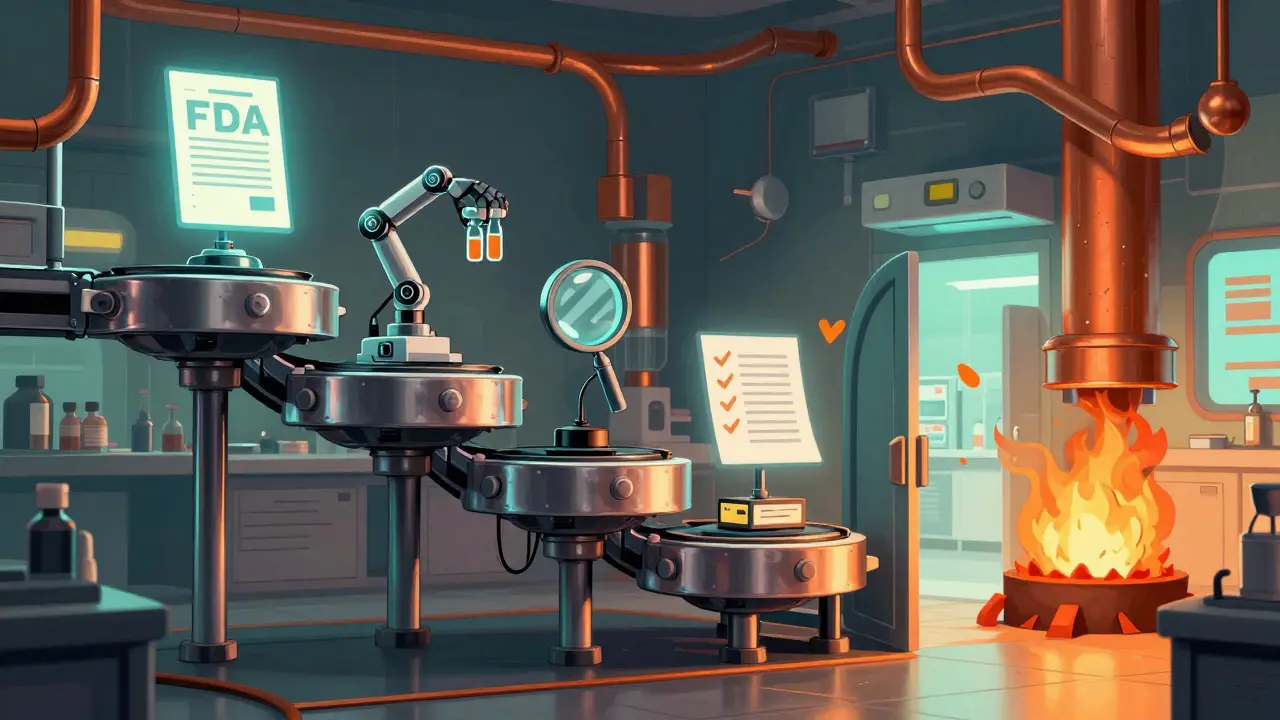
The Fast Track: The Secure Supply Chain Pilot Program
Not all importers face the same delays. Companies with a perfect compliance record for at least three years can join the Secure Supply Chain Pilot Program (SSCPP). As of late 2023, only 27 manufacturers qualified. They can designate up to five products each for near-instant clearance-often within 24 to 48 hours. Johnson & Johnson uses this program. Their global regulatory director says it cut their clearance variability from ±5 days to ±8 hours. That’s huge for just-in-time manufacturing. But the bar is high. You need flawless audits, perfect documentation, and zero violations. Smaller companies, especially generic drug makers, rarely qualify. That’s why some generic manufacturers report detention rates as high as 37% for shipments from certain Indian facilities-even when they’re fully compliant.Where the System Falls Short
The FDA doesn’t have enough inspectors to physically check more than 1.2% of all drug shipments. That means they’re betting on data to catch the bad stuff. Sometimes, they miss it. The Government Accountability Office (GAO) found the FDA hasn’t fully implemented 13 of 17 key performance measures required by law. They still can’t reliably track how many counterfeit drugs actually slip through. And while the SSCPP helps big players, it doesn’t fix the system for the rest. Generic drug makers say the problem is worse for active pharmaceutical ingredients (APIs) from China and India. These are the raw chemicals that make up the pills. They’re shipped in bulk, often from unregistered facilities, and are harder to trace. A 2023 survey by the National Association of Chain Drug Stores found 78% of pharmacy executives believe the system works for brand-name drugs but not for generics.What Importers Need to Get It Right
If you’re importing drugs into the U.S., you can’t wing it. One mistake delays your shipment by nearly five business days on average. Here’s what you need:- **Commercial invoice** - Must list every ingredient and its source.
- **Bill of lading** - Tracks the shipment from origin to port.
- **CBP Entry Documents** - Required by Customs and Border Protection.
- **Affirmation of Compliance** - A signed statement that your product meets U.S. standards.
- **FDA registration** - Both your company and the foreign manufacturer must be registered.

Who’s Feeling the Pressure?
The system isn’t just tough on manufacturers-it’s tough on researchers too. Since the de minimis exemption ended, academic labs importing biological samples for research now pay $285-$420 extra per shipment. Delays added 3-5 days to their timelines. A 2023 survey found 63% of U.S. medical schools reported significant delays in research due to import rules. Small biotech startups, which often rely on quick-turnaround shipments for clinical trials, are hit hardest. Many now hire third-party customs brokers at $285-$450 per entry. Larger companies have full compliance teams. One rule of thumb: For every $100 million in imported drugs, a company needs 3-5 dedicated compliance staff.What’s Next for FDA Import Inspections?
The FDA isn’t standing still. By mid-2024, they plan to expand the Secure Supply Chain Pilot Program to 50 companies, including contract manufacturers. They’re also testing AI tools to improve risk scoring and launching a blockchain pilot to track drug movement from factory to pharmacy. They’re working with international regulators through the Pharmaceutical Inspection Co-operation Scheme (PIC/S) to align standards. But the biggest challenge remains: e-commerce. Nearly half the websites selling drugs to U.S. customers operate outside U.S. law. The FDA can’t inspect every online pharmacy. That’s a growing blind spot.Bottom Line
The FDA’s import inspection system is one of the most advanced in the world. It’s not perfect, but it’s constantly evolving. The elimination of the $800 exemption was a game-changer. The Secure Supply Chain Pilot rewards good actors. And the risk-based model keeps the system from collapsing under its own weight. But the system still struggles with scale, resources, and the rise of global supply chains. If you’re importing drugs into the U.S., you need to treat compliance like a core business function-not an afterthought. Because when it comes to your health, there’s no room for error.What happens if a drug shipment is detained by the FDA?
If a shipment is detained, it’s held at the port until the importer provides corrected documentation, fixes the issue (like relabeling), or proves the product meets U.S. standards. If the problem can’t be resolved, the FDA issues a refusal of admission. The product may be destroyed, re-exported, or, in rare cases, allowed to enter after significant remediation. Importers have 90 days to respond before the FDA disposes of the goods.
Can I import drugs for personal use?
The FDA generally allows personal importation of unapproved drugs if they’re for treating a serious condition, there’s no comparable U.S.-approved drug, and the drug isn’t a controlled substance. But you can’t import more than a 90-day supply, and it must be for your own use. The FDA doesn’t actively stop small personal shipments, but they’re not guaranteed to be allowed in-especially after the end of the de minimis exemption. Most personal shipments are still subject to review.
How do I know if a foreign drug manufacturer is FDA-registered?
You can search the FDA’s Drug Establishment Registration database online. Every foreign facility that manufactures, processes, or packages drugs for the U.S. must be registered. If the facility isn’t listed, the product can’t legally enter the U.S. Always verify the registration number on the product label and cross-check it with the FDA’s official database before importing.
What’s the difference between a Detention without Physical Examination (DWPE) and a regular detention?
A Detention without Physical Examination (DWPE) means the FDA has reason to believe the product is violative based on its history, manufacturer, or product type-and they don’t need to open the shipment to hold it. It’s an automatic hold. A regular detention requires physical inspection first. DWPE is faster for the FDA but harder to appeal. If your product is under DWPE, you must prove the issue is resolved without the FDA ever opening the box.
Are there any drugs that are exempt from FDA import inspection?
No. As of October 2023, all FDA-regulated products, including drugs, biologics, and medical devices, are subject to inspection regardless of value or quantity. Even small personal shipments or samples for research are reviewed. The only exceptions are non-regulated items like vitamins sold as food supplements (if not making drug claims) or cosmetics without therapeutic claims.



jeremy carroll
December 15, 2025 AT 13:49I never thought about how many pills come from overseas. Glad they’re finally cracking down on the $800 loophole. My grandma’s blood pressure med could’ve been fake otherwise. 🙏
Edward Stevens
December 17, 2025 AT 00:52Oh wow, so the FDA now inspects every single shipment? That’s cute. Meanwhile, my local pharmacy still sells expired melatonin labeled as 'natural energy booster.' But hey, at least the pills from China aren’t smuggling in pill presses anymore. 😌
Alexis Wright
December 17, 2025 AT 21:00Let’s be real - this whole system is a performative charade. They flag 15.7% of shipments, but how many of those are actually *dangerous*? The FDA’s risk algorithm is trained on past failures, not future threats. It’s like using a map from 1998 to navigate a city that’s been rebuilt twice. And don’t get me started on the SSCPP - it’s not a pilot program, it’s a corporate welfare scheme for Big Pharma. The real crisis isn’t counterfeit drugs - it’s the erosion of public trust in institutions that pretend to protect us while outsourcing our health to unregulated global supply chains.
Rich Robertson
December 18, 2025 AT 09:01I’ve worked with Indian API suppliers for over a decade. The system is broken, but not because they’re cutting corners. It’s because the FDA’s inspection model was built for 2005, not 2025. A lot of these factories are ISO-certified, have clean audit trails, and export to Europe and Japan without issue. But because they’re not on the FDA’s 'trusted' list? They get held for 10 days over a typo in the invoice. Meanwhile, the same company ships to Germany and gets cleared in 4 hours. It’s not about safety - it’s about bureaucratic inertia.
Natalie Koeber
December 18, 2025 AT 16:11I knew it. This is all part of the Deep State’s plan to control what we take. The FDA doesn’t care about safety - they care about controlling the narrative. Why do you think they suddenly closed the $800 loophole right after the 2022 election? Coincidence? I think not. Those ‘contaminated’ valsartan batches? Probably planted. The real danger is the blockchain pilot - they’re laying the groundwork for digital ID tracking on every pill. Next thing you know, your aspirin will need a government QR code to work.
Rulich Pretorius
December 20, 2025 AT 10:17As someone who’s shipped pharmaceuticals from South Africa to the US, I can tell you: the system works better than people think - but only if you treat compliance like your life depends on it. It’s not about bribes or shortcuts. It’s about details. One misplaced decimal in the product code, and your shipment vanishes for weeks. I’ve seen good companies fail because they thought ‘it’s just paperwork.’ It’s not. It’s the difference between a patient getting their insulin - or not.
Dwayne hiers
December 21, 2025 AT 21:46Detention without Physical Examination (DWPE) is a critical enforcement tool, but its overuse creates systemic inefficiencies. The algorithmic risk scoring lacks transparency, and appeal mechanisms are opaque. For generic manufacturers, this creates a chilling effect: compliance costs now exceed R&D spend in some cases. Moreover, the 78% statistic from NACDS reflects a structural bias: brand-name drugs are more traceable due to serialization and supply chain control - not because they’re inherently safer.
Jonny Moran
December 23, 2025 AT 08:22To anyone thinking this is just bureaucracy - it’s not. I’ve seen a single mislabeled vial delay a clinical trial by 6 weeks. That’s not just money lost. That’s a patient waiting for a treatment that could save their life. The system isn’t perfect, but the people working in FDA import review? They’re overworked, underpaid, and doing the damn job. Cut them some slack. And if you’re importing? Hire a real customs broker. Not your cousin who ‘knows a guy’.
Tim Bartik
December 25, 2025 AT 03:30So let me get this straight - we’re letting China and India make 42% of our pills, but if a US company tries to import a little batch of herbal supplements? Instant detention. This ain’t about safety - it’s about protecting Big Pharma’s monopoly. Why can’t we just let people buy what they want? If you want fake pills, go to a shady website. But if you’re a legit manufacturer? You’re treated like a criminal. This country’s lost its damn mind.
Sinéad Griffin
December 25, 2025 AT 07:48I’m so sick of this. 😤 My husband’s cancer med came from India. He’s alive because of it. But the FDA held it for 3 weeks because the label said '100mg' instead of '100 mg'. THREE WEEKS. Meanwhile, the guy who runs the factory is a single dad who works 18-hour days. We’re punishing the people who are actually helping us. 🤦♀️ #FixTheSystem #NotAllImportsAreBad
Daniel Wevik
December 27, 2025 AT 07:11The Secure Supply Chain Pilot is the only real innovation here. It rewards excellence, not just compliance. But we need to expand it to mid-tier manufacturers - not just J&J. The cost of compliance shouldn’t be a barrier to entry. If you’re clean for 3 years, you deserve faster clearance. That’s not corporate favoritism - it’s smart resource allocation. We need more programs like this, not more inspections.
Thomas Anderson
December 27, 2025 AT 12:54Bottom line: if you’re importing, read the damn rules. Don’t guess. Don’t wing it. The FDA’s website has a whole section on import requirements. Save yourself the headache. One wrong box checked = 5-day delay. That’s 5 days your patients wait. Not worth it.
Wade Mercer
December 28, 2025 AT 01:55This is what happens when you outsource your moral responsibility. We used to make our own medicines. Now we trust strangers in factories we’ve never seen to keep us alive. And we call this progress? No. This is surrender. The FDA can’t inspect everything - because we don’t want to pay for it. We want cheap pills and safe pills. You can’t have both without sacrifice.
Sarthak Jain
December 29, 2025 AT 18:05As someone from India, I see both sides. Our factories are under pressure to meet US standards - and many do. But the paperwork? It’s insane. One comma out of place and your whole shipment gets flagged. I’ve seen labs with perfect quality control get held because the invoice used 'mg' instead of 'milligrams'. It’s not about safety - it’s about how the system treats people who aren’t American. We’re not enemies. We’re partners. But the system acts like we’re criminals.
Daniel Thompson
December 31, 2025 AT 06:09The FDA’s current model is fundamentally incompatible with the scale of modern pharmaceutical supply chains. Risk-based targeting is theoretically sound, but without standardized global data interoperability, it’s just a statistical gamble. The blockchain pilot is a step in the right direction, but it’s being implemented in silos. True reform requires international regulatory harmonization - not just US-centric enforcement. Until then, we’re all just playing whack-a-mole with counterfeit pills.