
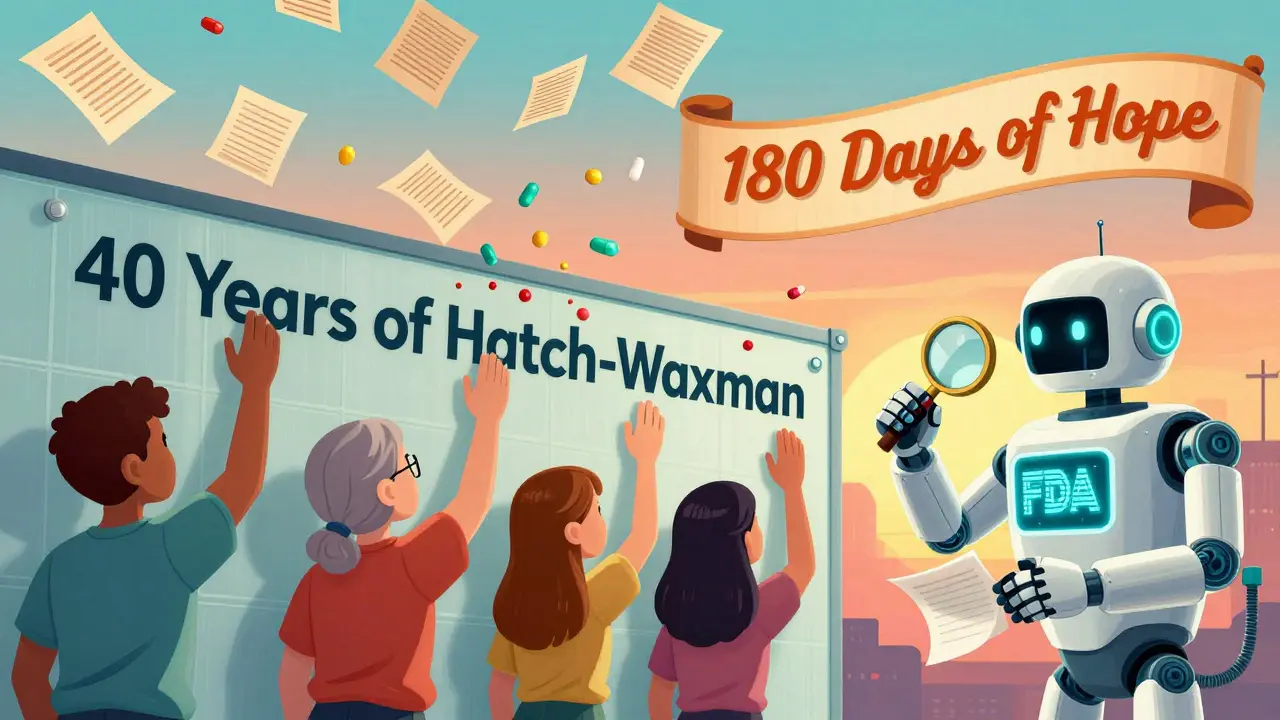
The Hatch-Waxman Act didn’t just change how generic drugs get approved-it rewrote the rules of the entire U.S. pharmaceutical market. Before 1984, getting a generic version of a brand-name drug to market was nearly impossible. The FDA required full clinical trials, even if the drug had already been proven safe and effective. That meant generics were rare, expensive, and slow to arrive. The Hatch-Waxman Act, officially called the Drug Price Competition and Patent Term Restoration Act of 1984, fixed that. It created a smart, balanced system that lets generic companies enter the market faster-without killing innovation. Today, 90% of prescriptions in the U.S. are filled with generics. That’s not an accident. It’s the direct result of this law.
How the Hatch-Waxman Act Made Generics Possible
The key innovation was the Abbreviated New Drug Application (ANDA). Before Hatch-Waxman, every new drug-brand or generic-needed a full New Drug Application (NDA). That meant years of expensive clinical trials. The ANDA changed everything. Generic manufacturers no longer had to prove their drug worked. They just had to show it was bioequivalent to the brand-name version. That means the generic delivers the same amount of active ingredient into the bloodstream at the same rate. The FDA compares blood levels. If they match, the drug is approved. This cut development costs by about 75%. A brand-name drug might cost $100 million to develop. A generic? Often under $5 million.
But there was a problem. Patent law said you couldn’t test a drug while it was still under patent. The 1984 Supreme Court case Roche v. Bolar made it illegal for generics to even start testing until the patent expired. That gave brand companies up to 17 years of market control-sometimes longer. Hatch-Waxman fixed this with a simple but powerful rule: 35 U.S.C. §271(e)(1). It created a legal safe harbor. Generic companies can now make, test, and study patented drugs during the patent term-so long as it’s only to get FDA approval. That’s why generics can file their applications up to five years before a patent expires. Without this, we’d still be waiting years after a patent ends to get affordable versions.
Patent Term Restoration: The Trade-Off
The Act didn’t just help generics. It also protected brand-name drugmakers. The FDA review process can take up to 10 years. That eats into the 20-year patent clock. By the time a drug hits the market, it might have only 7-8 years of patent life left. Hatch-Waxman gave innovators a way to get that time back. The law allows the U.S. Patent and Trademark Office (USPTO) to extend a patent for up to 14 years-but only for the time lost during FDA review. In practice, most patents get extended by about 2.6 years. That’s not a windfall. It’s a reset. The goal was to give companies enough time to recoup their R&D costs before generics arrive.
This trade-off was intentional. Brand companies got more time to profit. Generics got a clear, fast path to market. It worked-for a while. Between 1984 and 2018, the U.S. approved 30-40% more new drugs than it would have without Hatch-Waxman, according to OECD modeling. That’s a win for innovation.

The 180-Day Exclusivity Hook
There’s one part of the law that turned into a gold rush: the 180-day exclusivity period for the first generic to file a Paragraph IV certification. A Paragraph IV certification is when a generic company says, “This patent is invalid or we don’t infringe it.” That triggers a 45-day window for the brand company to sue. If they do, FDA approval is automatically paused for 30 months. But if the generic wins-or the patent is found invalid-they get 180 days of exclusive market rights. No other generics can enter during that time.
In the 1990s and early 2000s, companies would camp outside the FDA offices to be first in line. The first filer could make hundreds of millions of dollars during those 180 days. But things changed. In 2003, the FDA started allowing multiple companies to share exclusivity if they filed on the same day. Then came patent thickets. Instead of one patent, brand companies started filing 10, 15, even 20 patents on minor changes-like a new coating or a different tablet shape. Suddenly, even if you were first to file, you’d face years of lawsuits. The 180-day prize became harder to claim. Today, for blockbuster drugs, it’s often not worth the risk.
How the System Got Gamed
Like any good system, Hatch-Waxman was designed to be fair. But people found ways to bend it.
Product hopping is one tactic. A brand company slightly changes a drug-say, from a pill to a capsule-and gets a new patent. Then they stop making the old version. Patients are forced to switch. Generics can’t copy the new version until that patent expires. It’s not fraud. It’s legal. But it delays competition.
Pay-for-delay is another. Sometimes, a brand company pays a generic manufacturer to stay out of the market. In exchange for millions of dollars, the generic agrees to delay launch until after the patent expires. Between 2005 and 2012, 10% of all generic challenges ended this way. The FTC called it anti-competitive. Congress tried to ban it with the 2023 Preserve Access to Affordable Generics Act. It passed the House. It’s still stuck in the Senate.
And then there’s the Orange Book. This is the FDA’s official list of approved drugs and their patents. But not all patents belong there. Brand companies have filed patents for things that don’t even relate to the drug’s use-like packaging or manufacturing methods. The FDA now says only patents covering the drug’s chemical structure, formulation, or approved use can be listed. But enforcement is slow. In 2022, 22% of patent disputes centered on whether a patent should’ve been listed at all.
What It Costs-And What It Saves
Generics now make up 90% of U.S. prescriptions. But they cost only 18% of total drug spending. That’s a $313 billion annual savings, according to the Association for Accessible Medicines. The Congressional Budget Office estimated Hatch-Waxman saved the U.S. healthcare system $1.18 trillion between 1991 and 2011.
But abuse has a cost. A 2020 study found patent manipulation tactics added $149 billion to drug spending each year. The FTC tracked 262 cases between 2010 and 2022 where drugs stayed monopolized past patent expiry-mostly in oncology, immunology, and neurology. For patients with chronic conditions, that delay can mean thousands in extra out-of-pocket costs.
For generic manufacturers, the legal fight is brutal. One patent challenge can cost $15-30 million. A single company might need 15-20 full-time staff just to manage the paperwork and legal filings. The FDA’s Generic Drug User Fee Amendments (GDUFA) helped. Before 2012, ANDA reviews took 36 months. Now, they take about 10 months. But 43% of submissions still get rejected for major flaws on the first try.
The Future: Reform or Ruin?
The Hatch-Waxman Act is 40 years old. The world has changed. Drug prices are higher. Patents are more complex. The system is still working-but it’s strained.
New rules are coming. The 2022 CREATES Act stopped brand companies from blocking access to drug samples needed for testing. The FDA’s 2022 guidance tightened Orange Book listing rules. GDUFA IV, starting in 2023, aims to cut ANDA review times to 8 months by 2025. If that happens, generics could enter the market 1.4 years faster on average. That could save another $45 billion a year by 2030.
But push too hard, and you risk the other side of the balance. The Biotechnology Innovation Organization warns that overhauling Hatch-Waxman could reduce new drug approvals by 12-15%. Japan tried similar reforms in 2018. New drug approvals dropped 34%. The U.S. can’t afford that.
The truth? The Hatch-Waxman Act still works. It just needs fixing-not replacing. Targeted updates to stop pay-for-delay, clean up patent listings, and speed up reviews could restore its original promise. The goal isn’t to eliminate brand-name profits. It’s to make sure generics get a fair shot. Because for millions of Americans, that’s the difference between taking their medicine-or skipping it.

Leonard Shit
January 7, 2026 AT 15:21so like... the hatch-waxman act basically said "hey generics, you dont need to re-prove water is wet" and it was genius
now we got 90% of prescriptions being cheap stuff
but then big pharma went full minecraft modder and started adding 17 patents for different colors of pill coating
its like they turned the law into a video game cheat code
Melanie Clark
January 9, 2026 AT 10:23THEY KNOW WHAT THEY DID THE GOVERNMENT LET THEM DO THIS ON PURPOSE TO KEEP YOU SICK AND DEPENDENT
THEY DONT WANT YOU HEALTHY THEY WANT YOU ON MEDS FOREVER
THE ORANGE BOOK IS A LIE AND THE FDA IS IN ON IT
THEY PAID THE JUDGES AND THE SCIENTISTS AND NOW YOUR KID CAN’T AFFORD HIS ASTHMA INHALER BECAUSE SOME CORPORATE LAWYER GOT A BONUS
Harshit Kansal
January 9, 2026 AT 22:09bro this is wild honestly
in india we still fight to get generics even when patents expire
u guys had the system but still got gamed
guess capitalism is the same everywhere
Brian Anaz
January 11, 2026 AT 14:47we built the best system in the world and then we let lawyers and lobbyists turn it into a casino
we got 90% generics and still pay more than any other country
that’s not innovation
that’s surrender
Venkataramanan Viswanathan
January 12, 2026 AT 17:01the hatch-waxman act was a beautiful balance until greed found the cracks
in india we admire the intent but see the decay
patent thickets and pay-for-delay are not american problems
they are global failures of oversight
the law was right
the people enforcing it were not
Vinayak Naik
January 12, 2026 AT 23:24yo i work in a pharmacy and let me tell ya
the 180-day exclusivity was like winning the lottery back in the day
some generic company would go all in on one patent challenge and boom - 6 months of monopoly cash
now? they just shrug and say "nah man too many lawsuits, let the brand keep the price"
its like they gave out a golden ticket but then made the whole castle a maze with lawyers guarding every door
and dont even get me started on the orange book
they listing patents for the shape of the bottle like that’s gonna cure diabetes
Kiran Plaha
January 13, 2026 AT 15:08i never thought about how hard it is for generic makers to even get samples to test
like you need the original drug to prove you’re the same
but the brand company just says no
so you’re stuck
the creates act was a good start
but why did it take 40 years to fix something so obvious
Matt Beck
January 14, 2026 AT 08:51we’re living in the paradox of progress: the more we optimize for access, the more we optimize for exploitation
hatch-waxman was supposed to be the middle path - not monopoly, not chaos
but now it’s just a battlefield where patents are landmines and patients are collateral
the system isn’t broken - it’s been weaponized
and we’re all just waiting for someone to say "what if we just… fixed it?"
Kelly Beck
January 15, 2026 AT 12:13you know what’s amazing? that this law still works at all after 40 years
it’s like a vintage car that still runs because someone kept tinkering with it
yes, there are glitches - pay-for-delay, product hopping, patent clutter
but the core? still brilliant
and guess what? we can fix it without breaking it
small changes, smart updates, better enforcement
we don’t need a revolution - we need a tune-up
and every time a grandma gets her blood pressure med for $4 instead of $400?
that’s the win
that’s the heart of it
and we can still protect innovation while making sure no one gets left behind
we just have to choose to try
Molly McLane
January 16, 2026 AT 10:06the most important thing about hatch-waxman isn’t the law itself - it’s the idea behind it
that innovation and access aren’t enemies
that you don’t have to choose between saving lives and rewarding scientists
we lost sight of that when we let lobbyists write the fine print
but the original vision? still valid
we just need to remember who we’re serving
not shareholders
not lawyers
not patent offices
but the person standing in line at the pharmacy wondering if they can afford to fill this script today