
When a patient in Germany picks up a generic version of a blood pressure pill, and another in Poland gets the same medicine at half the price, they’re both benefiting from a complex, multi-layered regulatory system that’s changing faster than ever. The European Union doesn’t have one single rulebook for generic drugs-it has four different approval paths, 27 national agencies, and a major overhaul that took effect in 2025. This isn’t just paperwork. It determines whether a life-saving generic reaches the market in six months or two years. And it’s reshaping who can compete, where, and at what cost.
How Generic Drugs Get Approved in the EU
There are four ways a generic drug can get approved across the EU. Each has different rules, costs, and timelines. The choice a company makes can mean the difference between a successful launch and a financial loss.
The Centralized Procedure is the fastest way to get access to all 27 EU countries, plus Iceland, Liechtenstein, and Norway. A company submits one application to the European Medicines Agency (EMA). If approved, the drug can be sold everywhere at once. But it’s expensive-application fees alone run around €425,000, and consulting help can push total costs to €1.2-1.8 million. That’s only worth it for high-value generics expected to sell over €250 million across the EU. Sandoz used this route to launch its version of Novartis’s Cosentyx in Q2 2025, hitting all markets 11 months faster than the old way.
The Mutual Recognition Procedure (MRP) is the most popular, used in 42% of cases. A company gets approval in one country first-the Reference Member State-then asks others to recognize it. Sounds simple, right? In practice, it’s messy. National agencies often add extra requirements. Teva’s generic rosuvastatin got approved in Germany in 2023, but pricing delays pushed its launch in the Netherlands and Belgium out by over eight months. The official clock says 90 days for consensus. The real average? 132.7 days.
The Decentralized Procedure (DCP) lets companies apply to multiple countries at the same time. No prior approval needed. But coordination is a nightmare. One country’s objection can reset the entire timeline. A 2024 case study from the GMDP Academy found 37% of DCP applications faced delays longer than six months, especially in Eastern Europe, where quality standards for generics are interpreted differently. The process is supposed to take 210 days. It usually takes 247.
The National Procedure is the simplest-apply to just one country. But that means you only sell there. It’s used for just 5% of applications, mostly when a company wants to target a high-reimbursement market like France. But even here, timing varies. Accord Healthcare found it took 197 days for a national approval in France, versus 142 days using MRP across five countries.
What the EU Requires: Bioequivalence and Composition
No matter which path you choose, the rules for proving a generic works the same as the original are strict. The EMA requires three things: identical active ingredients, the same dosage form (tablet, injection, etc.), and proof of bioequivalence.
Bioequivalence means the generic must release the drug into the bloodstream at the same rate and amount as the original. This is proven through clinical studies on healthy volunteers. The results must show that the concentration of the drug in the blood (measured as AUC and Cmax) falls within 80% to 125% of the original. That’s not a suggestion-it’s a hard cutoff. If the data doesn’t meet this, the application is rejected.
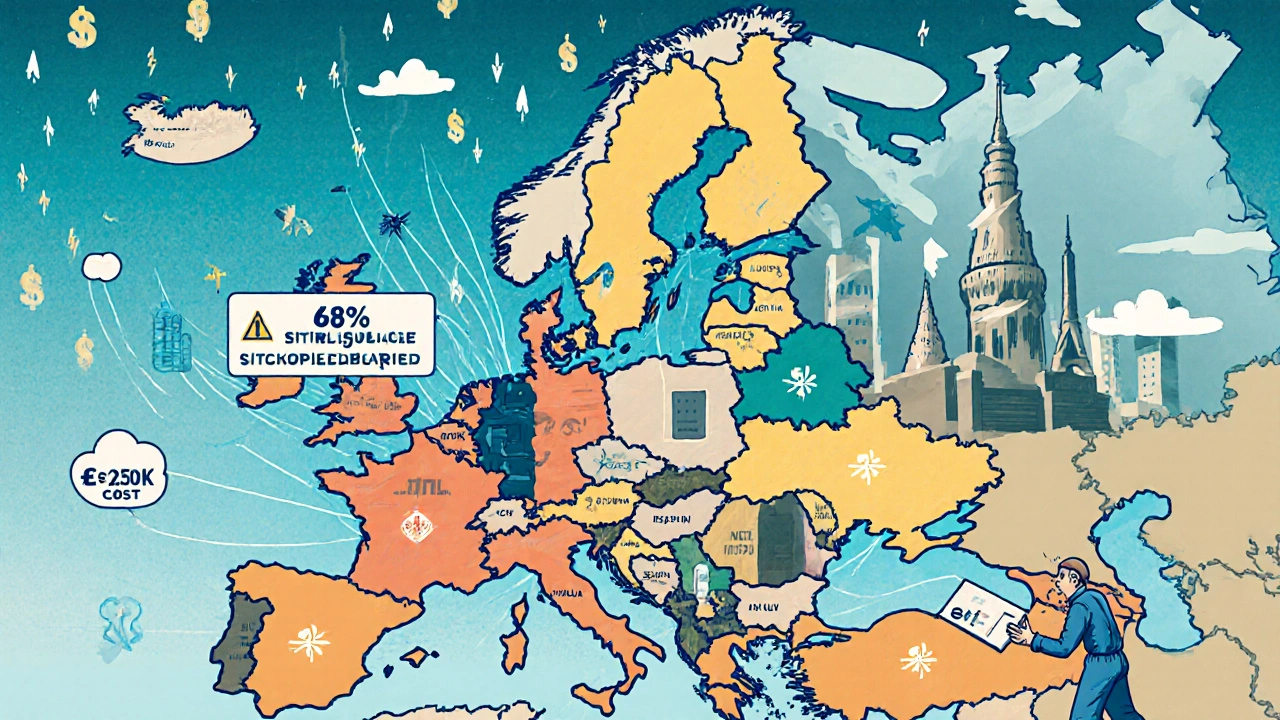
But here’s where it gets complicated. While the EMA sets the standard, national agencies sometimes add extra tests. Germany’s BfArM requires additional pharmacodynamic studies for complex generics like inhalers. France demands specific documentation for pediatric formulations. These aren’t EU-wide rules-they’re national add-ons. A 2025 ABPI survey of 47 generic companies found 68% listed inconsistent national requirements as their biggest regulatory headache.
The 2025 Pharma Package: What Changed
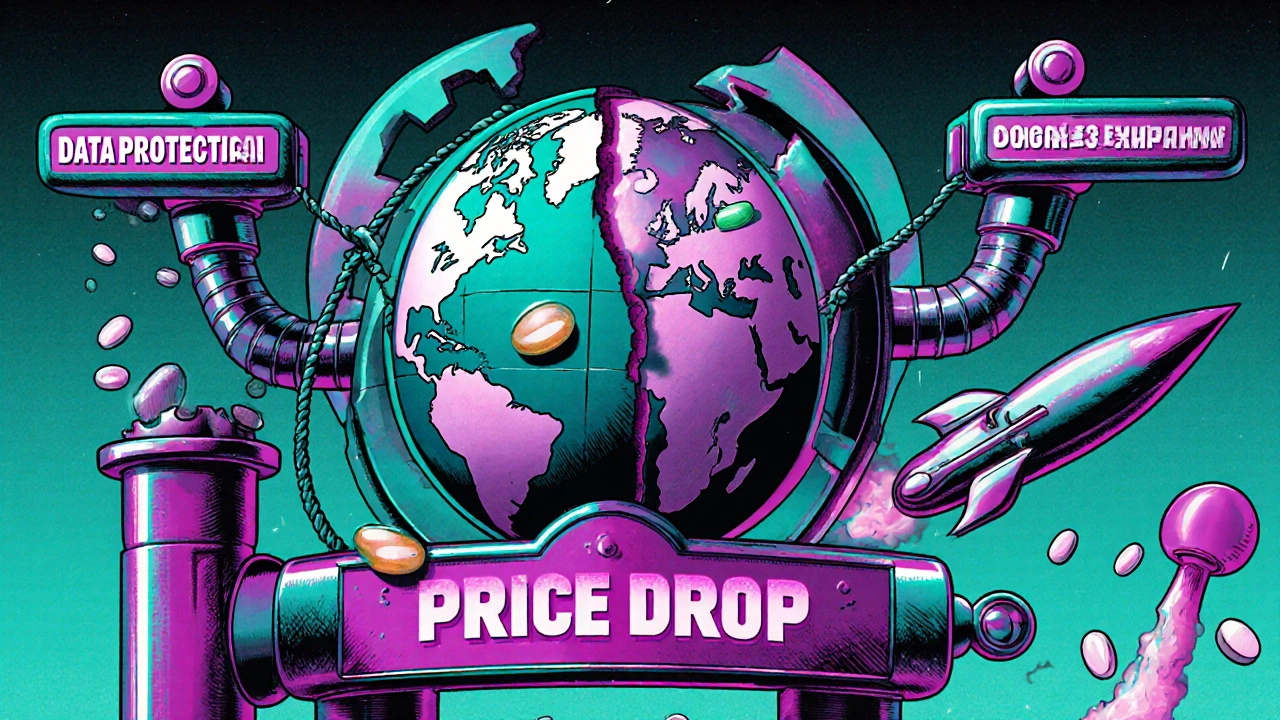
In June 2025, the EU finalized its biggest drug regulation update in 20 years. The Pharma Package is designed to speed up generic access, reduce shortages, and make the system more predictable. Three changes hit hardest.
First, Regulatory Data Protection was shortened. Before, innovator drugs got 10 years of protection (8 years of data exclusivity + 2 years of market exclusivity). Now it’s 8 years of data protection, plus 1 year of market protection. That year can be extended to 2 if the drug meets public health targets. This means generics can enter sooner. For 78 high-value biologics in development, this could cut launch delays by over a year.
Second, the Bolar Exemption was expanded. Before, generic companies could only start pricing and reimbursement talks 2 months before a patent expired. Now, they can start 6 months before. This might sound small, but it’s huge. REMAP Consulting’s 2025 model shows this alone can cut generic market entry time by 4.3 months on average. It also gives payers more leverage-hospitals and insurers can negotiate prices earlier, which may lower launch prices by 12-18%.
Third, the EU introduced an Obligation to Supply. Companies must now prove they can make enough of a generic to meet demand. If they don’t, national authorities can step in and authorize another manufacturer to produce it. This is meant to prevent shortages. But experts like Professor Panos Kanavos warn that if countries interpret “sufficient quantities” too loosely, they might block new entrants in smaller markets.
Who’s Winning and Who’s Struggling
The EU generic market was worth €42.7 billion in 2024, growing 6.2% from the year before. But the winners aren’t evenly spread.
Indian manufacturers now control 38% of all EU generic approvals, up from 29% in 2020. Their low-cost production and aggressive pricing let them target high-volume, low-margin products. Meanwhile, European giants like Sandoz and Viatris still hold 52% of the market-but they’re winning by playing the long game. They use the Centralized Procedure for high-value drugs, invest in complex formulations, and build relationships with national payers.
Smaller companies are squeezed. The new €490 million sales threshold for Transferable Exclusivity Vouchers-a bonus incentive for drugs that meet public health goals-favors big players. Mid-sized firms can’t afford the upfront costs of the Centralized Procedure or the compliance burden of multiple national rules. One generic company executive told a 2025 EGA conference that the 180-day assessment clock resets every time a country objects. “It’s impossible to plan supply chains when the timeline keeps changing,” they said.
What’s Next: Electronic Files, Stockpiles, and Global Pressure
By 2026, all generic applications must include electronic product information (ePI) in XML format. That means companies need new software systems. White & Case estimates this will cost €180,000-250,000 per firm. Many small players can’t afford it.
Also in 2025, the Critical Medicines Act kicked in. It requires EU countries to stockpile 200 essential generics. That’s good for patients-it prevents shortages. But it adds another layer of quality checks. Companies now need to prove their product can be stored for years without degrading. That’s harder than it sounds, especially for complex molecules.
And then there’s the US-EU Framework Agreement, effective September 2025. It adjusts tariffs on pharmaceutical ingredients. The impact on generic manufacturing costs isn’t clear yet. But if raw materials from India or China become more expensive, European producers might raise prices-or shift production.
Why This Matters
Generics make up 65% of all prescriptions in the EU by volume, but only 18% by value. That gap exists because brand-name drugs still charge high prices, and generics often enter late or in limited supply. The 2025 reforms are trying to fix that. Faster approvals, earlier negotiations, and supply guarantees should bring more generics to more people, faster.
But the system is still fragmented. A drug approved in the Netherlands might still be held up in Bulgaria because of a paperwork mismatch. A small company might never get past the first national review. The EU’s goal is harmony. The reality? A patchwork of rules, costs, and delays.
For patients, the result should be lower prices and fewer shortages. For manufacturers, it’s a minefield. Those who understand the pathways, plan for national quirks, and invest in compliance will thrive. Everyone else will struggle to keep up.
How long does it take to get a generic drug approved in the EU?
Approval times vary by pathway. The Centralized Procedure takes about 210-250 days total. The Mutual Recognition Procedure averages 132.7 days, but often takes longer due to national delays. The Decentralized Procedure runs about 247 days on average. National approvals alone can take 180-240 days. The 2025 reforms aim to cut these times, especially with the expanded Bolar exemption allowing earlier pricing talks.
What’s the difference between the Centralized and Mutual Recognition Procedures?
The Centralized Procedure gives you approval across all EU countries with one application to the EMA. It’s faster for wide launches but costs over €1.6 million. The Mutual Recognition Procedure starts with approval in one country, then asks others to accept it. It’s cheaper (€180K-220K) but slower in practice because each country can add its own requirements, causing delays.
Can a generic drug be approved faster than the brand version?
No. Generics can’t enter the market until the brand’s patent and data protection expire. But the 2025 reforms let generic companies start pricing and reimbursement negotiations 6 months before patent expiry-instead of 2 months. This speeds up market entry after the patent ends, not before.
Why do some EU countries delay generic launches even after approval?
Approval means the drug is safe and effective. But it doesn’t mean it’s reimbursed. Countries control pricing and reimbursement separately. A drug can be approved in Germany but stuck for months because the health authority hasn’t set a price or included it in the public formulary. This is especially common in the Mutual Recognition Procedure.
Are Indian generic manufacturers dominating the EU market?
Yes. In 2024, Indian companies received 38% of all EU generic approvals, up from 29% in 2020. They focus on high-volume, low-cost products and compete aggressively on price. But European firms like Sandoz and Viatris still hold 52% of the market share because they target high-value, complex generics using the Centralized Procedure.
What’s the biggest challenge for small generic companies in the EU?
The cost and complexity of navigating multiple national rules. Small firms can’t afford the €1.6 million for the Centralized Procedure. But the Mutual and Decentralized Procedures are unpredictable-delays from one country can reset timelines. They also lack resources to handle new requirements like electronic submissions (ePI) or extra testing for complex drugs.





Matthew Higgins
November 30, 2025 AT 21:29So let me get this straight - a pill that saves lives is stuck in paperwork limbo because some country in Eastern Europe needs a signed affidavit from a goat herder? The EU says it wants harmony, but it’s more like a bureaucratic tango where everyone’s stepping on each other’s toes.
linda wood
November 30, 2025 AT 21:48Wow. So the system’s designed to help patients… but only if you’re rich enough to hire a team of lawyers and compliance wizards just to get a $0.50 pill on the shelf. Brilliant.
Sara Shumaker
December 2, 2025 AT 02:35It’s fascinating how the same scientific standard - bioequivalence within 80-125% - becomes a battleground when it hits national bureaucracies. The EMA sets the floor, but each country builds its own ceiling. It’s not about safety anymore. It’s about sovereignty disguised as regulation. And the cost? Paid by patients who wait longer for medicine, and by smaller manufacturers who simply can’t afford to play the game.
What’s ironic is that the 2025 reforms tried to fix this - shortening data exclusivity, expanding the Bolar exemption - but they didn’t touch the real problem: the lack of harmonized implementation. The rules are written in Brussels, but enforced in Sofia, Warsaw, and Lisbon with entirely different interpretations. That’s not regulation. That’s fragmentation with a fancy name.
And don’t get me started on the electronic submissions. Requiring XML ePIs is sensible in theory, but for a small firm in Romania with a single regulatory officer? That’s a €200K investment they can’t justify. The EU wants innovation and access, but it’s building walls out of digital paperwork.
Meanwhile, Indian manufacturers are winning not because they’re unethical - they’re winning because they’ve optimized for scale, not bureaucracy. They treat the EU like a portfolio of markets, not a single entity. That’s not a flaw in the system. That’s a feature of its design.
Patients deserve predictable timelines, not a lottery where the odds depend on whether your drug was reviewed by Germany or Greece. The real reform isn’t in the law - it’s in the culture. We need regulators who collaborate, not compete. Until then, we’re just rearranging deck chairs on the Titanic of generic access.
Richard Thomas
December 2, 2025 AT 21:43The assertion that the Centralized Procedure is the optimal path for high-value generics is statistically sound, yet it ignores the fundamental asymmetry in market access. The €1.2–1.8 million cost barrier effectively institutionalizes oligopolistic behavior, privileging vertically integrated pharmaceutical conglomerates while marginalizing emerging competitors. The Mutual Recognition Procedure, despite its nominal efficiency, is rendered functionally obsolete by the de facto regulatory nationalism exhibited by Member States, which systematically reintroduce non-tariff barriers under the guise of pharmacovigilance or local pharmacoeconomic criteria. This is not merely inefficiency - it is regulatory capture by incumbents.
The expansion of the Bolar exemption, while procedurally elegant, fails to address the structural imbalance between pricing negotiation autonomy and market entry timelines. The 6-month window permits preparatory activity, yet does not compel payer alignment. Consequently, the temporal advantage is neutralized by administrative inertia - a phenomenon well-documented in the French and Italian reimbursement systems, where formulary inclusion lags approval by an average of 217 days. The Obligation to Supply clause, though well-intentioned, introduces moral hazard: if national authorities are empowered to authorize parallel manufacturing, the incentive to scale production diminishes, potentially exacerbating supply volatility rather than mitigating it.
The rise of Indian manufacturers is not a triumph of innovation but a consequence of regulatory arbitrage. Their business model exploits the fragmentation of national requirements, deploying low-cost, high-volume production in jurisdictions with minimal compliance overhead, then targeting the EU’s most price-sensitive markets. Their success underscores a broader failure: the EU’s regulatory architecture prioritizes procedural rigor over systemic accessibility. The 2025 Pharma Package, while technically sophisticated, is a masterpiece of policy theater - it restructures the surface without altering the underlying power dynamics. Until the EU enforces true mutual recognition - without national opt-outs, without additional testing, without pricing interference - the promise of equitable generic access remains an academic abstraction.
Jennifer Wang
December 2, 2025 AT 23:03The 2025 reforms introduced critical improvements, particularly the reduction of data exclusivity from 10 to 8 years and the extension of the Bolar exemption to six months pre-expiry. These changes directly impact time-to-market, with REMAP Consulting’s modeling indicating a 4.3-month reduction in generic entry timelines. However, these benefits are unevenly distributed. The Centralized Procedure remains cost-prohibitive for SMEs, and the Mutual Recognition Procedure’s average 132.7-day timeline is misleading - the 90-day official window does not account for national-level delays, which often stem from non-harmonized interpretation of bioequivalence data. For instance, Germany’s BfArM requires additional pharmacodynamic studies for inhalers, while France mandates pediatric formulation documentation - both outside EMA requirements. These are de facto regulatory barriers.
Furthermore, the introduction of the Obligation to Supply clause is a double-edged sword. While it mitigates shortages, it creates uncertainty for manufacturers who must now forecast demand with imperfect data. The 200-unit stockpile mandate under the Critical Medicines Act adds another layer: stability testing for long-term storage is not standardized across member states, increasing compliance costs. The upcoming ePI requirement in XML format, while improving traceability, imposes a fixed cost of €180K–250K per firm - a prohibitive burden for small enterprises with limited regulatory budgets. The EU’s goal of harmonization is laudable, but without mandatory alignment of national requirements and financial support for SMEs, the system will continue to favor large, vertically integrated firms.
Andrew Keh
December 4, 2025 AT 14:34It’s kind of crazy that the same pill can be approved in Germany but stuck for months in Bulgaria just because of paperwork. The EU says it’s one market, but it feels like 27 different countries each with their own rulebook. I get that they want to make sure drugs are safe, but if it takes two years to get a cheap medicine to someone who needs it, something’s broken. The new rules seem like they’re trying to fix it, but it still feels like the big companies win and everyone else gets left behind.
LINDA PUSPITASARI
December 6, 2025 AT 04:04So Indian companies are now getting almost 4 out of 10 approvals in the EU 🤯 and honestly? Good for them. They’re playing the game smart - low cost, high volume, no drama. Meanwhile, some EU firms are still stuck in 2010 mode, spending millions on centralized apps when they could’ve just nailed one country first and scaled. The real tragedy? Small companies that just want to make affordable meds but can’t afford the €200K to submit an ePI file 😭 The system’s supposed to help patients, not lawyers and consultants. I hope the EU realizes that harmony doesn’t mean more paperwork - it means fewer roadblocks. #GenericAccessNow
Scott Collard
December 7, 2025 AT 18:33The system is rigged.