
When antidepressants don’t work, it’s not because the person isn’t trying hard enough. It’s because their brain chemistry doesn’t respond the way doctors expected. About 30-40% of people with depression end up with treatment-resistant depression (TRD) - meaning they’ve tried at least two different antidepressants at full doses for long enough, and nothing stuck. This isn’t rare. It’s common. And it’s not a failure. It’s a signal that the system needs to shift.
What Exactly Is Treatment-Resistant Depression?
TRD isn’t a separate diagnosis. It’s a label used when standard treatments fail. The definition is clear: after two adequate trials of different antidepressants - meaning at least six to eight weeks at the right dose - there’s no meaningful improvement. The Sequenced Treatment Alternatives to Relieve Depression (STAR*D) trial, which tracked over 2,800 people from 2001 to 2006, showed that nearly half of patients didn’t respond to their first antidepressant. By the time they’d tried two, about a third were still stuck.
What does that look like in real life? Someone who’s been on sertraline for three months, then switched to venlafaxine for another two, and still can’t get out of bed, still feels numb, still cries for no reason. Their job is slipping. Relationships are fraying. They’ve been told to "just keep trying," but their body isn’t listening.
Augmentation: Adding Something, Not Switching
Instead of starting over with a new antidepressant, doctors often add something else - an augmentation strategy. Think of it like upgrading a car engine instead of replacing the whole vehicle. The goal isn’t to cure depression overnight. It’s to nudge the brain into a better state.
The FDA has approved four specific augmentation agents for use with SSRIs or SNRIs:
- Aripiprazole (Abilify)
- Brexpiprazole (Rexulti)
- Quetiapine extended-release (Seroquel XR)
- Olanzapine-fluoxetine combination (Symbyax)
These aren’t random choices. Each was studied in large trials. For example, in the VAST-D trial (2013-2017), adding aripiprazole led to a 24.8% remission rate after 12 weeks - better than switching to bupropion alone (15.5%) or adding bupropion (19.9%). That’s not a miracle, but it’s meaningful.
Other agents have strong evidence too, even if they’re not FDA-approved for this use:
- Lithium - used for decades, especially when mood swings creep in. Target blood levels: 0.3-0.6 mEq/L. Too high, and you risk toxicity. Too low, and it does nothing.
- Liothyronine (T3 thyroid hormone) - surprisingly effective. One study showed a 2.87x higher chance of response than placebo.
- Modafinil - helps with fatigue and brain fog. Not a mood lifter, but it clears the fog so other treatments can work better.
- Bupropion - often used as an add-on, especially for people with low energy or sexual side effects from other meds.
But here’s the catch: not all augmentations are equal. A 2022 network meta-analysis of 12,415 patients found that while some agents like aripiprazole and quetiapine had solid results, others like ziprasidone and mirtazapine had high dropout rates because of side effects. You can’t just pick one and hope for the best. It’s a puzzle.
The Side Effects You Can’t Ignore
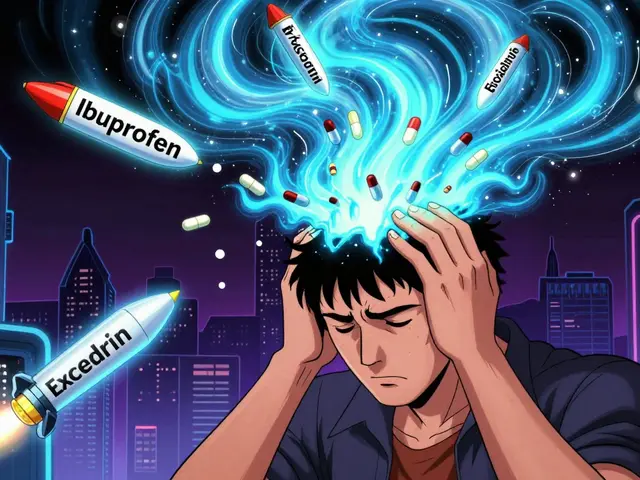
Augmentation isn’t harmless. Every added drug brings new risks.
Aripiprazole? Up to 25% of people feel restless - a condition called akathisia. It’s not just anxiety. It’s an inner trembling, a need to move constantly. Some people stop taking it because they can’t sit still.
Quetiapine? Sedation. Up to 60% feel drowsy. Weight gain is common. One study showed a 5-7% increase in body weight over six months - enough to make someone feel worse about their body.
Olanzapine-fluoxetine? That combo can cause serious metabolic changes: high blood sugar, cholesterol spikes. It’s effective, but not for someone with diabetes or heart risks.
And lithium? It’s old, cheap, and effective - but it needs blood tests every few months. Too little, and it’s useless. Too much, and you get tremors, nausea, even kidney damage. It’s not for everyone.
This is why treatment isn’t just about what works - it’s about what you can live with.
Advanced Therapies: When Pills Aren’t Enough
When augmentation fails, it’s time to think beyond pills.
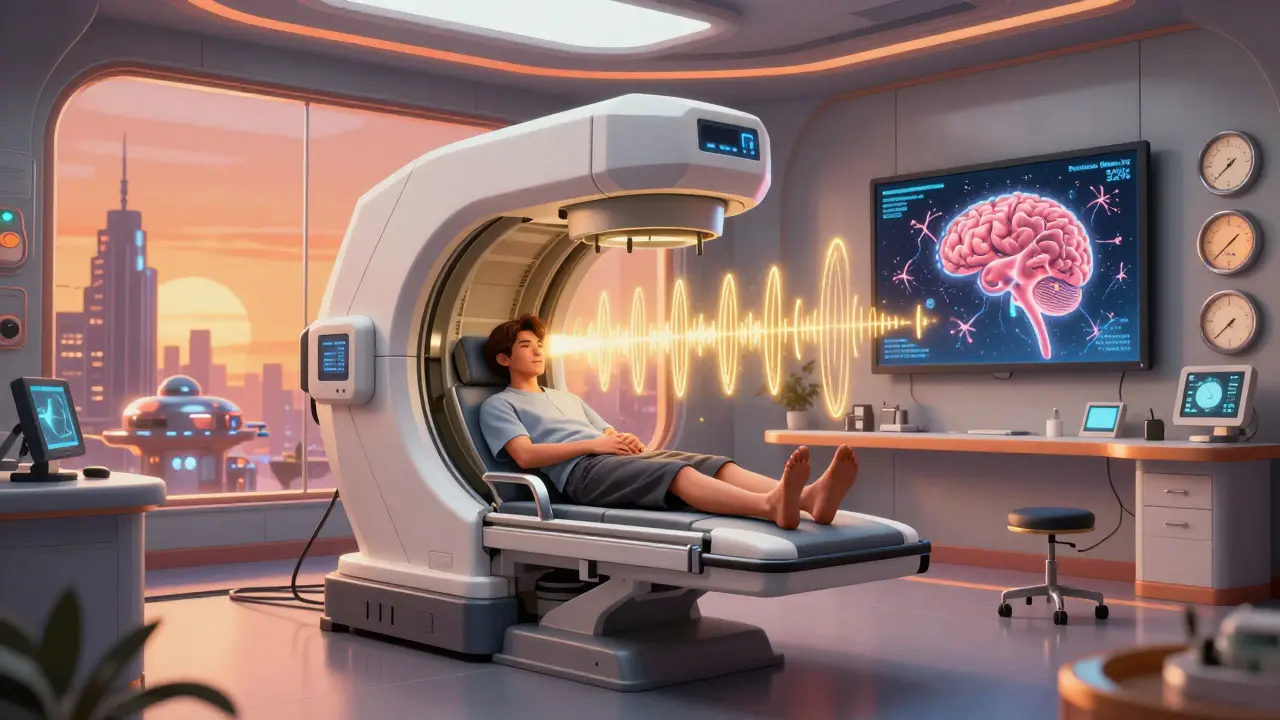
Repetitive Transcranial Magnetic Stimulation (rTMS) is one of the most reliable options. It uses magnetic pulses to stimulate the prefrontal cortex - the part of the brain that’s underactive in depression. Over 50 clinical trials, involving more than 10,000 people, show 50-55% respond, and 30-35% go into full remission. No anesthesia. No memory loss. No hospital stay. You sit in a chair. A device clicks against your head. You go home. It’s not magic, but it’s close.
Esketamine nasal spray (Spravato) is newer and faster. Approved in 2019, it can lift mood in hours - not weeks. In the TRANSFORM-2 trial, 70.3% of patients responded at four weeks, compared to 47.5% on placebo. But there’s a catch: you must take it in a certified clinic. Why? Because it can cause dissociation - feeling detached from your body. About 60% of users report this. Some say it’s weird but helpful. Others find it terrifying. It’s not a home remedy. It’s a medical procedure.
Cognitive Behavioral Therapy (CBT) as an add-on isn’t flashy, but it’s powerful. A 2022 review found an effect size of 1.58 - higher than most medications. Talking through negative thoughts, changing behaviors, building routines - it’s work, but it sticks.
Then there’s the frontier: deep brain stimulation (DBS). A tiny wire is implanted into the brain, targeting the subcallosal cingulate cortex. One small study (N=6) showed a 92% response rate two years later. But it’s experimental. Only done in research centers. Risky. Expensive. Not for most people - yet.
The New Frontiers: Psilocybin and Inflammation
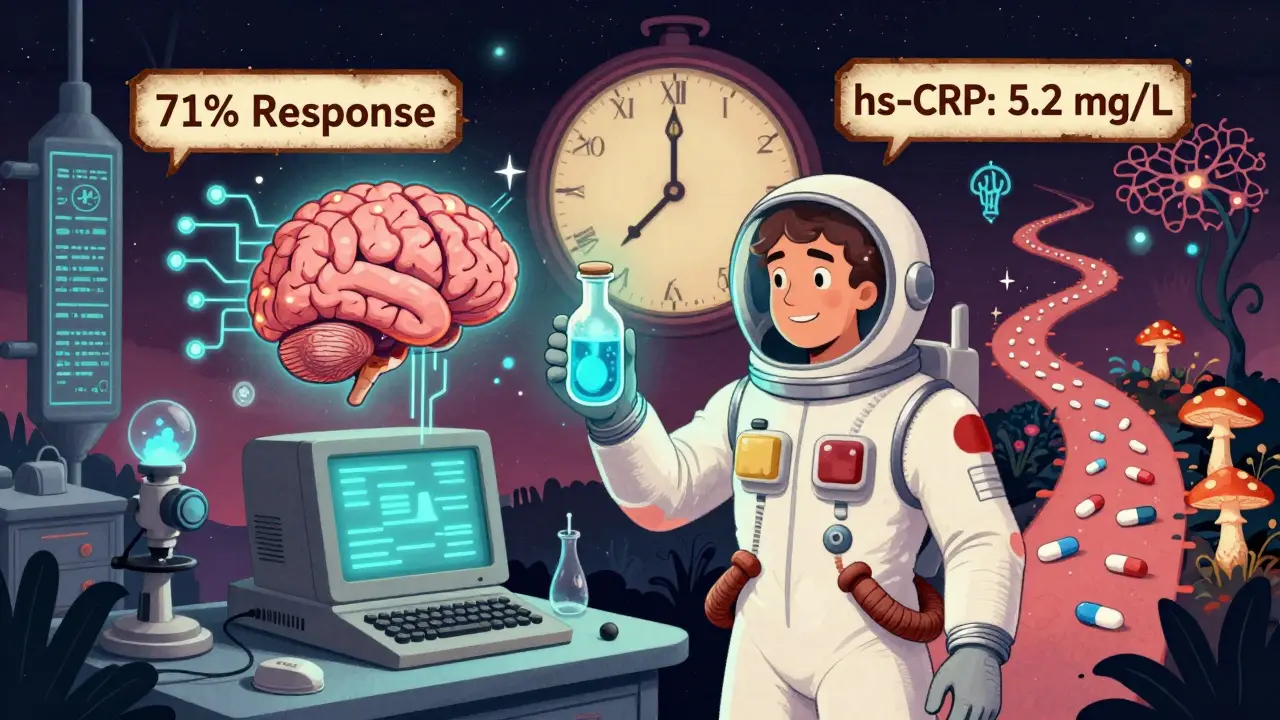
Science is moving fast. In 2020, a small but groundbreaking trial in JAMA Psychiatry gave people with TRD a single dose of psilocybin - the active ingredient in magic mushrooms. At four weeks, 71% responded. Only 9.4% did in the placebo group. The effects lasted. The brain seemed to reset.
Another study in Molecular Psychiatry (2022) looked at inflammation. They found that TRD patients with high levels of a blood marker called hs-CRP (above 5 mg/L) had a 30.5% remission rate when given infliximab - a drug used for autoimmune diseases. The placebo group? 13.7%. This suggests depression isn’t just about serotonin. It’s about inflammation. About immune system glitches. About the body’s stress response.
These aren’t treatments yet. But they’re proof that the old model - one drug, one target - is outdated.
Why Some People Still Don’t Get Better
Even with all these options, real-world data is sobering. The EU-NEURD registry tracked 1,872 TRD patients and found that only 28.4% achieved remission with augmentation alone. That means more than seven in ten still struggle.
Why? Because depression isn’t one thing. It’s many. One person’s TRD is fueled by inflammation. Another’s by chronic stress. Another’s by genetic differences in how their liver breaks down drugs. We’re still learning to match treatments to biology, not just symptoms.
And then there’s access. rTMS isn’t covered everywhere. Esketamine costs thousands per month. DBS is only available in a handful of centers. Many people give up because the system doesn’t meet them where they are.
What Works Best? The Real Answer
There’s no single best treatment. But there are clear patterns:
- If fatigue is the main problem: try modafinil or bupropion.
- If anxiety and rumination dominate: aripiprazole or CBT.
- If you’re tired of side effects: rTMS.
- If you need fast relief and can access a clinic: esketamine.
- If mood swings are present: lithium.
And always - always - confirm the diagnosis. Sometimes what looks like TRD is actually bipolar disorder, thyroid issues, sleep apnea, or chronic stress. Treating the wrong thing makes everything worse.
Personalization is the future. Blood tests. Brain scans. Genetic profiles. We’re not there yet - but we’re closer than ever.
What does "adequate trial" mean for antidepressants?
An adequate trial means taking the medication at the recommended dose for at least six to eight weeks. Many people stop too soon because they don’t feel better right away. But antidepressants take time - often four to six weeks just to start working. If you don’t give it that window, you can’t know if it will work.
Can I try augmentation at home?
Some augmentation medications, like lithium or thyroid hormone, can be started at home under a doctor’s supervision. But others - like esketamine - require clinic visits due to safety risks. Never add a new medication without medical guidance. Mixing antidepressants with other drugs can be dangerous.
Is rTMS painful?
No. rTMS feels like a tapping or knocking on the scalp. Some people get mild headaches or scalp discomfort, especially early on. It’s not electric shock. No anesthesia. No memory loss. Most people return to work immediately after a session.
Why isn’t psilocybin available yet for depression?
Psilocybin is still classified as a Schedule I drug in the U.S. and many other countries, meaning it’s illegal outside of research. While clinical trials show strong results, regulatory approval is slow. It’s not a matter of effectiveness - it’s a matter of policy, law, and stigma. But that’s changing fast.
How long does it take to see results from augmentation?
It varies. Some people notice changes in two to four weeks. Others take up to 12 weeks. Lithium and thyroid hormone often take longer. Aripiprazole and quetiapine may show effects in three weeks. Esketamine works in hours. But improvement usually builds slowly. Patience is part of the treatment.
TRD is not a dead end. It’s a detour. And with the right combination - medication, therapy, brain stimulation, or even future breakthroughs - people do find their way back. It’s not easy. But it’s possible.




Charity Hanson
February 27, 2026 AT 18:43Y’all need to stop acting like TRD is some kind of personal failure. I’ve been through 7 meds, 3 augmentations, and rTMS twice. It’s not about willpower. It’s about biology. And honestly? The fact that we’re even talking about psilocybin and inflammation as real options? That’s hope. I didn’t think I’d live to see this shift.
Noah Cline
February 28, 2026 AT 04:21Let’s be clear: augmentation with atypical antipsychotics is not first-line. It’s a salvage strategy. You’re modulating dopamine D2/5-HT2A receptors in a non-selective fashion - a blunt instrument with metabolic and extrapyramidal trade-offs. The VAST-D trial’s 24.8% remission rate? That’s barely above placebo-adjusted effect size. We need biomarkers, not shotgun approaches.
Lisa Fremder
February 28, 2026 AT 14:38Why are we giving people magic mushrooms while our vets get stuck on SSRIs? This country spends billions on drones but won’t fund real mental health research. If you’re not in a big city with a research hospital, you’re out of luck. And don’t even get me started on how insurance denies rTMS like it’s cosmetic surgery. This isn’t healthcare. It’s a lottery.
Justin Ransburg
March 2, 2026 AT 10:29Thank you for writing this with such clarity. Many people don’t realize that treatment resistance isn’t a reflection of their character - it’s a sign that neuroscience is still evolving. The fact that we’re moving toward personalized, biologically informed care is one of the most promising developments in psychiatry in decades. Keep pushing for access. Keep pushing for awareness.
Sumit Mohan Saxena
March 2, 2026 AT 13:50Based on the STAR*D data, the cumulative response rate after four treatment steps is approximately 67%. This implies that while TRD is common, it is not necessarily permanent. The key lies in sequential, algorithmic, and evidence-based augmentation - not random trial-and-error. Furthermore, the use of lithium as an augmenting agent remains underutilized due to perceived complexity, despite its cost-effectiveness and robust long-term efficacy in mood stabilization.
Brandon Vasquez
March 3, 2026 AT 06:38I’ve been on three different augmentations. The akathisia from aripiprazole almost broke me. I didn’t sleep for 72 hours. But when I switched to modafinil + CBT? I started cooking again. Not cured. Not fixed. But I could breathe. If you’re stuck - don’t give up. Just don’t trust the first answer the system gives you.
Vikas Meshram
March 4, 2026 AT 17:06Psilocybin is not a treatment. It’s a hallucinogen. You can’t just give people psychedelics and call it medicine. The FDA hasn’t approved it. The studies are tiny. And what about the people who have psychotic breaks? This is reckless. Also, Esketamine is just ketamine with a fancy name. Big Pharma is repackaging street drugs. Wake up.
Ben Estella
March 6, 2026 AT 12:12They want us to believe this is science. It’s not. It’s a profit machine. Aripiprazole costs $600 a month. Esketamine? $900 a dose. And they want you to believe this is about healing? No. It’s about who can afford to keep trying. Meanwhile, my cousin in Ohio can’t even get a therapist who takes Medicaid. This isn’t medicine. It’s a luxury.
Jimmy Quilty
March 8, 2026 AT 00:39Did you know the FDA approved esketamine because of a single trial where the placebo group had a 30% drop-out rate? That’s not science. That’s manipulation. And what about the brain scans? The same companies that pushed SSRIs are now pushing rTMS and psilocybin. They’re just changing the packaging. The system is rigged. The data is curated. They don’t want you to know that 80% of antidepressant trials are funded by pharma. And that’s just the tip.
Miranda Anderson
March 9, 2026 AT 11:35I think what’s really missing from this conversation is how much of TRD is tied to trauma and chronic stress - not just serotonin. I’ve been on everything. The only thing that gave me back my life was therapy where we actually talked about my childhood. Not just swapping pills. I don’t think we talk enough about how the body holds trauma. How depression isn’t just chemical. It’s cellular. It’s emotional. It’s spiritual. And no drug can fix that alone. Maybe that’s why augmentation fails sometimes - because we’re trying to fix a soul problem with a chemistry solution.
Gigi Valdez
March 10, 2026 AT 20:45The most important takeaway is not which drug works best, but that treatment resistance is not a personal failing. It is a systemic signal - that our current diagnostic models are too simplistic, our access to care is unequal, and our understanding of depression as a single disease is outdated. The future lies in multidimensional assessment: inflammatory markers, genetic pharmacokinetics, neuroimaging, and psychosocial history - not a one-size-fits-all pill.