
Stevens-Johnson Syndrome and Toxic Epidermal Necrolysis are not just rare skin conditions-they’re life-threatening emergencies triggered by your own body’s reaction to medication. Imagine waking up with a fever, sore throat, and burning eyes, only to wake up days later with large sections of your skin peeling off like a bad sunburn. That’s what happens in SJS and TEN. These aren’t allergies in the usual sense. They’re immune system overreactions that turn your skin and mucous membranes into battlegrounds. And they happen fast-sometimes within 48 hours of taking a drug you’ve used for years without issue.
What’s the Difference Between SJS and TEN?
Doctors used to treat Stevens-Johnson Syndrome and Toxic Epidermal Necrolysis as two separate diseases. Now they see them as points on the same spectrum. The difference? How much of your skin dies.
SJS affects less than 10% of your body surface area. TEN? More than 30%. There’s even a middle zone-10% to 30%-called SJS/TEN overlap. It sounds like a simple percentage, but that number means everything. A 10% skin loss is like losing the skin from your entire chest and back. Thirty percent? That’s the equivalent of a major burn injury. The more skin that detaches, the higher the risk of death.
Both conditions start the same way: flu-like symptoms. Fever above 102°F, headache, cough, sore throat. You’d think it’s a cold or the flu. But within a day or two, red or purple spots appear on your skin-often starting on the chest or abdomen. These aren’t normal rashes. They’re flat, painful, and spread fast. Within 24 to 72 hours, they turn into blisters. Then the top layer of skin starts peeling off in sheets. You can even see the Nikolsky sign-gently rubbing the skin causes it to slough away.
The Real Culprits: Drugs You Might Not Suspect
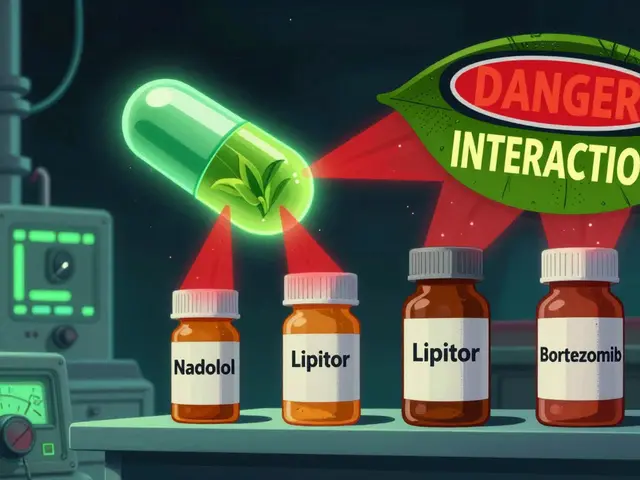
Over 80% of SJS and TEN cases are caused by medications. And it’s not just the obvious ones. The most common triggers include:
- Antiepileptic drugs like carbamazepine, phenytoin, and lamotrigine (account for about 30% of cases)
- Sulfonamide antibiotics like trimethoprim-sulfamethoxazole (20%)
- Allopurinol, used for gout (15%)
- Nonsteroidal anti-inflammatory drugs (NSAIDs) like ibuprofen or naproxen
- The HIV drug nevirapine
What’s scary is that you can take these drugs for months or years without a problem. Then, out of nowhere, your body flips. It’s not about dosage-it’s about your genes.
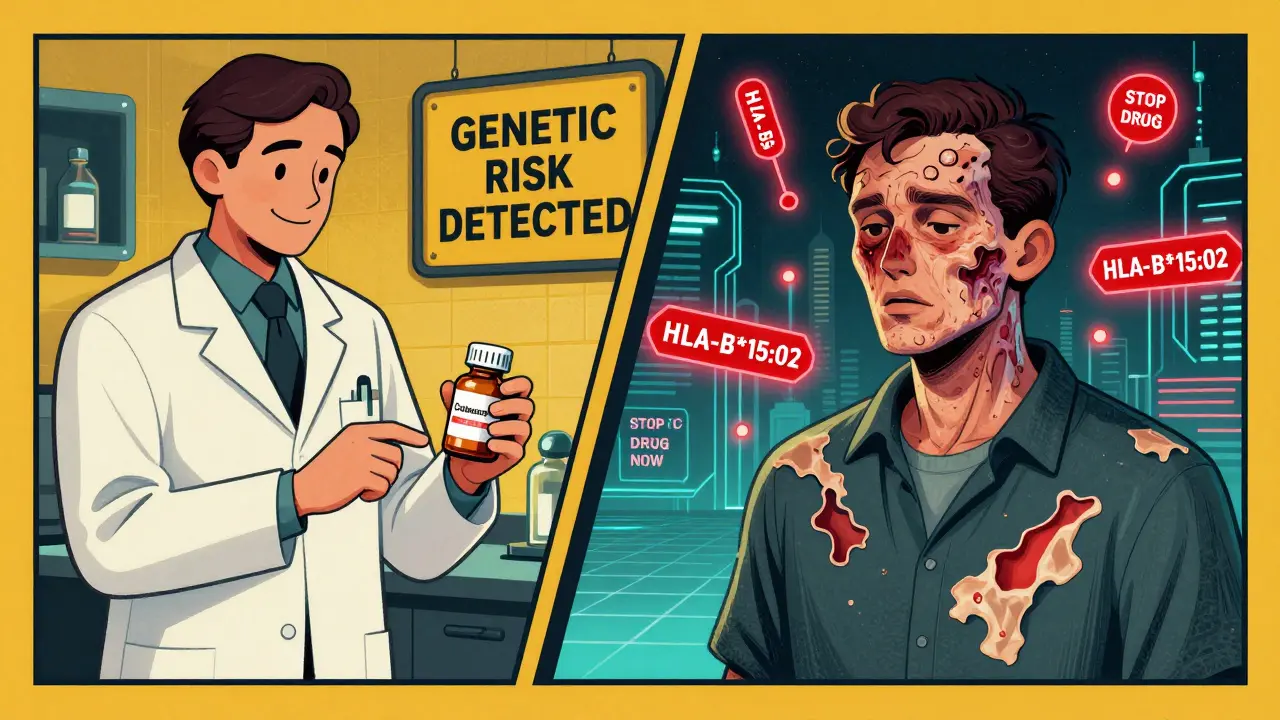
Some people carry a genetic marker called HLA-B*15:02. If you have this and take carbamazepine, your risk of SJS/TEN jumps 1,000 times. That’s why in Taiwan and other parts of Asia, doctors test for this gene before prescribing carbamazepine. Since 2007, that simple test cut SJS/TEN cases by 80%.
Another gene, HLA-B*58:01, massively increases risk with allopurinol. In 2022, the FDA approved a point-of-care test that gives results in 4 hours-not two weeks. That’s a game-changer.
It’s Not Just Your Skin-Your Eyes, Mouth, and Lungs Are in Danger
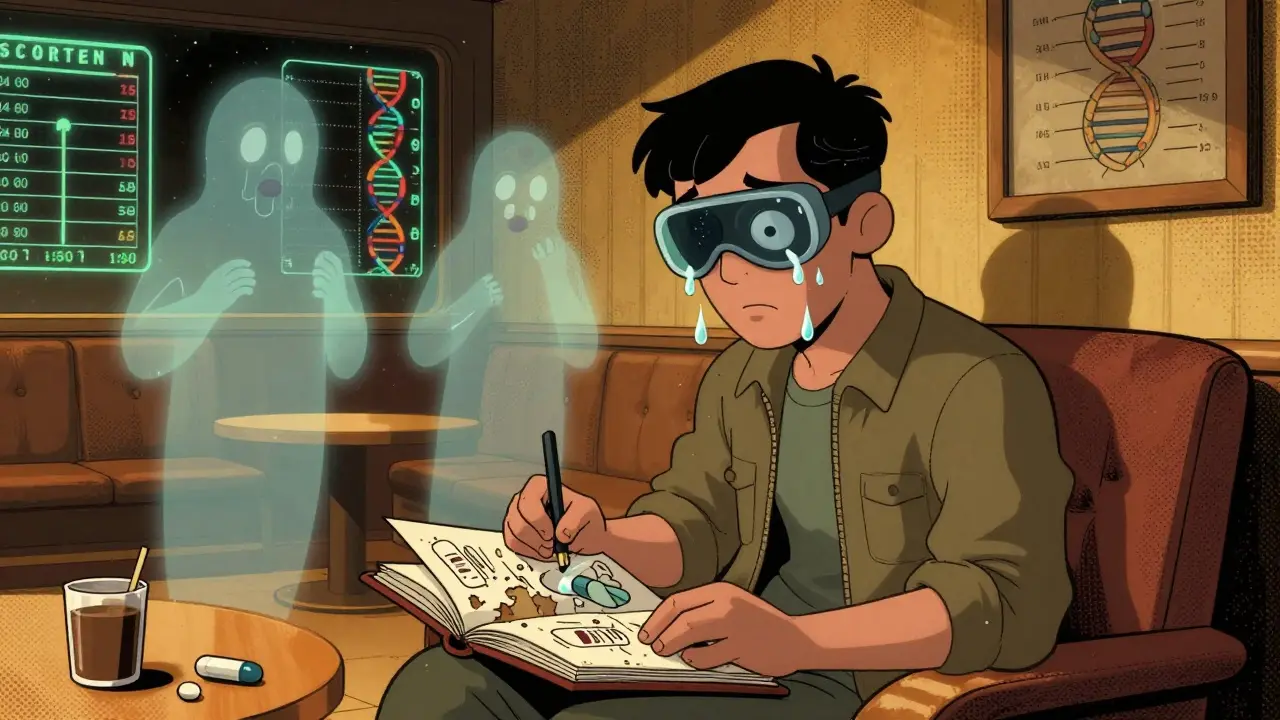
Most people think of SJS/TEN as a skin condition. It’s not. It’s a full-body crisis. At least two mucous membranes are always involved. In 90% of cases, your mouth is covered in painful sores. You can’t eat or drink. In 80%, your eyes swell shut with blisters and pus. Without daily eye care, up to 80% of survivors develop permanent damage: dry eyes, scarring, even blindness.
Half of patients have genital sores. Men can develop urethral strictures. Women can get vaginal adhesions. Both require surgery. And if your lungs are involved, you’re at risk of pneumonia and respiratory failure. That’s why many patients end up in burn units-not dermatology wards.
How Is It Diagnosed?
There’s no blood test for SJS/TEN. No quick scan. Diagnosis relies on three things:
- Your history-what drugs you took in the past 1-4 weeks
- Your symptoms-skin lesions, mucosal damage, fever
- A skin biopsy
The biopsy is key. Under the microscope, doctors look for full-thickness death of skin cells with almost no inflammation. That’s what sets it apart from infections like staphylococcal scalded skin syndrome, which affects children and has a different pattern.
Doctors use the SCORTEN score to predict survival. It looks at seven factors within the first 24 hours:
- Age over 40
- Cancer history
- Heart rate over 120
- More than 10% skin detachment
- Blood urea above 10 mmol/L
- Blood sugar above 14 mmol/L
- Bicarbonate below 20 mmol/L
Each factor adds risk. Three factors? 35% chance of death. Five or more? Over 90%. That’s why speed matters.
What Happens in the Hospital?
If you’re suspected of having SJS or TEN, you’re admitted immediately. Often to a burn unit. Here’s what happens:
- All non-essential drugs are stopped. Even aspirin or vitamins can be risky.
- Fluids are replaced aggressively. Skin loss means you’re losing fluids like a burn victim. You might need 3-4 times your normal daily fluid intake.
- Wounds are treated like burns. Non-stick dressings, gentle cleaning, no peeling.
- Eye care starts day one. Ophthalmologists visit daily to prevent scarring and adhesions.
- Nutrition is forced. If your mouth is too painful, you get a feeding tube.
There’s no single cure. And some treatments are still debated.
IVIG (intravenous immunoglobulin) was once thought to help. But large studies later showed it doesn’t improve survival.
Corticosteroids are risky. They can cause deadly infections, but some doctors still use high-dose pulses early on.
Cyclosporine has shown real promise. One 2016 study cut death rates from 33% to 12.5%.
Etanercept, a TNF-alpha blocker used for arthritis, gave stunning results in a 2019 study. Twelve TEN patients treated within 48 hours had zero deaths. That’s unheard of.
Survivors Don’t Just Heal-They Live With Damage
Even if you survive, you’re not out of the woods. Sixty to eighty percent of survivors have long-term problems:
- 50-80% have chronic dry eyes, light sensitivity, or vision loss
- 70% have skin discoloration-patches that are darker or lighter
- 40% have scarring on skin or genitals
- 25% have deformed or lost nails
- 15% need surgery for urethral or vaginal strictures
- 40% develop PTSD from the trauma of being hospitalized
One woman, who survived TEN after taking a common painkiller, told her doctor years later: “I can’t cry anymore. My tear ducts are scarred shut.” She needed daily eye drops for the rest of her life.
Can It Be Prevented?
Yes-and it’s getting easier.
For people of Asian descent, testing for HLA-B*15:02 before taking carbamazepine is now standard. For anyone starting allopurinol, HLA-B*58:01 testing is recommended. These tests cost under $100 and take hours.
Doctors are also getting better at recognizing early warning signs. If you get a rash after starting a new drug-especially with fever or mouth sores-stop the drug and get help immediately. Don’t wait.
The future? Researchers are studying drugs that block granulysin, the protein that kills skin cells in SJS/TEN. Phase II trials are expected to start in 2024. That could mean a targeted treatment one day-not just supportive care.
What Should You Do?
If you’re taking any of these drugs:
- Know your family history. Did anyone have a bad skin reaction to medication?
- Ask your doctor about genetic testing if you’re prescribed carbamazepine, phenytoin, or allopurinol.
- Never ignore a rash with fever or mouth sores. It’s not just “an allergy.” It could be life-threatening.
- Keep a list of all medications you’ve taken, even over-the-counter ones.
SJS and TEN are rare-but they’re not random. They’re predictable. And with the right testing and awareness, we can stop them before they start.
Can Stevens-Johnson Syndrome be caused by infections?
Yes, though it’s rare. About 10% of pediatric cases are triggered by infections, especially Mycoplasma pneumoniae. In adults, infections are much less common than drugs. Still, any illness that causes a strong immune response can, in rare cases, lead to SJS or TEN.
Is Stevens-Johnson Syndrome contagious?
No. It’s not an infection. It’s your immune system attacking your own skin and mucous membranes. You can’t catch it from someone else, and you can’t spread it to others. It’s a personal reaction to a medication or, rarely, an infection.
How long does it take to recover from SJS or TEN?
The acute phase lasts 8 to 12 days. Skin regrows over the next few weeks. But full recovery can take months or years. Many survivors deal with chronic eye problems, skin changes, or scarring for life. Psychological recovery is just as important-PTSD is common.
Can you get SJS or TEN more than once?
Yes-if you take the same drug again. Once you’ve had SJS or TEN from a medication, you must avoid it forever. Re-exposure can trigger an even worse reaction. Cross-reactivity with similar drugs is also common, so your doctor needs to know your full history.
Are children at risk for SJS or TEN?
Yes, but less often than adults. The most common trigger in children is infection, especially Mycoplasma pneumoniae. Medications like carbamazepine and NSAIDs can still cause it. Genetic testing is less common in kids, so doctors rely more on symptoms and history. Early recognition is critical.

Stephen Habegger
March 17, 2026 AT 20:45Just read this and had to share: I’m on carbamazepine for seizures, and my doc tested me for HLA-B*15:02 before prescribing. That test saved my life. Don’t wait for a rash-ask for the gene check. Simple, cheap, life-saving.
Justin Archuletta
March 18, 2026 AT 18:32Wow. Just… wow. I had no idea. I took lamotrigine for years. Never even thought twice. Now I’m scared to even take ibuprofen. 😅
Sanjana Rajan
March 19, 2026 AT 00:08Of course it’s drugs. People don’t take responsibility anymore. Why don’t you just stop taking everything? Maybe your body’s just weak. I’ve never had a reaction-because I don’t play Russian roulette with meds.
lawanna major
March 20, 2026 AT 04:49This is one of the most important medical summaries I’ve ever read. It’s not just about skin-it’s about the body’s betrayal. The fact that we can now prevent this with genetic screening is one of the quietest triumphs of modern medicine. HLA-B*58:01 testing for allopurinol? That’s public health poetry. We’re learning to listen to our DNA before it screams.
And yet, most doctors still don’t screen. That’s not negligence-it’s inertia. And inertia kills.
Let’s not wait for someone’s child to lose their eyesight before we make this routine.
Linda Olsson
March 21, 2026 AT 22:09Who funded this article? Pharma? Because the way they push genetic testing feels like a scheme to make us pay for tests we don’t need. The FDA approved a 4-hour test? That’s convenient timing. Coincidence? I think not.
Also-why aren’t they talking about the mercury in vaccines? That’s the real cause. I’ve read 17 studies.
Ayan Khan
March 22, 2026 AT 10:03As someone from India, I’ve seen this firsthand. My cousin’s sister lost her vision after taking a common painkiller. No one warned her. No one tested her. We need to make this awareness part of every community health drive. Genetic testing isn’t a luxury-it’s a right. And we must push for it here, too.
Let’s not wait for death before we act.
Emily Hager
March 22, 2026 AT 22:46While I appreciate the clinical precision of this piece, I must express profound concern regarding the normalization of pharmacological intervention as a first-line solution. The underlying assumption-that all adverse reactions are genetically predetermined-ignores the systemic erosion of holistic medicine. We have regressed into a biochemical reductionist paradigm. Where is the mindfulness? The dietary balance? The spiritual equilibrium? This article, though well-researched, is a symptom of a deeper cultural malaise.
Melissa Starks
March 22, 2026 AT 23:39I’m so glad someone finally said this. I had SJS after taking naproxen. I was in the hospital for 3 weeks. My skin peeled off in sheets. I couldn’t swallow. I couldn’t blink. My eyes were glued shut with pus. I had a feeding tube. I still have scars on my arms and my eyelids don’t close all the way. I cry every day because I can’t cry anymore. My tear ducts are gone. I’ve been on eye drops for 8 years. I didn’t know I was at risk. No one told me. I’m 32. I’m not even old. But I’m broken. If you’re on any of these meds? Please, please, please ask your doctor about testing. It’s not a big deal. It’s a blood test. It takes 10 minutes. It could save your eyes. Your life. Please. I’m begging you.
Kal Lambert
March 24, 2026 AT 11:15Genetic screening works. Period. HLA-B*15:02 testing cut cases by 80% in Taiwan. That’s not theory. That’s real-world data. If your doctor hasn’t mentioned this, ask. Don’t wait for symptoms. Prevention > treatment.
Melissa Stansbury
March 25, 2026 AT 10:32I’m so mad. My sister died from this. She took a single dose of ibuprofen. No one warned her. No one asked about her family history. I’ve been screaming into the void for 5 years. Why isn’t this on every prescription bottle? Why isn’t this mandatory? Why is this still a secret?
cara s
March 26, 2026 AT 20:18It’s fascinating how modern medicine has shifted from observation to algorithm. The SCORTEN score, HLA typing, granulysin inhibitors-these are brilliant. But I wonder: are we losing the art of the bedside diagnosis? The human intuition? I once saw a patient whose rash appeared after taking a new herbal tea. No drug list, no lab work-just a nurse who asked, ‘What else have you been taking?’ That’s how we used to find things. Now we wait for the test. And sometimes… we wait too long.
Amadi Kenneth
March 28, 2026 AT 15:25Wait… so you’re telling me the government and big pharma are hiding this? Because they make billions off of burn units and eye surgeries? I’ve been researching this for 3 years. I found a whistleblower. He said they knew about HLA-B*15:02 since 1998. They buried it. They didn’t want people to know they could prevent it with a $100 test. That’s why it’s still rare. That’s why you’re still dying. They want you sick. They want you dependent. Wake up.
Nilesh Khedekar
March 28, 2026 AT 15:27Bro I had this happen to my cousin in Mumbai. He took allopurinol for gout. 3 days later his whole back was peeling. He almost died. We didn’t know anything. No doctor mentioned genes. Just said ‘bad luck.’ But now I tell everyone: if you’re taking any of these drugs, ask for HLA-B*58:01. It’s like 200 rupees. Don’t be like us. Learn before it’s too late.
Robin Hall
March 29, 2026 AT 17:32While the statistical correlation between HLA alleles and SJS/TEN is statistically significant, one must consider the confounding variables inherent in retrospective cohort studies. The causal inference drawn here is predicated upon an implicit assumption of linearity and homogeneity within genetic populations-a questionable proposition given the polygenic nature of immune response. Furthermore, the normalization of pharmacogenomic screening as a universal standard may inadvertently foster diagnostic complacency, potentially obscuring the etiological role of environmental co-factors such as viral load, microbiome disruption, and epigenetic modulation.