
If your skin stings when you wash your face, turns red after using a new moisturizer, or flares up every time you try a new product-you’re not alone. Millions of people deal with sensitive skin, and the biggest culprit is often something you can’t even see: fragrance.
Why Fragrance Is the #1 Irritant for Sensitive Skin
Fragrance isn’t just about smell. On ingredient lists, it’s often hidden under terms like “fragrance,” “parfum,” or “aroma.” Even products labeled “natural” or “essential oil-based” can trigger reactions. According to the American Contact Dermatitis Society, fragrance compounds cause 30-45% of all cosmetic-related skin allergies. That’s nearly half of all reactions. What most people don’t realize is that natural doesn’t mean safe. Lavender oil, citrus extracts, and tea tree oil-common in “gentle” or “organic” products-are just as likely to irritate sensitive skin as synthetic scents. Dermatologists like Dr. Whitney Bowe and Dr. Sandy Skotnicki have shown in clinical studies that eliminating fragrance reduces inflammatory markers like IL-6 by up to 57%. That’s not a small change. It’s the difference between daily discomfort and clear, calm skin.What “Fragrance-Free” Really Means (And What It Doesn’t)
Not all “fragrance-free” products are created equal. There’s a big difference between “fragrance-free” and “unscented.” - Fragrance-free: No added scent compounds at all-not even masking agents. This is what you want. - Unscented: May contain fragrance chemicals to cover up the smell of other ingredients. These can still irritate. A 2023 analysis by Pretty Farm Girl found that 68% of products marketed as “natural” still contain undisclosed fragrance. Even some “hypoallergenic” brands fall into this trap. The only way to be sure? Read the ingredient list. Look for “fragrance,” “parfum,” “essential oil,” or “aroma.” If you see any of those, skip it.The Science of a Good Fragrance-Free Routine
A simple, effective routine doesn’t need 10 steps. Dermatologists agree: start with three.- Fragrance-free cleanser: Use once a day, preferably at night. Avoid foaming cleansers-they strip your skin. Look for creamy or balm textures. SVR’s SENSIFINE Cleansing Balm removes 98.7% of makeup while keeping skin hydrated at 82% after 24 hours. Most regular cleansers drop to 65-70%.
- Fragrance-free moisturizer: Apply within 30 seconds of washing, while skin is still damp. Key ingredients: ceramides (0.5-3%), glycerin (3-10%), and hyaluronic acid (0.5-2%). Vanicream Moisturizing Cream and CeraVe Hydrating Cleanser both show 42% higher hydration retention than scented versions. They also cause 78% fewer reactions.
- Mineral sunscreen: Zinc oxide or titanium dioxide, SPF 30 or higher. Chemical sunscreens often contain fragrances and are more likely to sting. Mineral options sit on top of the skin, not absorb into it, making them ideal for reactive skin.
How to Test a Product Before Using It on Your Face
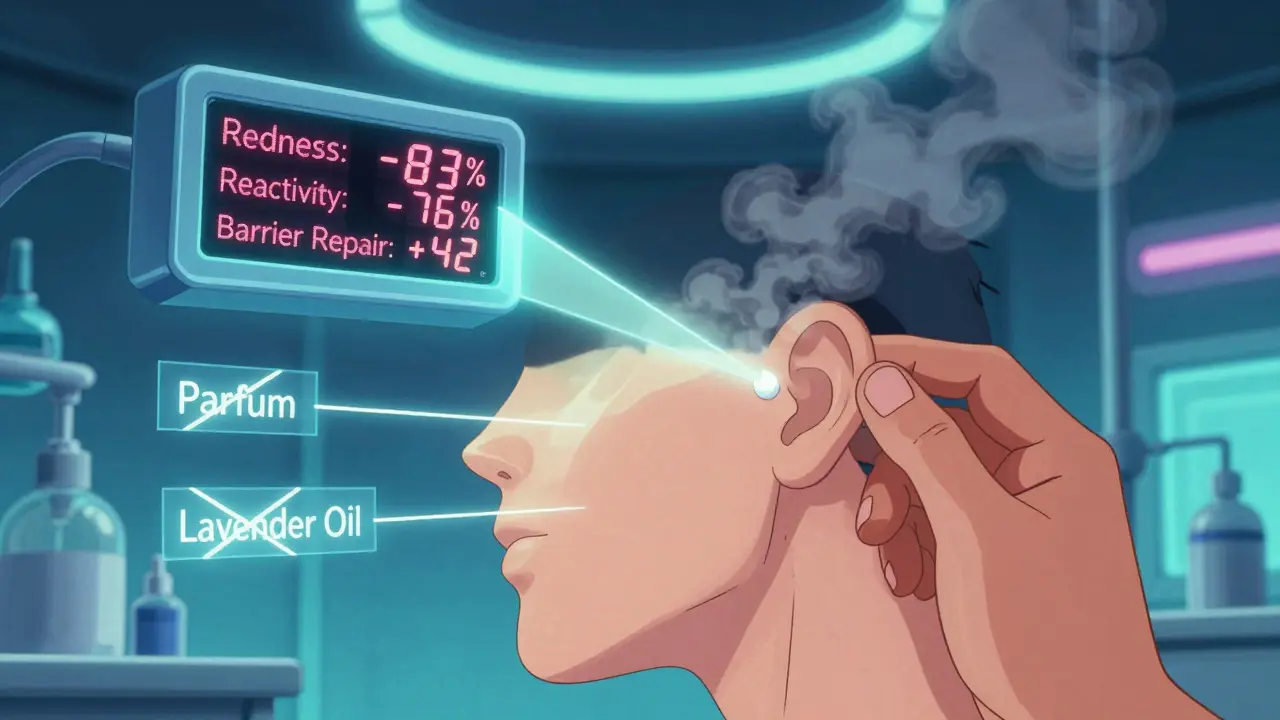
Never apply a new product all over your face right away. That’s how you end up with a red, burning mess. The gold standard is a 72-hour patch test behind your ear. Here’s how:- Wash and dry the area behind your ear.
- Apply a pea-sized amount of the product.
- Leave it on for 72 hours. Don’t wash it off.
- Watch for redness, itching, swelling, or flaking.
What to Look for on the Label (Beyond “Fragrance-Free”)
Not all claims are trustworthy. “Hypoallergenic” isn’t regulated in the U.S. It means nothing unless backed by testing. Look for these trusted certifications: - National Eczema Association Seal: Over 1,200 products are certified. They test for fragrance, dyes, and common allergens. - INCI compliance: Check the ingredient list. “Parfum” or “Fragrance” = red flag. “Ceramide NP” or “Glycerin” = good. - pH level: Skin’s natural barrier works best at 4.5-5.5. Products outside this range can damage your barrier. - Non-comedogenic: Tested to not clog pores. Important if you have acne-prone sensitive skin. Cleure’s products are verified to contain zero parts per million of fragrance. That’s the standard you should aim for.Real Results: What People Actually Experience
Reddit’s r/SkincareAddiction community has over 1.2 million members. In a 2023 survey, 78% of users with sensitive skin saw improvement within 4-6 weeks of switching to fragrance-free products. The top benefits:- 83% reported less redness
- 76% noticed less reactivity to weather, pollution, or stress
- 62% felt less tightness after cleansing
- 47% saw measurable hydration gains
The Downsides (And How to Deal With Them)
Fragrance-free skincare isn’t perfect. - It smells like nothing: 63% of users in Skincare.com’s 2023 survey said the lack of scent made routines feel “clinical” or “bland.” - It’s more expensive: Fragrance-free products average $28.50, compared to $22.75 for scented ones. - Not all “sensitive skin” products are safe: 58% of products labeled for sensitive skin still contain hidden fragrance, according to Cleure’s testing. Here’s how to handle it: - Accept that skincare doesn’t need to smell like a spa. Your skin doesn’t care about lavender. - Buy travel sizes first. Test before committing to full bottles. - Use the National Eczema Association’s app to verify products. It’s used by over 285,000 people.
Who Benefits Most?
Fragrance-free routines aren’t just for people with eczema or rosacea. They’re for anyone whose skin reacts easily. - 41% of users have a diagnosed condition (eczema, psoriasis, rosacea) - 59% self-identify as having sensitive skin Dermatologists recommend fragrance-free routines for post-procedure care-after chemical peels, laser treatments, or microneedling. Studies show 89% fewer complications when using these products. The market is growing fast. In 2023, the global fragrance-free skincare market hit $3.8 billion, growing at 17% a year. By 2026, it’s expected to reach $6.1 billion. Why? Because people are learning: if your skin is reacting, the problem isn’t your skin-it’s what you’re putting on it.What’s Next? Transparency Is Coming
Right now, companies in the U.S. don’t have to list every fragrance ingredient. But that’s changing. - The EU requires disclosure of 26 specific fragrance allergens. - California’s proposed Fragrance Ingredient Transparency Act (AB 1234) would require full disclosure. - The U.S. FDA’s CARES Act (2023) could make this mandatory nationwide. Until then, you have to be your own detective. Read labels. Test before you use. Stick to trusted brands.Final Checklist: Your Fragrance-Free Starter Kit
Before you buy anything, ask yourself:- Is “fragrance,” “parfum,” or “essential oil” on the ingredient list? → Skip it.
- Does it have the National Eczema Association Seal? → If yes, it’s verified.
- Is the ingredient list under 15 items? → Better chance it’s safe.
- Does it contain ceramides, glycerin, or hyaluronic acid? → Yes? Good.
- Have I done a 72-hour patch test behind my ear? → If not, don’t use it on your face.
Can I use essential oils if I have sensitive skin?
No. Essential oils like lavender, citrus, peppermint, and tea tree are common triggers for sensitive skin. Even though they’re natural, they can cause inflammation, redness, and itching. Dermatologists confirm that 22% of sensitive skin patients react to essential oils, sometimes as badly as synthetic fragrances. Skip them entirely.
Is fragrance-free the same as hypoallergenic?
No. “Hypoallergenic” is a marketing term with no legal definition in the U.S. A product can say it’s hypoallergenic and still contain fragrance or dyes. Only look for products that explicitly say “fragrance-free” and list no “parfum,” “aroma,” or “essential oils” in the ingredients. The National Eczema Association Seal is the only reliable certification.
How long does it take to see results from a fragrance-free routine?
Most people notice less redness and stinging within 2-4 weeks. Full improvement-like fewer flare-ups and better skin barrier function-usually takes 6-8 weeks. Be patient. Your skin barrier takes time to heal. Don’t switch products every week. Stick with the routine for at least two months before judging it.
Can I still wear makeup with sensitive skin?
Yes, but choose carefully. Look for mineral-based makeup labeled fragrance-free and non-comedogenic. Brands like Colorescience, BareMinerals, and Cleure offer options tested for sensitive skin. Always patch test new makeup behind the ear. Remove it gently with a fragrance-free cleansing balm-never harsh wipes or micellar water with added scent.
Why do some fragrance-free products feel greasy or thick?
Because they’re packed with barrier-repairing ingredients like ceramides, squalane, and shea butter-none of which are light or watery. These ingredients are necessary to fix a damaged skin barrier. If a product feels heavy, it’s likely working. Try applying a smaller amount or layering it over damp skin to reduce the greasy feel. Texture doesn’t mean it’s ineffective.





Annie Choi
January 16, 2026 AT 10:11Stop buying anything with 'essential oils' labeled as natural-seriously. I used lavender oil for months thinking it was healing my skin. Turns out it was causing micro-tears. Switched to Vanicream and my face stopped looking like a tomato. Game changer.
Sarah Mailloux
January 17, 2026 AT 09:33Y’all need to stop trusting 'hypoallergenic' like it’s a magic word. My cousin bought a $40 'sensitive skin' moisturizer that had parfum in it. She broke out for weeks. Read the label. Always.
Amy Ehinger
January 18, 2026 AT 23:02I used to think fragrance-free meant boring. Then I started using SVR’s cleansing balm and realized-why does my skin need to smell like a spa when it’s just trying to survive my 3 a.m. stress breakout? Now I keep a candle burning in my bathroom for the vibe and my face gets peace. Best decision ever.
Jami Reynolds
January 20, 2026 AT 15:15Let’s be clear: the FDA’s lack of regulation on 'hypoallergenic' is a scandal. Companies exploit this to sell overpriced junk to vulnerable people. If you’re not using the National Eczema Association seal, you’re gambling with your skin barrier. And that’s not just advice-it’s a public health failure.
Frank Geurts
January 20, 2026 AT 17:58Wait-so you’re telling me that 'unscented' isn’t the same as 'fragrance-free'? And that essential oils are just as bad as synthetic ones? I’ve been using bergamot-infused toners for years thinking I was being 'clean'. I’m going back to my bathroom right now to throw everything out. Thank you for this.
Nat Young
January 22, 2026 AT 10:3078% improvement? That’s a cherry-picked stat. What about the 22% who got worse? Or the ones who spent $200 on 'fragrance-free' crap and still broke out? This whole movement is just fear marketing dressed up as science. Also, zinc oxide leaves a white cast-so much for 'clear skin'.
Amy Vickberg
January 22, 2026 AT 23:07Just tried the 72-hour patch test behind my ear. Didn’t even know I was reacting to my own shampoo. Now I only use CeraVe and I can actually wear makeup without feeling like my face is on fire. You’re not broken-you’re just using the wrong stuff. Keep going.
Nilesh Khedekar
January 24, 2026 AT 21:43Oh wow, so now we’re all supposed to become dermatology detectives? I work 60 hours a week, have three kids, and you want me to read INCI labels and wait 72 hours before washing my face? My skin’s sensitive, not my schedule. Also, why is this always so expensive? Someone’s making bank off our anxiety.
Crystel Ann
January 25, 2026 AT 03:08I used to think I had rosacea. Turns out I just had a face full of lavender-scented toner. After switching to fragrance-free, my redness dropped in two weeks. No drama. No magic. Just clean ingredients. I’m not a skincare addict-I just want to not feel like my face is burning.
Dan Mack
January 26, 2026 AT 21:18They don’t want you to know this-but fragrance is a distraction. The real issue? Microplastics in cleansers and glyphosate residue in botanical extracts. Fragrance-free is just the gateway drug to real detox. Big Beauty doesn’t want you to know that your 'natural' serum was made in a factory that dumps waste into rivers. Wake up.
Niki Van den Bossche
January 27, 2026 AT 16:07Let’s be honest: the entire fragrance-free movement is a performative act of spiritual hygiene. We’re not just cleansing our skin-we’re rejecting the commodification of sensory pleasure in a capitalist dystopia. The scentless balm? It’s not moisturizer-it’s a meditation on authenticity. My ceramides are my catharsis.
Jan Hess
January 28, 2026 AT 18:53My mom’s 72 and she’s been using petroleum jelly for 50 years. She doesn’t read labels. Doesn’t care about ceramides. Her skin’s better than mine. Maybe the real fix is simplicity-not a 15-item ingredient checklist. Just stop overthinking it.
RUTH DE OLIVEIRA ALVES
January 30, 2026 AT 03:22While the empirical data presented is robust, one must consider the cultural and socioeconomic dimensions of skincare accessibility. The assumption that all individuals possess the time, literacy, or financial means to conduct 72-hour patch tests or procure certified products is inherently exclusionary. A systemic solution requires policy reform, not individual vigilance.
Nicholas Urmaza
January 31, 2026 AT 21:07You’re all missing the point. The real issue isn’t fragrance-it’s that people don’t understand their skin’s pH. Most cleansers are alkaline. That’s why your barrier breaks. Use a pH 5.5 cleanser. That’s it. No patch tests. No seals. Just science. And stop buying expensive crap. Your skin doesn’t need luxury. It needs balance.