
Graves’ disease isn’t just a thyroid problem-it’s your immune system turning on itself. Imagine your body sending out soldiers to attack a harmless target: your thyroid gland. These soldiers, called thyroid-stimulating immunoglobulins (TSI), lock onto the thyroid’s receptors and force it to pump out way too much hormone. The result? A body running on high speed-heart racing, nerves frayed, weight slipping away even when you’re eating more than ever.
What Graves’ Disease Actually Feels Like
Most people don’t realize how broad the symptoms can be. Younger patients often feel like they’re on edge all the time: anxious, jittery, unable to sleep. They might lose weight despite eating more, sweat through their shirts in a cool room, or feel their heart pounding even while sitting still. Muscle weakness in the hips and shoulders is common, making stairs or lifting groceries feel like a workout. Hand tremors? That’s a classic sign-shaking coffee cups, spilling keys, struggling to hold a pen steady. But it’s not just energy and nerves. Older adults often show up with different symptoms: a fast or irregular heartbeat, chest discomfort, memory fog, or just plain exhaustion. Sometimes, they’re misdiagnosed with heart problems or depression. The thyroid doesn’t just affect metabolism-it touches your brain, your heart, your muscles, even your eyes. About one in three people with Graves’ develop eye issues. Eyes bulging out, redness, watering, double vision. In severe cases, vision can be threatened. And then there’s the skin-rare but startling-thick, reddish patches on the shins called pretibial myxedema. It’s not just a thyroid issue. It’s an autoimmune storm.How Doctors Confirm It
If you’re showing these signs, your doctor won’t just guess. They’ll start with a blood test. The first clue? Your TSH level. In Graves’, it’s almost always below 0.4 mIU/L-sometimes barely detectable. Meanwhile, your free T4 and T3 levels are sky-high. That’s the hallmark: your thyroid is overproducing, but your brain isn’t telling it to stop because the immune system is hijacking the controls. The real confirmation comes from antibody tests. TSI and TRAb antibodies are present in 85-95% of cases. If they’re positive, you have Graves’ disease. No need for extra scans. If those tests aren’t available, a radioactive iodine uptake test shows your thyroid soaking up way more iodine than normal-diffusely, not in patches like with thyroid nodules. Ultrasound is also becoming more common. High blood flow through the thyroid, visible on Doppler imaging, gives doctors another way to spot Graves’ without radiation. Sensitivity and specificity? Over 90%.Three Main Treatments-and What They Really Mean
There are three paths, and none is perfect. Each has trade-offs you need to understand before choosing. Methimazole is the first-line drug for most people under 60. It blocks hormone production. Most start with 10-40 mg daily. It’s not a cure-it’s a pause button. About 30-50% of people go into remission after 12-18 months. The odds improve if your thyroid is small and your antibodies drop to zero by the end of treatment. But you need to take it daily. Miss doses? Your relapse risk jumps by 40-50%. Side effects? Rare, but serious. Agranulocytosis-a drop in white blood cells-can happen in 1 out of every 500 people. Fever or sore throat? Stop the drug and get blood work immediately. Liver damage is another risk, though rare. Monthly blood checks are standard in the first few months. Radioactive iodine (I-131) is the most common treatment in the U.S. You swallow a pill. The radiation destroys your thyroid over weeks to months. By six months, 80-90% of people become hypothyroid. That means you’ll need levothyroxine for the rest of your life. Many don’t realize this upfront. One patient on a support forum said, “I thought it was a fix. Now I’m on a pill every morning, and I still feel tired.” It’s effective, but it’s permanent. And if you have eye disease, it can make it worse-unless you’re on steroids at the same time. Thyroidectomy means surgery to remove the thyroid. It’s recommended if your thyroid is huge and pressing on your windpipe, if you can’t take meds or iodine, or if you have severe eye disease. Success rate? Over 95%. But risks? One in 50 people develop low calcium from damaged parathyroid glands. One in 100 might have nerve damage leading to voice changes. Recovery takes a few weeks. Afterward, you’ll also need lifelong thyroid hormone replacement.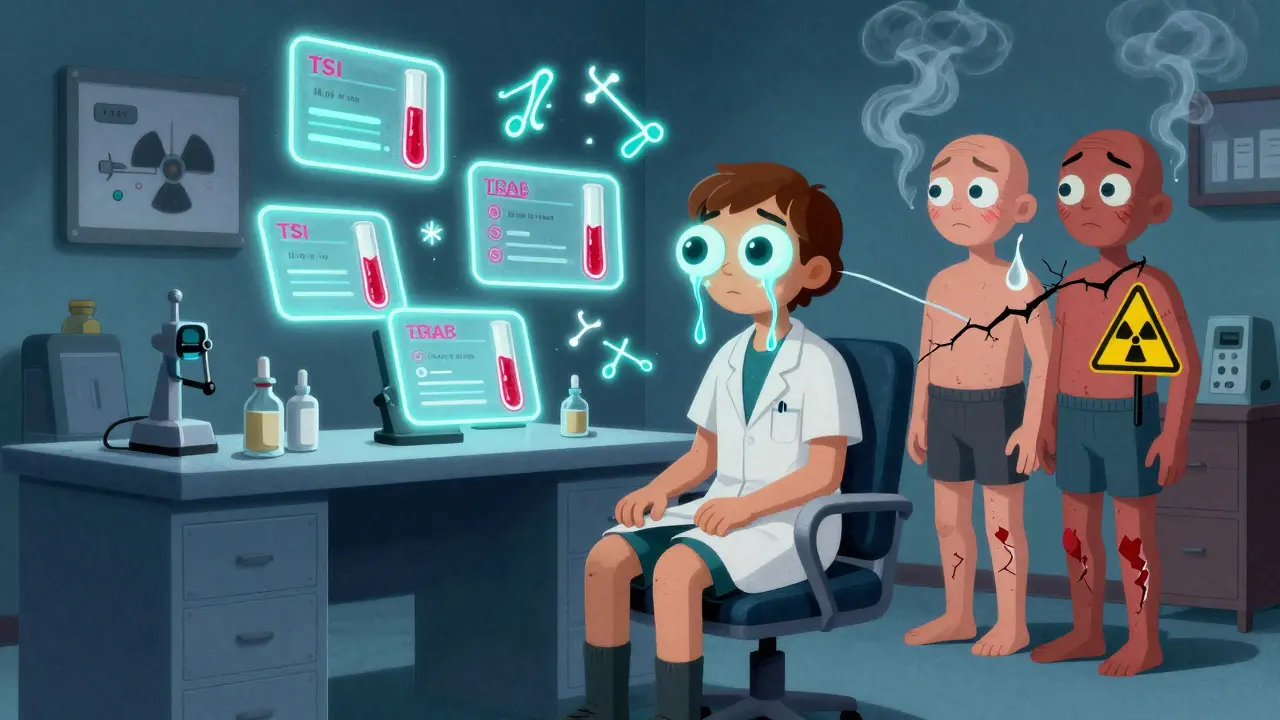
What About the Eyes?
Graves’ eye disease is its own battle. Mild cases? Selenium supplements-100 mcg twice a day for six months-can help reduce swelling and irritation. It’s cheap, safe, and backed by solid data. Moderate to severe cases need stronger tools. Intravenous steroids-methylprednisolone-are given weekly for 12 weeks. About 60-70% of patients see improvement. But steroids come with their own problems: weight gain, mood swings, high blood sugar. The newest option? Teprotumumab. This monoclonal antibody targets the IGF-1 receptor, which plays a big role in eye tissue swelling. In trials, 75-80% of patients saw their bulging eyes shrink. Nearly 70% had meaningful improvement. It’s not cheap, and it’s not for everyone-but for those with severe, progressive eye disease, it’s life-changing.Smoking Changes Everything
If you smoke and have Graves’ disease, you’re playing Russian roulette with your eyes. Smokers are 7-8 times more likely to develop severe eye complications than non-smokers. Quitting isn’t just good advice-it’s medical necessity. Studies show quitting can stop eye disease from getting worse, even if you’ve already started treatment. No other single change has this kind of impact.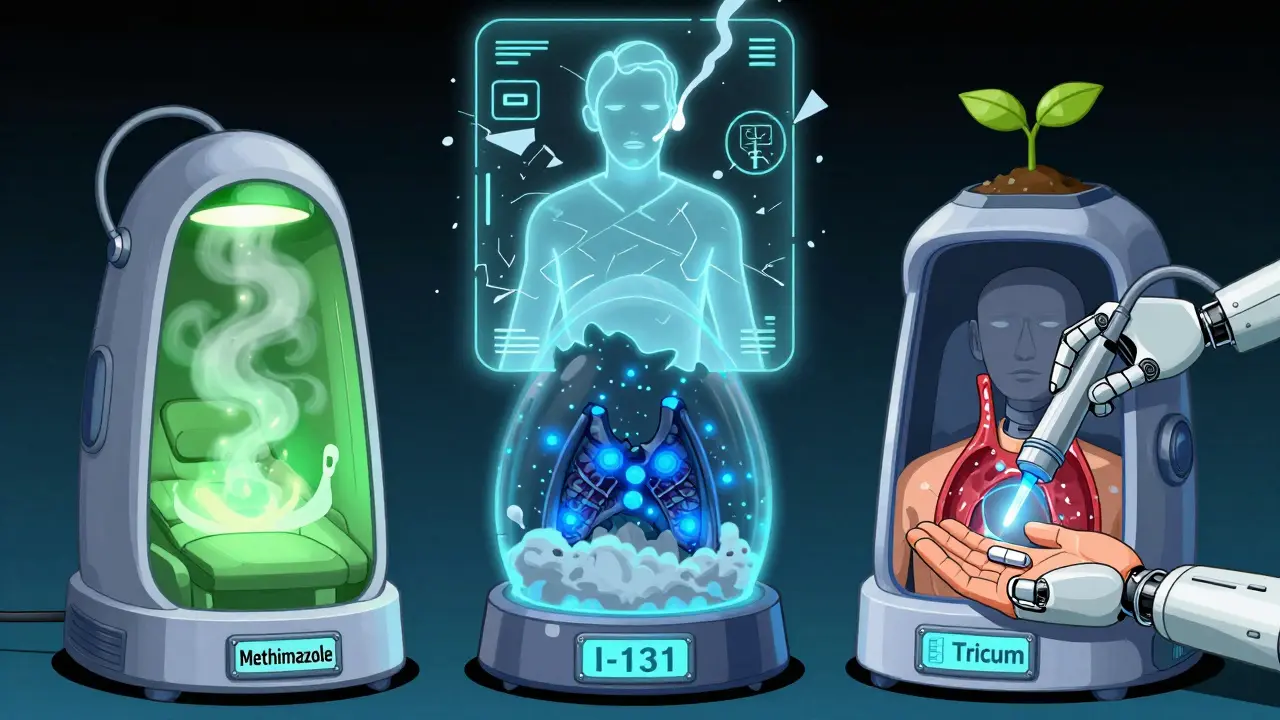
What Happens After Treatment?
No matter which path you choose, monitoring doesn’t stop. After starting methimazole, you’ll need blood tests every month for three months, then every two to three months. After radioactive iodine, you’ll be checked at 4-6 weeks, then 3 and 6 months, then every six months forever. Your hormone levels need to stay in range. Too much levothyroxine? You’ll feel jittery again. Too little? You’ll feel sluggish, cold, and depressed. One study found that 55% of patients regretted their initial treatment choice-especially those who didn’t fully understand that radioactive iodine meant lifelong medication. Talking through your lifestyle, your fears, your long-term goals with your doctor matters more than you think.What’s on the Horizon?
Researchers are looking at new ways to reset the immune system. Rituximab, a drug that wipes out B-cells (the immune cells making the bad antibodies), showed a 60% response rate in early trials for stubborn eye disease. Genetic studies have found 12 key genes linked to Graves’-including HLA-DQA1 and CTLA4. That means someday, we might predict who’s at risk before symptoms even start.Living With It
Graves’ disease doesn’t go away quietly. But most people do get better. One patient wrote: “After 15 mg of methimazole, my heart stopped racing. I slept through the night for the first time in two years.” Another said, “I had to have surgery. Now I take one pill a day. I’m alive. I’m not perfect-but I’m not dying anymore.” The key is finding your path, sticking with it, and not letting fear make the decision for you. It’s not a quick fix. But with the right treatment and support, you can get your life back.Can Graves’ disease go away on its own?
Rarely. While a small number of people (about 1 in 5) may experience temporary remission without treatment, most cases require medical intervention. Left untreated, Graves’ disease can lead to heart problems, bone loss, thyroid storm (a life-threatening surge of hormones), and worsening eye disease. It’s not something to wait out.
Is radioactive iodine dangerous?
The dose used for Graves’ disease is not dangerous to others if you follow simple precautions for a few days-like sleeping alone, not sharing utensils, and avoiding close contact with pregnant women and young children. The radiation stays mostly in your thyroid. The bigger risk is that it permanently destroys your thyroid, meaning you’ll need thyroid hormone replacement for the rest of your life. That’s not a side effect-it’s the goal. But many patients aren’t fully warned about this before choosing it.
Why do women get Graves’ disease more often than men?
Women are 7-8 times more likely to develop Graves’ disease, especially between ages 30 and 50. The exact reason isn’t fully known, but hormones play a big role. Pregnancy, postpartum changes, and estrogen fluctuations can trigger or worsen autoimmune activity. It’s also more common in women with other autoimmune conditions like type 1 diabetes or rheumatoid arthritis.
Can I get pregnant with Graves’ disease?
Yes-but it requires careful planning. Uncontrolled hyperthyroidism increases risks of miscarriage, preterm birth, and low birth weight. If you’re on methimazole, your doctor may switch you to propylthiouracil in the first trimester because it crosses the placenta less. Radioactive iodine is absolutely off-limits during pregnancy. Many women choose to stabilize their condition before trying to conceive, and some opt for thyroidectomy before pregnancy to avoid medication risks.
What should I avoid if I have Graves’ disease?
Avoid smoking-it dramatically worsens eye disease. Limit iodine-rich foods like seaweed, kelp supplements, and some cough syrups, as excess iodine can make your thyroid overproduce even more. Don’t skip your blood tests or medication. And avoid stress if you can-while it doesn’t cause Graves’, it can trigger flare-ups or make symptoms worse.
How long does it take to feel better after starting treatment?
Most people notice improvement within 2-4 weeks of starting antithyroid medication. Heart palpitations and anxiety often ease first. Weight gain and energy levels take longer-usually 2-3 months. Eye symptoms can take months to improve, even with treatment. Patience is key. But if you’re still feeling terrible after three months, talk to your doctor-your dose may need adjusting.
Is Graves’ disease hereditary?
It runs in families, but it’s not guaranteed. If a close relative has Graves’, your risk is higher-about 25-30% of patients have a family history. But genes alone don’t cause it. Environmental triggers like stress, infection, or smoking are usually needed to turn on the disease. Having the genes means you’re more vulnerable-not destined to get it.



Naomi Walsh
February 1, 2026 AT 09:59Let’s be real-most people don’t understand autoimmune thyroid disorders because they’ve been fed oversimplified narratives by primary care docs who think ‘thyroid = take synthroid and call it a day.’ Graves’ isn’t just hyperthyroidism; it’s a systemic immune betrayal. The fact that TSI antibodies directly mimic TSH is fucking brilliant in a horrifying way. And teprotumumab? Finally, a targeted therapy that doesn’t just mask symptoms but actually interrupts the pathogenic cascade. If your doctor hasn’t mentioned it, they’re operating on 2010 guidelines. Time to upgrade your medical team.
Also, selenium for mild orbitopathy? Only if you’re not smoking. Otherwise, you’re wasting money and time. Quitting smoking is the single most underappreciated intervention in endocrinology. Period.
And yes, HLA-DQA1 and CTLA4 are the big genetic players, but epigenetic triggers like viral infections (EBV, Yersinia) are the real ignition switches. Stop blaming ‘stress’ like it’s a personality flaw-it’s a biological catalyst.
Also, why is no one talking about the gut-thyroid axis? Dysbiosis exacerbates molecular mimicry. Probiotics aren’t ‘alternative medicine’ here-they’re adjuvant therapy. Just saying.
Bob Cohen
February 3, 2026 AT 06:23Okay but like… I had Graves’ and went the radioactive iodine route. Thought I was getting ‘fixed.’ Turns out I just got a lifetime subscription to ‘How to Not Feel Like a Zombie.’
Turns out being hypothyroid isn’t the same as being ‘normal.’ You’re just… less broken. Still tired. Still cold. Still weirdly emotional.
Also, the eye thing? Yeah. I didn’t know my eyes were bulging until my niece asked if I was a frog. That’s when I knew I needed help.
But hey-at least I’m alive. And I don’t have to take methimazole anymore. So… win? I guess?
Aditya Gupta
February 4, 2026 AT 21:14bro i had this too. took methimazole for 14 months. lost 20 lbs, couldnt sleep, heart felt like it was gonna pop out.
then one day i just felt… normal. like, i could sit still. no shaking. no panic.
doc said remission. i cried.
but now i check my levels every 6 months. because this shit comes back if you slack. dont be me. dont wait till your heart is in your throat to take it serious.
and quit smoking. like. just do it.
Nancy Nino
February 6, 2026 AT 02:24It is profoundly concerning that the medical community continues to normalize radioactive iodine as a ‘first-line’ intervention without adequately addressing the lifelong implications. The fact that 55% of patients regret their choice underscores a systemic failure in informed consent. Thyroidectomy, while invasive, offers a definitive resolution without the need for daily pharmacological dependency. One must consider not merely efficacy, but autonomy. Are we treating patients-or simply managing a chronic condition with a chemical lobotomy?
Jaden Green
February 6, 2026 AT 14:33Let’s be honest-this whole ‘Graves’ disease’ narrative is just Big Pharma’s way of keeping people on pills forever. Methimazole? A Band-Aid on a bullet wound. Radioactive iodine? A slow, quiet genocide of your endocrine system. And now they’re pushing this $100,000 monoclonal antibody like it’s a miracle cure. Please. The real cause? Glyphosate. The EMFs. The fluoride in the water. The fact that we’ve poisoned our microbiomes into oblivion.
My cousin went on a 30-day juice cleanse, stopped all meds, started taking iodine drops (yes, I know, ironic), and ‘cured’ herself in six weeks. No labs, no scans. Just ‘listening to her body.’
And don’t even get me started on the ‘smoking worsens eye disease’ thing. That’s just a distraction. The real enemy? The government’s thyroid surveillance program. They want you dependent. They want you docile. They want you on levothyroxine so you don’t notice the real symptoms-like the fact that your brain is being slowly rewired by microchips embedded in your food.
Wake up. The thyroid is just the messenger. The real war is happening in the shadows.
Angel Fitzpatrick
February 7, 2026 AT 13:39So… you’re telling me that if I have Graves’ and I’m a smoker, my eyes will turn into bowling balls? And that quitting smoking can stop it? That’s it? That’s the whole thing? No magic pills, no gene therapy, no secret cure? Just… stop smoking?
That’s the most depressing thing I’ve heard all week. Like, the entire medical system is built on complexity, but the one thing that actually works is the simplest, most universally available intervention?
I’m not even mad. I’m just… disappointed. Like, we spent billions on drugs and scans and antibodies, and the answer was ‘don’t light up’ this whole time?
Someone get me a smoke. I need to mourn.
Nidhi Rajpara
February 9, 2026 AT 13:37Regarding the use of selenium for mild Graves’ orbitopathy: the 2018 European Thyroid Association guidelines explicitly recommend 100 mcg of sodium selenite twice daily for six months, with a number needed to treat (NNT) of 3.3 for clinically significant improvement in proptosis and quality of life. This is not anecdotal-it is evidence-based, randomized, double-blind, placebo-controlled. I am surprised that this is not emphasized more in clinical practice, especially given its low cost and minimal adverse effects. It is a rare example of a truly accessible, effective, and safe intervention in autoimmune disease. I urge all clinicians to consider it before escalating to corticosteroids or biologics.
Donna Macaranas
February 10, 2026 AT 21:21I just wanted to say… thank you for writing this. I was diagnosed 3 years ago. I felt so alone. Like my body was broken in a way no one else understood. I didn’t know about the eye thing until it happened. I didn’t know quitting smoking could help. I thought I was just ‘anxious’ or ‘lazy.’
Now I’m on levothyroxine. I take it every morning. I still have bad days. But I’m here. I’m alive. And I finally feel like I’m not crazy.
You’re not alone. I’m here with you.