
When your chest burns after dinner, or you wake up with a sour taste in your mouth, it’s not just indigestion-it could be GERD. Gastroesophageal reflux disease isn’t just occasional heartburn. It’s when stomach acid keeps leaking into your esophagus, irritating the lining and turning everyday meals into a source of discomfort. About 7% of adults in the U.S. have symptoms every day, and millions more deal with it weekly. The good news? You don’t have to live with it. The better news? You don’t always need pills to fix it.
What’s Really Happening in Your Body?
Your esophagus and stomach are connected by a muscle called the lower esophageal sphincter (LES). Think of it like a door that opens for food to go in, then shuts tight to keep stomach acid from coming back up. In GERD, that door gets loose. It doesn’t close right. So when you lie down after eating, or bend over, acid slips upward. Your esophagus doesn’t have the same protective lining as your stomach, so that acid burns. That’s heartburn. That’s regurgitation. That’s the chronic irritation that leads to complications like esophageal strictures or even Barrett’s esophagus-a precancerous change seen in 10-15% of long-term GERD patients.
Symptoms aren’t always obvious. While 90% of people feel that classic burning sensation, nearly half also have a chronic cough, hoarseness, or bad breath. Some don’t feel heartburn at all-just a lump in their throat or a persistent sore throat. If your symptoms happen twice a week or more, it’s not just "bad luck." It’s GERD.
Why PPIs Are the Go-To Medication
Proton pump inhibitors-PPIs like omeprazole, pantoprazole, and esomeprazole-are the most powerful acid-reducing drugs we have. They don’t just calm things down. They shut off the acid factory. PPIs block the final step of acid production in stomach cells, cutting acid output by 90-98%. That’s why they heal erosive esophagitis in 70-90% of cases, compared to 50-60% with older H2 blockers like famotidine.
They work fast, too. Most people feel better within a few days. But here’s the catch: they’re not meant to be taken forever. The FDA and the American College of Gastroenterology both warn that long-term use (over a year) raises risks. Studies show a 20-50% higher chance of gut infections like C. diff, lower vitamin B12 levels, and even a 35% increased risk of hip fractures in older adults on high doses for three or more years. And when you stop? About 44% of users get rebound acid hypersecretion-where your stomach overproduces acid for weeks after stopping the pill, making symptoms worse than before.
That’s why doctors now say: start with the lowest dose for the shortest time. If you’ve been on PPIs for more than 8 weeks without a clear reason, it’s time to reevaluate.
Lifestyle Changes Are the Real Game-Changer
Medication helps, but lifestyle changes? They fix the root cause. And the evidence is overwhelming.
- Losing 5-10% of your body weight cuts GERD symptoms by half. For someone who weighs 200 pounds, that’s just 10-20 pounds.
- Avoiding food 2-3 hours before bed reduces nighttime acid exposure by 40-60%. That’s because lying down lets gravity stop working in your favor.
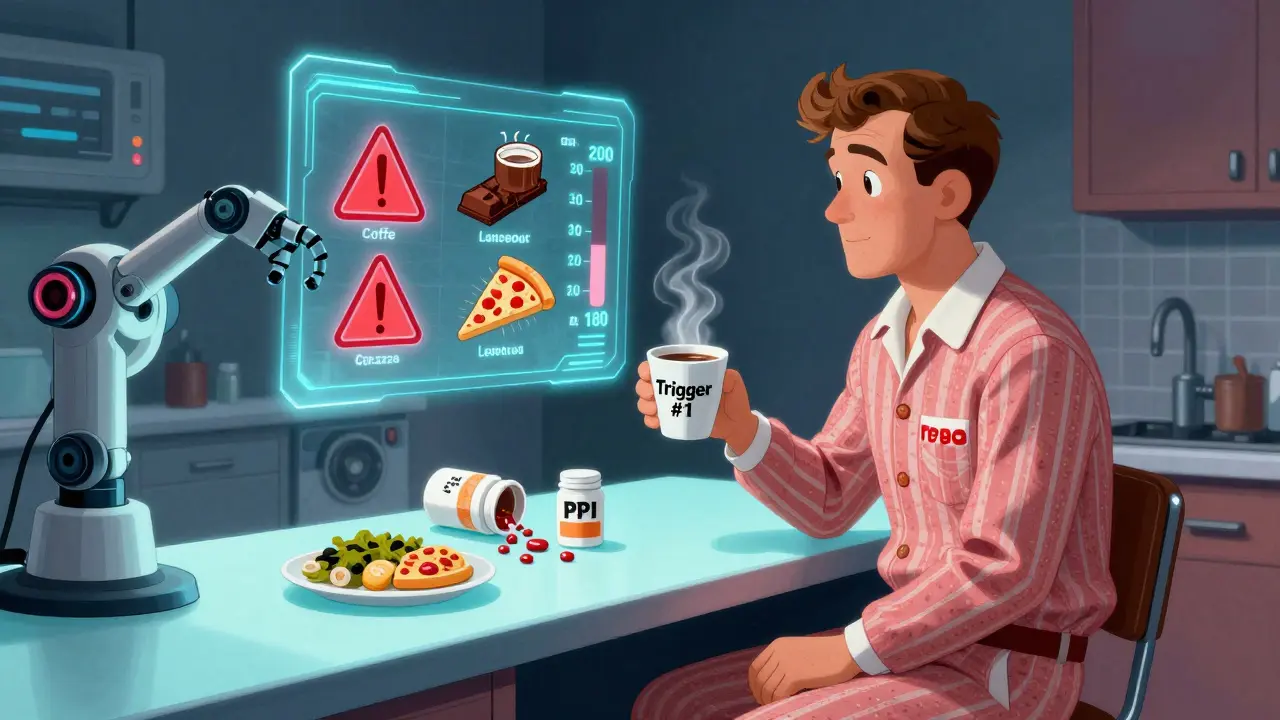
- Cutting out coffee, alcohol, chocolate, tomatoes, and fatty foods helps 70-80% of people. One study found 73% of those who quit coffee saw major improvement.
- Elevating the head of your bed by 6 inches (using blocks or a wedge pillow) reduces nighttime reflux better than most medications for some people.
These aren’t "nice to haves." They’re medical interventions. A 2023 Johns Hopkins study showed that a 12-week structured program of diet, timing, and posture changes allowed 65% of participants to stop PPIs completely-without symptoms returning. That’s more effective than many drugs.
What Works Better Than Just Pills?
Combining lifestyle changes with short-term PPI use is the gold standard. Here’s how to do it right:
- Start with lifestyle-even if you’re on PPIs. Don’t wait for the pill to fix everything. Change your eating habits now.
- Take PPIs correctly-30-60 minutes before your first meal. Taking them after food makes them far less effective.
- Track your triggers. Use a food diary for 2 weeks. Note what you eat, when you eat it, and how you feel 2 hours later. Apps like RefluxMD help 8,500 users identify patterns with 90% accuracy.
- Don’t quit PPIs cold. If you want to stop, taper slowly over 4-8 weeks. Use an H2 blocker like famotidine during the transition to avoid rebound.
- Know when to see a doctor. If you have trouble swallowing, unexplained weight loss, vomiting blood, or black stools-get an endoscopy. These aren’t normal GERD signs. They’re red flags.
The Hidden Problem: Overprescribing
Here’s the uncomfortable truth: half of all PPI prescriptions are unnecessary. People take them for "just in case," or because they were prescribed for a short-term issue and never stopped. A Kaiser Permanente program cut inappropriate long-term use by 35% by using automated alerts and pharmacist reviews. The Choosing Wisely campaign has reduced unnecessary prescriptions by 25% in hospitals since 2015.
Doctors aren’t ignoring this. New 2024 guidelines from the American Gastroenterological Association say: "Lifestyle modification is foundational therapy. PPIs should be reserved for confirmed erosive disease or severe symptoms." That means if you have mild heartburn without tissue damage, you should start with diet and posture-not pills.

What’s Next? New Tools, New Hope
There’s exciting progress beyond PPIs. In 2023, the FDA approved Vonoprazan (Voquezna)-the first new acid-blocking drug in 30 years. It works differently than PPIs and shows slightly better healing rates in trials. Endoscopic procedures like LINX® (a magnetic ring implanted around the LES) and TIF (a no-incision repair) are helping patients who don’t want lifelong pills. Early data shows 85% report better quality of life than with PPIs.
And AI is stepping in. Trials using IBM Watson Health’s food-tracking AI predict individual triggers with 78% accuracy. Imagine your phone telling you, "Eating pizza at 8 p.m. causes reflux for you-try grilled chicken instead." That’s not sci-fi anymore.
Real Talk: Why People Struggle
Let’s be honest. Changing habits is hard. People love pizza. They like wine with dinner. They work late and snack while watching TV. Social pressure, cultural norms, and convenience make lifestyle changes feel impossible. A Cleveland Clinic survey found 41% of patients couldn’t stick with dietary changes because of family meals or work schedules.
But success stories exist. One patient in New Zealand stopped PPIs after switching to a plant-based diet, eating dinner by 6 p.m., and sleeping on a wedge. She’s been symptom-free for 18 months. Another man in Texas lost 30 pounds, cut out soda, and now uses PPIs only once a week-when he eats out.
It’s not about perfection. It’s about progress. Even cutting out one trigger-like coffee-can cut symptoms in half. Skipping late-night snacks? That alone can make a huge difference.
Final Take: You Have More Control Than You Think
GERD isn’t a life sentence. It’s not something you just have to live with. PPIs are powerful tools-but they’re not the whole answer. The real power lies in what you do before you reach for the pill.
You can reduce symptoms, heal your esophagus, and avoid long-term risks-all without relying on medication. Start small. Track your meals. Stop eating before bed. Lose a little weight. Give your body a chance to heal itself.
And if you’ve been on PPIs for more than a year? Talk to your doctor. Ask if you can try lifestyle changes first. You might be surprised how much better you feel.
Can lifestyle changes cure GERD?
Lifestyle changes won’t "cure" GERD in the sense of permanently fixing a broken valve, but they can eliminate symptoms and prevent complications in most people. Studies show that weight loss, avoiding trigger foods, and not eating before bed can reduce symptoms by 50-70%. For many, these changes make PPIs unnecessary. The key is consistency-not perfection.
Are PPIs safe for long-term use?
Long-term PPI use (over a year) carries risks. Studies link it to higher chances of gut infections, vitamin B12 deficiency, low magnesium, and increased hip fractures in older adults. The FDA and medical guidelines recommend using the lowest effective dose for the shortest time. Always reevaluate with your doctor after 8 weeks. If symptoms are under control, try stepping down to an H2 blocker or stopping altogether with a taper plan.
What foods trigger GERD the most?
The top triggers are coffee, alcohol, chocolate, tomatoes, citrus, fatty or fried foods, and spicy dishes. But triggers vary by person. A 2022 survey found 73% of people improved after cutting out coffee, while 68% benefited from avoiding spicy foods. Keep a food diary for 2 weeks to find your personal triggers. What affects one person might not affect another.
Why do I feel worse when I stop taking PPIs?
This is called rebound acid hypersecretion. When you take PPIs for weeks or months, your stomach increases acid-producing cells to compensate. When you stop suddenly, those cells overproduce acid for a few weeks. It’s not a relapse-it’s a temporary adjustment. To avoid this, taper off slowly over 4-8 weeks. Use an H2 blocker like famotidine during the transition to help manage symptoms.
When should I see a doctor for GERD?
See a doctor if you have trouble swallowing, unexplained weight loss, vomiting blood, black or tarry stools, or chest pain that feels like a heart attack. These aren’t typical GERD symptoms-they could signal serious complications like esophageal strictures, ulcers, or Barrett’s esophagus. Also, if lifestyle changes and short-term PPIs don’t help after 8 weeks, it’s time for further testing.


Donnie DeMarco
March 11, 2026 AT 11:41I swear to god, cutting out coffee and not eating after 7 p.m. was the only thing that saved me from 8 years of PPI hell. I thought I was addicted to the pill, turns out I was addicted to pizza at midnight. Lost 15 lbs, no more nighttime cough, and my dentist said my enamel looks better. Who knew the cure was just not being a dumbass with dinner?
LiV Beau
March 12, 2026 AT 21:43This is SO GOOD 🙌 I’ve been on PPIs for 5 years and just started the 12-week plan last month. Already down to half-dose and no rebound! Eating dinner by 6pm and sleeping on a wedge changed my LIFE. Also, I didn’t know about the 6-inch head elevation thing-holy crap, why isn’t this in every doctor’s office? 🛌✨
Tom Bolt
March 14, 2026 AT 13:09The FDA and American College of Gastroenterology are finally admitting what we’ve known for years: pharmaceutical companies have been selling snake oil disguised as a cure. PPIs are not a treatment-they’re a bandage on a ruptured artery. And the rebound effect? That’s not a side effect. That’s a business model. Wake up, people. Your stomach doesn’t need a chemical shutdown. It needs space, silence, and a damn dinner curfew.
Miranda Varn-Harper
March 15, 2026 AT 08:50I find it alarming how casually this article dismisses the biological complexity of GERD. The lower esophageal sphincter is not merely a 'loose door.' It's a neuromuscular junction governed by vagal tone, gastric distension, and hormonal signaling. Reducing acid without addressing motility disorders or hiatal hernias is akin to treating hypertension with aspirin. Lifestyle changes are beneficial, yes-but they are not a panacea. Evidence-based medicine requires stratification, not slogans.
Shourya Tanay
March 15, 2026 AT 13:28The pharmacokinetics of PPIs are fascinating-covalent binding to H+/K+ ATPase pumps, irreversible inhibition, and the subsequent compensatory hyperplasia of parietal cells. But the real clinical insight here is the therapeutic window: short-term suppression + long-term behavioral modulation. The 65% remission rate in the Johns Hopkins cohort isn't anecdotal-it's a paradigm shift. We need to reframe GERD not as a chemical imbalance, but as a biomechanical and circadian disorder. The data supports it.
Adam Kleinberg
March 16, 2026 AT 04:11They don’t want you to know this but the PPI industry is run by Big Pharma and the FDA is in their pocket. I read a study once that said PPIs cause autism in babies. And the 'lifestyle changes' thing? That’s just a distraction so you don’t sue them. I stopped PPIs and started drinking apple cider vinegar and now I’m 100% healed. Also, the moon controls acid reflux. You’re being gaslit.
Denise Jordan
March 16, 2026 AT 05:56I tried all that stuff. Didn’t work. I still get heartburn. So I just take my pill. Chill out.
Gene Forte
March 16, 2026 AT 09:20The human body is designed to heal. When we remove the toxins-late meals, processed foods, caffeine-we give it the space to restore balance. Medication can be a bridge, not a permanent home. I’ve seen patients transform not because they followed a protocol, but because they chose to listen-to their hunger, their sleep, their rhythm. This isn’t medicine. It’s mindfulness with a scientific backbone.