
Between 2023 and 2025, the U.S. Food and Drug Administration (FDA) overhauled how generic drugs get approved - and the changes are reshaping who makes these drugs, where they’re made, and how fast they reach patients. This isn’t just bureaucratic fine-tuning. It’s a strategic pivot driven by drug shortages, national security concerns, and the realization that relying on overseas factories for half of America’s medicines is risky. The centerpiece? The ANDA Prioritization Pilot Program, launched in October 2025, which gives faster reviews to generic drug makers who do their testing and manufacturing right here in the U.S.
Why the FDA Changed the Rules
For years, the generic drug market ran on a simple formula: low cost, high volume, overseas production. India and China supplied most of the active ingredients (APIs) and finished pills. But the pandemic exposed the cracks. When factories in Asia shut down, critical medications like antibiotics, heart drugs, and anesthetics vanished from U.S. shelves. By September 2025, 147 drugs were on the FDA’s official shortage list - up from 98 in 2022. The numbers tell the story: only 9% of API manufacturers are in the U.S. Meanwhile, 44% are in India and 22% in China. Over half of all drugs sold in America are made overseas. That’s not just a supply chain issue - it’s a public health vulnerability. In 2023, the National Defense Authorization Act forced the Department of Health and Human Services to act. The result? Executive Order 14080, which directed the FDA to create incentives for domestic production.The ANDA Prioritization Pilot Program: How It Works
The new pilot program doesn’t change the science behind generic approval. It changes the speed. Under the old system, an Abbreviated New Drug Application (ANDA) took 12 to 15 months to review. Now, if a company does everything - from making the active ingredient to running bioequivalence tests - in the U.S., their application jumps to the front of the line. There are four tiers of priority, but only Tier 1 gets the fastest track. To qualify, manufacturers must prove:- 100% of the active pharmaceutical ingredient (API) comes from a U.S.-based facility
- All testing (including bioequivalence studies) is done at FDA-registered U.S. labs
- The final product is manufactured and packaged in the U.S.
- The facility passes Current Good Manufacturing Practices (CGMP) inspections
- Initial review: 30 days (down from 60-90)
- Complete response letter: 45 days (down from 120)
- Full approval timeline: 8 months (down from 12-15)
First Generics Are Driving the Market
The FDA isn’t just pushing for domestic production - it’s pushing for first generics. These are the very first versions of a brand-name drug to hit the market after patent expiration. They’re the most valuable because they capture the largest share of sales before competitors enter. In 2025 alone, the FDA approved nine first generics, including:- Ivermectin Tablet (for parasitic infections)
- Nimodipine Solution (for stroke recovery)
- Azilsartan Medoxomil and Chlorthalidone Tablet (for high blood pressure)
Who Benefits - and Who Struggles
The pilot program favors companies that can afford to rebuild their supply chains from scratch. Large manufacturers like Teva, Mylan, and Sandoz have the resources to invest in U.S. facilities. Mid-sized firms - those with 50 to 500 employees - are leading adoption, with 63% enrolled in the pilot. But smaller companies? Many are stuck. Setting up a single U.S. manufacturing facility costs $120-180 million. Adding domestic API sourcing and testing adds $1.2-1.8 million per application. For a small company making a low-margin generic like metformin, that’s impossible. They’re forced to either delay launches, stick with foreign suppliers (and lose priority), or exit the market entirely. The trade-off is clear: faster approvals and better supply security come at a higher cost. Industry analysts estimate domestic production will increase generic drug prices by 12-18% in the short term. But the FDA projects those costs will drop after 3-5 years as more U.S. facilities come online and economies of scale kick in.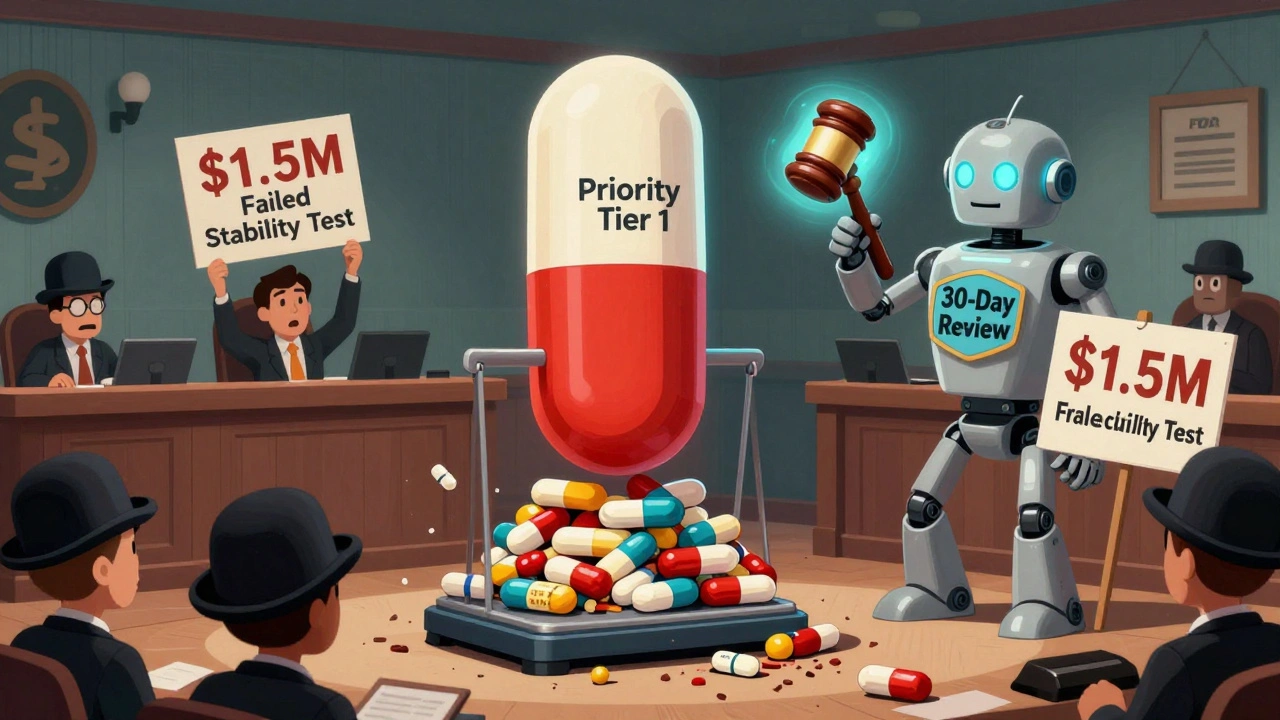
Real-World Impact: Manufacturer Stories
Teva Pharmaceuticals’ regulatory team told the FDA’s industry forum that the 30-day initial review window “transformed our development timelines.” They brought nimodipine solution to market eight months faster than planned. But not everyone is celebrating. On Reddit’s r/pharmaceuticals, a thread with 147 comments showed 79% of respondents cited immediate cost pressures. One small manufacturer wrote: “We spent $1.5 million trying to qualify a U.S. API supplier for a simple tablet. They failed three stability tests. We’re shelving the project.” The Association for Accessible Medicines surveyed 127 generic makers in August 2025. Results:- 54% started expanding U.S. manufacturing
- 31% delayed product launches due to costs
- 87% praised FDA’s communication
- Average documentation time: 217 hours per application
What’s Coming Next
The pilot program is expanding. Starting January 2026, it will include complex generics - things like inhalers, eye drops, and skin patches - which have historically been harder to copy. The FDA is also rolling out AI tools to automate parts of the review process, which could cut another 25% off review times. By 2028, the FDA expects U.S. API manufacturing to jump from 9% to 23%. That’s a massive shift. The Congressional Budget Office projects the program will save $4.2 billion annually by 2030 by reducing emergency drug purchases and hospital costs tied to shortages. But there are risks. The European Generic Medicines Association filed a formal complaint in July 2025, arguing the program violates international trade rules. And while the FDA says therapeutic outcomes are unchanged (per Harvard’s JAMA study), some pharmacists worry about hidden compromises in quality control.What This Means for Patients
You won’t see “Made in the USA” on your pill bottle - but you might see fewer shortages. If you take a drug like levothyroxine, metformin, or lisinopril, the chances of it being unavailable are dropping. The FDA’s goal isn’t to make generics more expensive - it’s to make sure they’re always there when you need them. Price drops from first generics will continue, but the savings may slow slightly as domestic production costs rise. Still, even with a 15% price bump, a U.S.-made generic will still cost far less than the brand. The real win? Predictability. No more scrambling when a shipment from India gets delayed. No more hospital pharmacists calling around to find a substitute. When your medication is made locally, it’s easier to track, easier to inspect, and easier to trust.
Key Takeaways
- The FDA’s ANDA Prioritization Pilot gives faster approvals to generics made and tested in the U.S.
- Only 9% of drug ingredients are currently made in America - the goal is 23% by 2028.
- First generic approvals are up 18.7% in 2025, driving major price drops.
- Small manufacturers struggle with costs; large ones are leading adoption.
- Complex generics (inhalers, patches) will be included starting January 2026.
- Drug shortages are falling - and patient safety hasn’t been compromised.
Frequently Asked Questions
What is the ANDA Prioritization Pilot Program?
The ANDA Prioritization Pilot Program is an FDA initiative launched in October 2025 that gives faster review timelines to generic drug manufacturers who produce their active ingredients, conduct testing, and manufacture the final product entirely within the United States. Applications meeting full domestic criteria receive priority status, with review times reduced from 12-15 months to as little as 8 months.
How has the FDA changed the way generic drugs are approved?
The FDA hasn’t changed the scientific standards for approval - generics still must prove they’re bioequivalent to the brand-name drug. But they’ve changed the process by introducing a prioritization system based on domestic manufacturing. Applications with U.S.-based production get faster reviews, earlier inspections, and quicker decisions. This incentivizes companies to move supply chains stateside.
Are U.S.-made generics safer than those made overseas?
The FDA says yes - not because the foreign-made drugs are unsafe, but because U.S.-based facilities are easier to inspect and monitor. Foreign inspections take 47% longer and cost 32% more. With domestic production, the FDA can conduct unannounced checks more frequently and respond faster to quality issues. A Harvard study published in JAMA Internal Medicine confirmed that therapeutic outcomes are equivalent between U.S.-approved and traditionally approved generics.
Why are some generic drugs still made overseas?
Cost. Manufacturing in countries like India and China is still 25-30% cheaper for high-volume, low-margin drugs like aspirin or metformin. Many companies can’t justify the $120-180 million investment needed to build a U.S. facility for these products. The FDA’s pilot program doesn’t force a change - it just makes domestic production more attractive for high-need or high-margin drugs.
Will generic drug prices go up because of these changes?
In the short term, yes - by an estimated 12-18%. That’s due to higher production and compliance costs. But the FDA and Congressional Budget Office project these costs will level out by 2028 as more U.S. facilities open and scale up. Long-term, the savings from fewer drug shortages and reduced emergency purchases will outweigh the price increase.
What drugs are most affected by these changes?
Drugs on the FDA’s Drug Shortage List are prioritized - things like insulin, antibiotics, chemotherapy agents, and heart medications. First generics - the first versions of a brand-name drug after patent expiry - are also fast-tracked because they have the biggest market impact. Complex generics like nasal sprays and patches will be included starting January 2026.



Ernie Blevins
December 8, 2025 AT 12:05This whole thing is just a scam to make drug companies richer. We’re paying more for pills now just so some CEO can say ‘Made in America’ on a label. Meanwhile, my insulin still costs $300 a vial. Thanks, FDA.
Nancy Carlsen
December 9, 2025 AT 01:35I’m so proud of our country stepping up! 🇺🇸 Finally, someone’s thinking about real people, not just profits. My grandma’s blood pressure med hasn’t been out of stock in 6 months-thank you for keeping us safe 💙
Ted Rosenwasser
December 9, 2025 AT 14:35Let’s be clear: this isn’t ‘patriotism’-it’s regulatory capture disguised as public health policy. The FDA’s own data shows no difference in bioequivalence between U.S.-made and foreign-made generics. This is a protectionist boondoggle masquerading as innovation. The 12–18% price hike? That’s a regressive tax on the poor. And don’t get me started on the $180M facility costs-this benefits exactly zero patients and every shareholder.
Kurt Russell
December 10, 2025 AT 12:42THIS IS A GAME CHANGER!!! 🚀 For the first time in decades, we’re not outsourcing our health to foreign labs with questionable quality control. Imagine a world where your heart med doesn’t vanish because some factory in Bangalore had a power outage. That’s not fantasy-that’s reality now. And the speed? 8 months instead of 15? That’s like going from a horse cart to a Tesla. We’re not just fixing supply chains-we’re rebuilding trust. And yes, prices will rise a bit… but is your life worth $10 extra a month?
Andrew Frazier
December 11, 2025 AT 11:44INDIA AND CHINA BEEN STEALIN OUR MEDS FOR DECADES. NOW WE FINALLY SAY NO. MAKE IT AMERICA OR DON’T MAKE IT AT ALL. NO MORE FOREIGN SLAVES MAKIN OUR LIFE SAVING DRUGS. WE OWN THIS NOW. #AMERICAFIRST #MADEINUSA
Mayur Panchamia
December 12, 2025 AT 09:23Ohhh, so now America wants to ‘protect’ its supply chain? Funny how you never cared when we built 80% of your generics for pennies while your companies pocketed billions! Now you want us to pay $180M to build a plant? You think we’re stupid? You’re not ‘safe’-you’re just greedy. And don’t forget: your ‘domestic’ APIs? Still rely on our chemicals. You can’t even make aspirin without us. Stop pretending.
Karen Mitchell
December 13, 2025 AT 07:57One must question the ethical implications of incentivizing domestic manufacturing through regulatory preferential treatment. This constitutes a de facto subsidy, distorting market equilibrium and violating the principle of non-discrimination under international trade law. Furthermore, the assertion that U.S.-made generics are inherently ‘safer’ is empirically unsupported. The FDA’s own inspection protocols are not materially superior abroad. This policy is not public health-it is economic nationalism dressed in lab coats.
Geraldine Trainer-Cooper
December 13, 2025 AT 22:31we make pills. they make money. now we make pills in usa. they make more money. same game. different board. 🤷♀️
Clare Fox
December 15, 2025 AT 04:36It’s interesting how we treat medicine like a commodity when it’s really the last thing that shouldn’t be. We outsource life-saving chemistry because it’s cheaper, then panic when it disappears. Now we’re building factories like they’re nuclear bunkers. Maybe the real question isn’t where it’s made-but why we ever let it get this fragile in the first place.
Arjun Deva
December 15, 2025 AT 19:06They’re using ‘national security’ to cover up a corporate power grab. Did you know the FDA’s new AI tools were developed by a contractor owned by a private equity firm that owns 3 major pharma companies? This isn’t about safety-it’s about locking out competition. The ‘first generics’? They’re just the ones the big boys want to monopolize. And the 147 drugs in shortage? Half of them were pulled because the FDA got distracted by this ‘pilot.’ They’re playing chess while we’re dying of diabetes.
Kyle Oksten
December 17, 2025 AT 18:56There’s a balance here. We need supply chain resilience, but we can’t ignore the reality that small manufacturers are being crushed. This policy isn’t flawed-it’s incomplete. We need subsidies for mid-sized firms, not just fast-track reviews for the rich. Otherwise, we’re not building a resilient system. We’re building a gated community for generics.
Sam Mathew Cheriyan
December 19, 2025 AT 07:06USA wants to be the pharmacy? But you guys can’t even make a good cup of coffee without paying $7. How you gonna make complex pills for cheaper? 😂 Also, you still buy our APIs, so stop pretending you’re independent. We’re not your slaves, we’re your partners. Or at least we were… before you got scared.
Helen Maples
December 19, 2025 AT 13:45Small manufacturers are being left behind, and that’s unacceptable. This isn’t just about profit-it’s about access. If we want real change, we need federal grants, tax credits, and technical assistance for companies with under 200 employees. Fast-tracking isn’t enough. We need equity. And if we don’t act now, we’ll have a two-tiered generic market: one for the wealthy, one for the forgotten.
Ashley Farmer
December 21, 2025 AT 06:11I’ve been a pharmacist for 22 years. I’ve seen shortages. I’ve had to call 12 pharmacies for one drug. I’ve watched patients cry because they couldn’t afford the brand. This isn’t perfect-but it’s the first real step I’ve seen in a decade that actually puts people before paperwork. Thank you for listening to the people who need this the most.
Sadie Nastor
December 21, 2025 AT 06:20my dad’s on 7 meds. 3 of them vanished last year. i cried in the pharmacy parking lot. this feels like hope. 🤍