
When you eat a meal and still feel bloated, gassy, or like your stomach is just sitting there heavy and slow, it’s easy to blame your diet. But sometimes, the problem isn’t what you ate-it’s what your body can’t break down. That’s where digestive enzymes come in.
These aren’t magic pills. They’re proteins your body naturally makes to split food into nutrients your gut can absorb. Your pancreas churns out 800-1,500 mL of enzyme-rich juice every day, packed with amylase for carbs, protease for protein, and lipase for fat. But when that system breaks down, symptoms don’t just go away with a probiotic or a cup of ginger tea.
When Your Body Just Can’t Keep Up
Not everyone needs enzyme supplements. In fact, most healthy people don’t. But for those with conditions like chronic pancreatitis, cystic fibrosis, or pancreatic cancer, enzyme production can drop by 80-90%. This isn’t just discomfort-it’s malnutrition. Without enough lipase, fat passes through undigested, leading to greasy, floating stools (steatorrhea), weight loss, and deficiencies in vitamins A, D, E, and K.
Exocrine pancreatic insufficiency (EPI) affects 1-5% of the general population, but jumps to 30-50% in people with long-term pancreatitis. That’s not rare. And for these folks, prescription enzyme replacement therapy (PERT) isn’t optional-it’s life-changing. Products like Creon, Zenpep, and Pancreaze are FDA-approved, enteric-coated capsules that survive stomach acid and release enzymes right where they’re needed: in the small intestine.
One patient I read about, a 62-year-old man with EPI after pancreatic surgery, said his stools went from watery and foul-smelling to normal within two weeks of starting Creon. He gained 12 pounds in three months. That’s not hype. That’s science.
OTC Enzymes: Help or Hype?
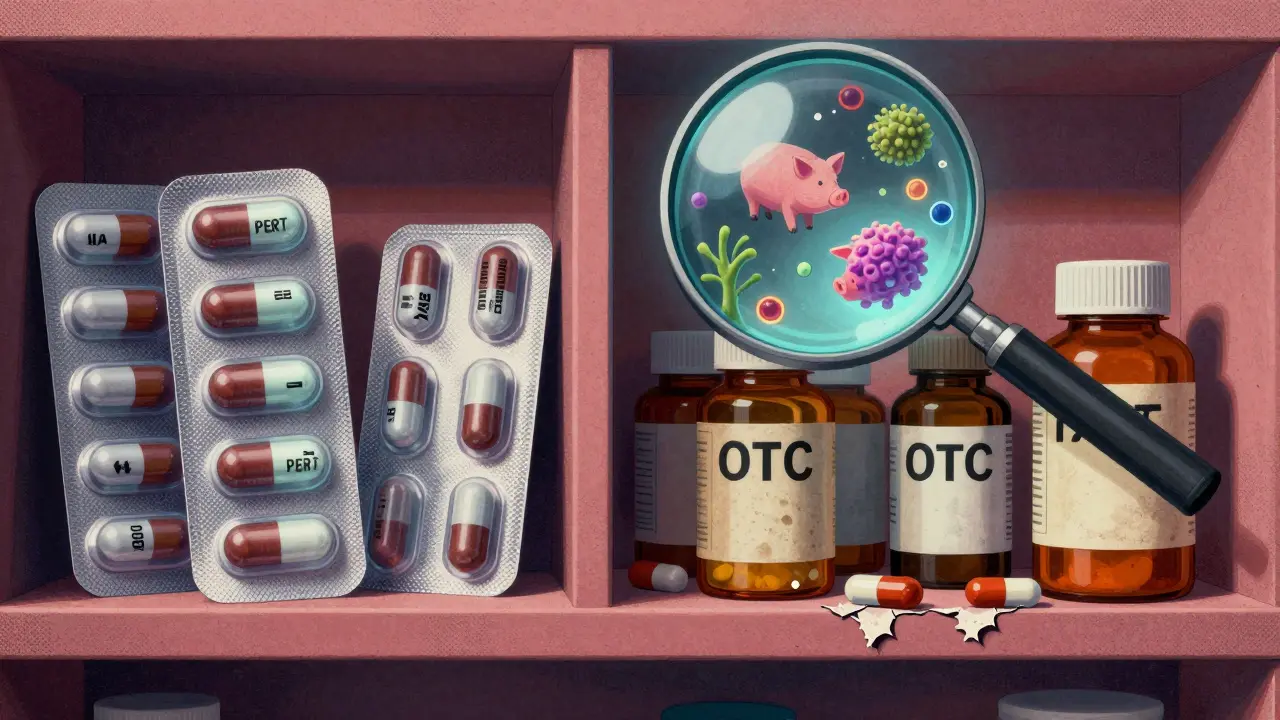
Walk into any health store, and you’ll see dozens of OTC digestive enzyme supplements-Digestive Gold, NOW Foods, Lactaid, Enzymedica. They promise relief from bloating, gas, and discomfort after eating beans, dairy, or cruciferous veggies. But here’s the truth: they’re not all the same.
Prescription PERT is standardized. Each capsule has exact amounts of lipase, protease, and amylase. OTC versions? A 2019 study found 20-30% variation between batches. Some contain only 80% of what’s listed on the label. And most lack enteric coating, meaning stomach acid kills the enzymes before they reach the small intestine.
So do they work?
For true EPI? Not reliably. Studies show prescription enzymes reduce fatty stools by 70-85%. OTC enzymes? Maybe 30-40%. But for people with functional issues-like IBS or lactose intolerance-the story changes.
Lactase enzyme supplements (like Lactaid) are one of the few OTC enzymes with solid evidence. Over 80% of users report being able to enjoy dairy without bloating. That’s a game-changer for millions.
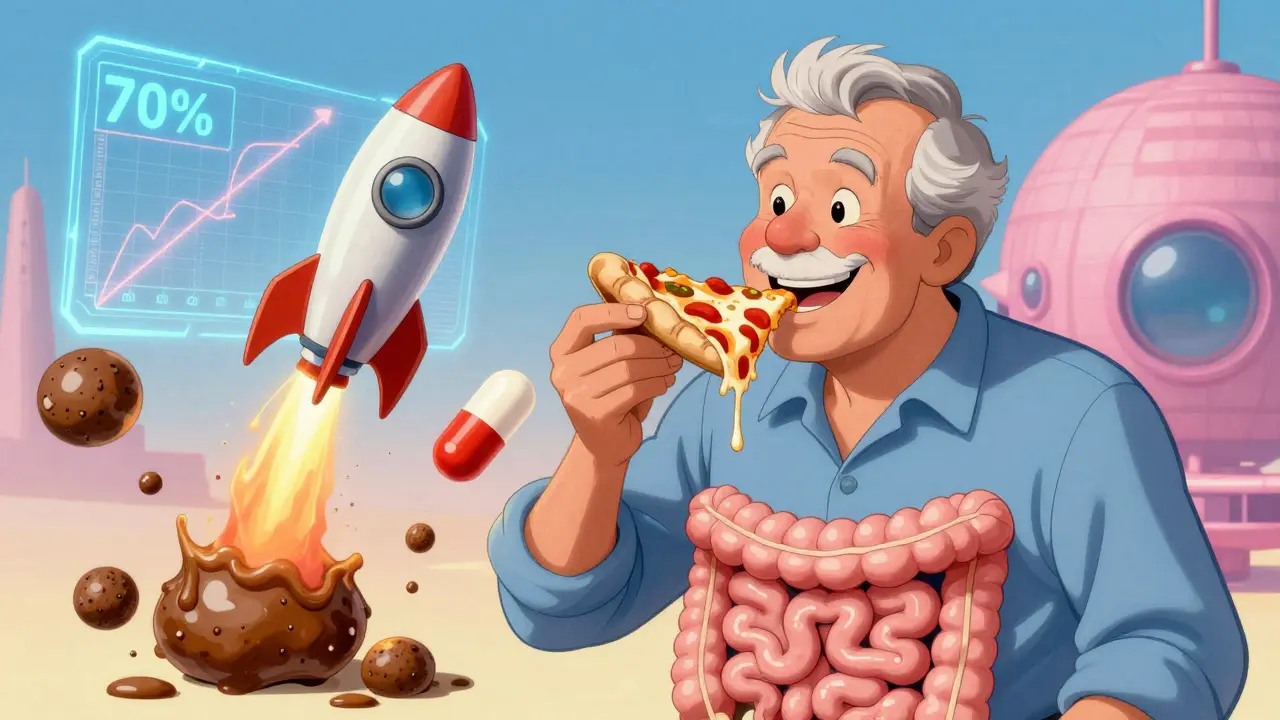
For IBS? A 2021 meta-analysis found OTC enzymes reduced bloating and diarrhea by 50-60%. That’s significant. But it’s not a cure. It’s a tool. One user on Reddit said, “I take Digestive Gold before pizza, and I don’t spend the next day in bed.” That’s the kind of win that matters.
What’s Actually in These Supplements?
Not all enzymes are created equal. There are two main sources:
- Animal-based (mostly from pig pancreas): Used in 95% of prescription products. They’re potent but need a specific pH (4.5-7.0) to work. That’s why enteric coating is essential.
- Microbial-based (from fungi like Aspergillus oryzae): Common in OTC products. They’re more stable across a wider pH range (3.0-8.0), so they can survive stomach acid even without coating. But they’re less concentrated-you need 30-50% less of them to get the same effect.
Dosage matters too. Lipase is the key player for fat digestion. One gram of dietary fat needs about 500 lipase units to break down properly. A high-fat meal (say, 40g of fat) might need 20,000 units. Most OTC supplements offer 10,000-20,000 lipase units per capsule. Prescription ones go up to 40,000.
And timing? Critical. You need to take them right before eating-ideally within 15 minutes. If you take them after, they’re too late. If you take them with water on an empty stomach, they’re wasted.
Who Should Consider Them?
Here’s a simple guide:
- Try OTC enzymes if: You get bloated after dairy, beans, or broccoli. You have IBS and haven’t found relief with low-FODMAP diet alone. You’re looking for a low-risk, affordable way to reduce gas.
- See a doctor if: You have unexplained weight loss, fatty stools, or chronic diarrhea. You’ve been diagnosed with pancreatitis, cystic fibrosis, or had pancreatic surgery. You’re on proton pump inhibitors (PPIs) like omeprazole-those reduce stomach acid and can interfere with enzyme activation.
One red flag: If you have SIBO (small intestinal bacterial overgrowth), enzyme supplements can make things worse. Bacteria feed on undigested carbs, and enzymes make more of those carbs available. A 2021 case series showed SIBO patients getting more bloated after taking enzymes. So if you’ve had a breath test for SIBO, talk to your doctor before trying them.
Cost, Coverage, and Real-World Trade-offs
Prescription PERT isn’t cheap. With insurance, you might pay $1.50-$3.00 per dose. Without it? $100-$300 a month. But Medicare Part D typically covers 70-90%. OTC enzymes? $0.50-$1.00 per dose. A bottle lasts a month. That’s why so many people start with OTC-they’re accessible, affordable, and low-risk.
But here’s the catch: if you’re using OTC enzymes for years because you’re avoiding a doctor’s visit, you might be missing something serious. Chronic diarrhea, weight loss, or nutrient deficiencies aren’t just “digestive issues.” They could be signs of EPI, celiac disease, or even cancer.
Dr. Shane from the University of Miami puts it bluntly: “OTC supplements aren’t designed to treat GI ailments. If symptoms persist, get checked.”
How to Use Them Without Wasting Money
If you decide to try an OTC enzyme, here’s how to do it right:
- Start with the lowest dose (10,000 lipase units) before a high-fat or high-protein meal.
- Wait 2-3 days. Keep a food/symptom journal. Note what you ate and how you felt.
- If no change, increase by 10,000 units weekly. Most people find their sweet spot between 20,000-40,000 units per meal.
- Take them with the first bite of food. Not after. Not before breakfast if you’re eating lunch.
- Don’t combine with PPIs unless your doctor says so. Acid suppression can make enzymes useless.
Some people find splitting the dose helps-half before the meal, half halfway through. One 2018 study showed this improved symptom control by 35% in slow eaters.
The Future: Personalized Enzymes?
Research is moving fast. A 2023 study showed a blend of gluten-specific enzymes reduced gluten toxicity by 80% in celiac patients-potentially letting them eat small amounts of wheat without symptoms. Other trials are testing enzyme-probiotic combos for IBS. One Phase 2 trial found adding Bifidobacterium to lactase improved symptom relief by 45% over lactase alone.
Companies like Viome are now using gut microbiome tests to recommend enzyme blends tailored to your unique digestion. It’s early, but it’s promising.
For now, though, the message is clear: Enzymes aren’t a cure-all. But for the right person, at the right time, they can be a quiet miracle.




David McKie
February 26, 2026 AT 04:52This article is basically just a glorified ad for prescription enzymes disguised as medical advice. I’ve seen this exact pattern before-some ‘doctor’ drops a few case studies, throws in a few numbers, and suddenly we’re all supposed to believe these $300/month pills are the answer to everything. Meanwhile, the real issue? Our food is poisoned with processed crap and our gut flora is dead from antibiotics and sugar. No amount of lipase is gonna fix that. You’re treating symptoms, not causes. And don’t even get me started on how Big Pharma owns every study cited here. Pathetic.
Southern Indiana Paleontology Institute
February 26, 2026 AT 19:23lol at all this science talk. i just eat a burrito and boom gut explodes. so i take one of those little enzyme pills from walmart. cost me 5 bucks. no doctor. no prescription. no drama. works better than my ex. i dont need no enteric coating. i just chew em and go. if it aint broke dont fix it. also america is the only country that makes this a big deal. in india they just drink buttermilk and call it a day. we got it figured out.
Anil bhardwaj
February 27, 2026 AT 18:14I’ve been taking OTC enzymes for a year now after my IBS got worse post-COVID. I started with Lactaid because dairy was killing me. Then I switched to Enzymedica because the bloating after beans and broccoli was still bad. It’s not perfect, but I can finally eat out without planning my day around the bathroom. I don’t need to be a scientist to know what works. I just listen to my body. And yeah, I know it’s not a cure. But sometimes, relief is enough.
lela izzani
February 27, 2026 AT 19:27Thank you for writing this so clearly. As a registered dietitian, I see so many patients who are terrified of supplements or convinced they’re snake oil. The truth is, enzymes aren’t magic-but they’re also not useless. For someone with EPI, they’re lifesaving. For someone with lactose intolerance? A game-changer. I always tell my clients: if you’re trying OTC enzymes, track your symptoms. Give it 2 weeks. If nothing changes, it’s probably not helping. And if you’re losing weight or having oily stools? See a doctor. No shame in that. Your gut deserves better than guesswork.
John Smith
February 28, 2026 AT 09:04Wow look at all these big words and studies and percentages. Did someone forget we’re talking about poop here? I mean really. We’re all just trying not to fart in public. You spent 10 paragraphs explaining how lipase works and yet the only thing that matters is whether I can eat pizza without turning into a human whooshie. Also, why is every supplement labeled like it’s from NASA? Just tell me if it works. Not how many micromoles of amylase are in each capsule. I’m not a lab rat. I’m a guy who just wants to digest his tacos.
Shalini Gautam
February 28, 2026 AT 11:57I love how this article mentions SIBO but doesn’t scream about it enough. My cousin had SIBO for 3 years and tried every enzyme under the sun. She went from bloated to exploding. Then she stopped everything, did a low-FODMAP diet for 6 weeks, and took a probiotic with prebiotic fiber. Boom. No more gas. No more panic attacks before meals. Enzymes might help some people-but they’re not the first thing you should reach for. Try diet first. Always. That’s what my Ayurvedic doctor told me and she’s been practicing in Jaipur for 40 years. She knows.
Natanya Green
March 1, 2026 AT 10:31OH. MY. GOSH. I JUST READ THIS ENTIRE THING AND I’M CRYING BECAUSE I’VE BEEN LIVING THIS. I’M THE 62-YEAR-OLD MAN IN THE ARTICLE. I LOST 20 POUNDS. I WASN’T EATING BECAUSE EVERY MEAL FELT LIKE A BOMB WENT OFF IN MY STOMACH. THEN I STARTED CREAON. AND I GOT MY LIFE BACK. I ATE A STEAK LAST WEEK AND DIDN’T HAVE TO SIT IN THE BATHROOM FOR AN HOUR. I JUST WANTED TO SAY THANK YOU. THIS ARTICLE? IT’S NOT JUST SCIENCE. IT’S HOPE. AND I’M SO GRATEFUL.
Steven Pam
March 2, 2026 AT 16:27This is the kind of post that reminds me why I love the internet. Real info. Real stories. Real science without the jargon overload. I’ve been using OTC enzymes for years-mostly Enzymedica-just for pizza nights and big family dinners. I started with 10k units, worked up to 30k, and now I don’t even think about it. I just take them. It’s not perfect, but it’s enough. And hey, if you’re reading this and you’ve been suffering silently? Try it. Start small. Track it. You might be surprised. Your gut will thank you. And honestly? You deserve to enjoy food without fear.