
When you’re older, your body doesn’t process medicine the same way it did when you were 30. That’s not just a myth-it’s science. A 75-year-old taking the same dose of a blood pressure pill as a 50-year-old might end up dizzy, falling, or in the hospital. The reason? Aging changes how your body absorbs, distributes, breaks down, and gets rid of drugs. And if you don’t adjust the dose, you’re not helping yourself-you’re risking harm.
Why Older Bodies Need Different Doses
Your liver slows down. Your kidneys filter less. Your body holds onto more fat and loses muscle. These aren’t minor changes. They directly affect how drugs move through you. For example, many common medications like gabapentin or metformin are cleared by the kidneys. After age 30, kidney function drops about 8 mL per minute every decade. By 70, that’s a 40% drop. If your kidneys can’t clear the drug, it builds up. That’s how you get side effects like confusion, falls, or low blood sugar-even with a "normal" dose.The "Start Low, Go Slow" Rule
This isn’t just advice-it’s the gold standard. The American Geriatrics Society has been pushing this since the 1980s, and it’s backed by decades of data. Instead of starting with the standard adult dose, doctors should begin with 25% to 50% less. Then, they wait. Weeks, sometimes months. They watch for results and side effects before increasing anything. Take warfarin, a blood thinner. A 70-year-old might need only 2 mg a day, while a 45-year-old gets 5 mg. Too much warfarin in an older person? Risk of dangerous bleeding. Too little? Risk of stroke. Finding the right dose isn’t guesswork-it’s careful monitoring, often with blood tests.How Kidney Function Changes Everything
The gold standard for measuring kidney function in older adults is the Cockcroft-Gault equation. It uses your age, weight, and blood creatinine level to estimate how well your kidneys are working. If your creatinine clearance drops below 50 mL/min, most kidney-cleared drugs need a dose reduction. About 40% of people over 65 have kidney function below this level, even if their blood tests look "normal" to a general doctor. Drugs like digoxin, lithium, and many antibiotics are dangerous if kidney function isn’t checked. For digoxin, the safe blood level in seniors is 0.5-0.9 ng/mL. In younger people, it’s 0.8-2.0 ng/mL. That’s a huge difference. Yet, many prescriptions still default to the higher range.Liver Changes and Drug Breakdown
Your liver doesn’t just slow down-it gets less efficient at breaking down drugs. For medications processed by the liver-like painkillers, antidepressants, or sleep aids-this means they stay in your system longer. That increases side effects: drowsiness, confusion, low blood pressure. Doctors use the Child-Pugh score to assess liver health in seniors. A score of 7-9 (moderate impairment) means you need about half the usual dose. A score of 10-15 (severe) means you should avoid the drug entirely. But here’s the problem: most primary care doctors don’t run this test unless liver disease is suspected. That’s a gap. Many seniors are on meds they shouldn’t be, simply because their liver function was never checked.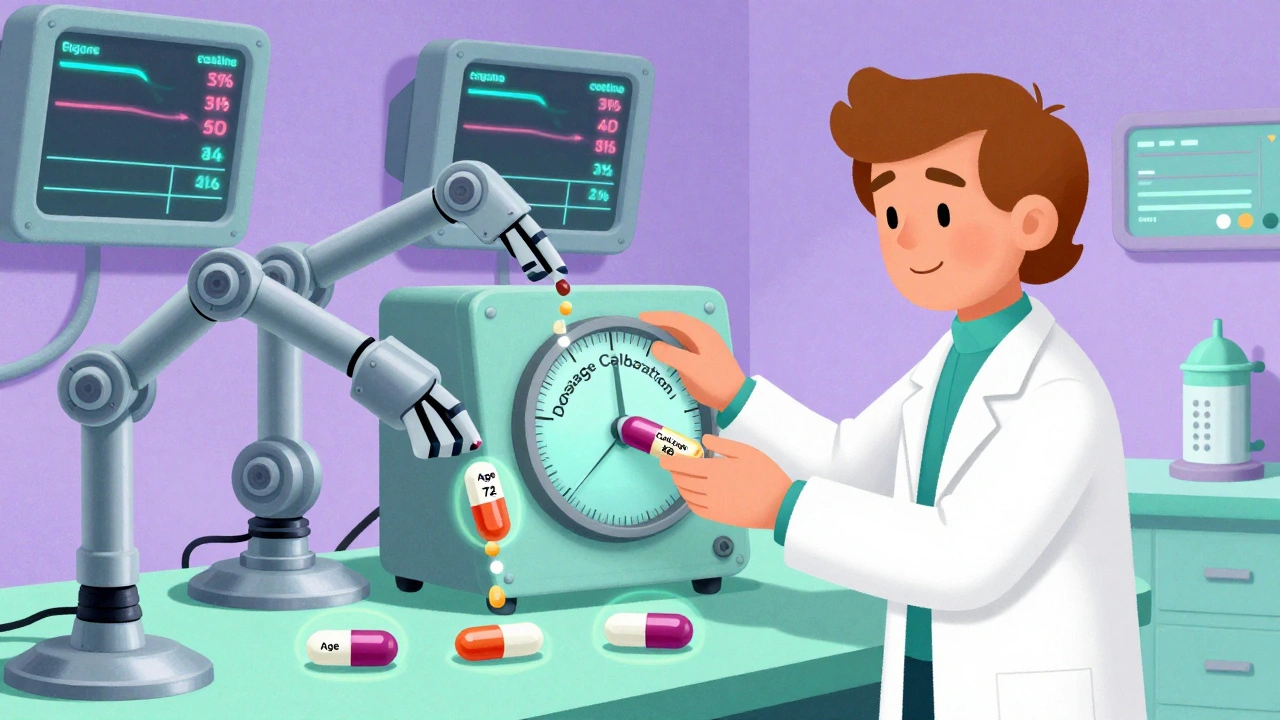
What Medications Are Riskiest?
The 2023 Beers Criteria® from the American Geriatrics Society lists 30 drug classes that are high-risk for older adults. Here are the top three:- Benzodiazepines (like diazepam or lorazepam): Increase fall risk by 50%. Even short-term use can cause memory loss and confusion.
- NSAIDs (like ibuprofen or naproxen): Raise the chance of stomach bleeding by 300%. Many seniors take these for arthritis, unaware of the danger.
- Anticholinergics (found in some sleep aids, bladder meds, and antidepressants): Double the risk of dementia with long-term use.
Why Clinical Trials Don’t Tell the Whole Story
Most drug trials include almost no one over 75. A 2019 FDA analysis of 218 major trials found 40% of them had fewer than 10% of participants over 75. That means the "standard" dose for a 78-year-old with three chronic conditions was tested on a 55-year-old with one condition and perfect kidneys. That’s why you hear conflicting advice. Some doctors say "avoid all anticholinergics." Others say, "But she’s been on this for 20 years and feels fine." The truth? There’s no one-size-fits-all. You need to look at the person-not just the label.How to Get It Right
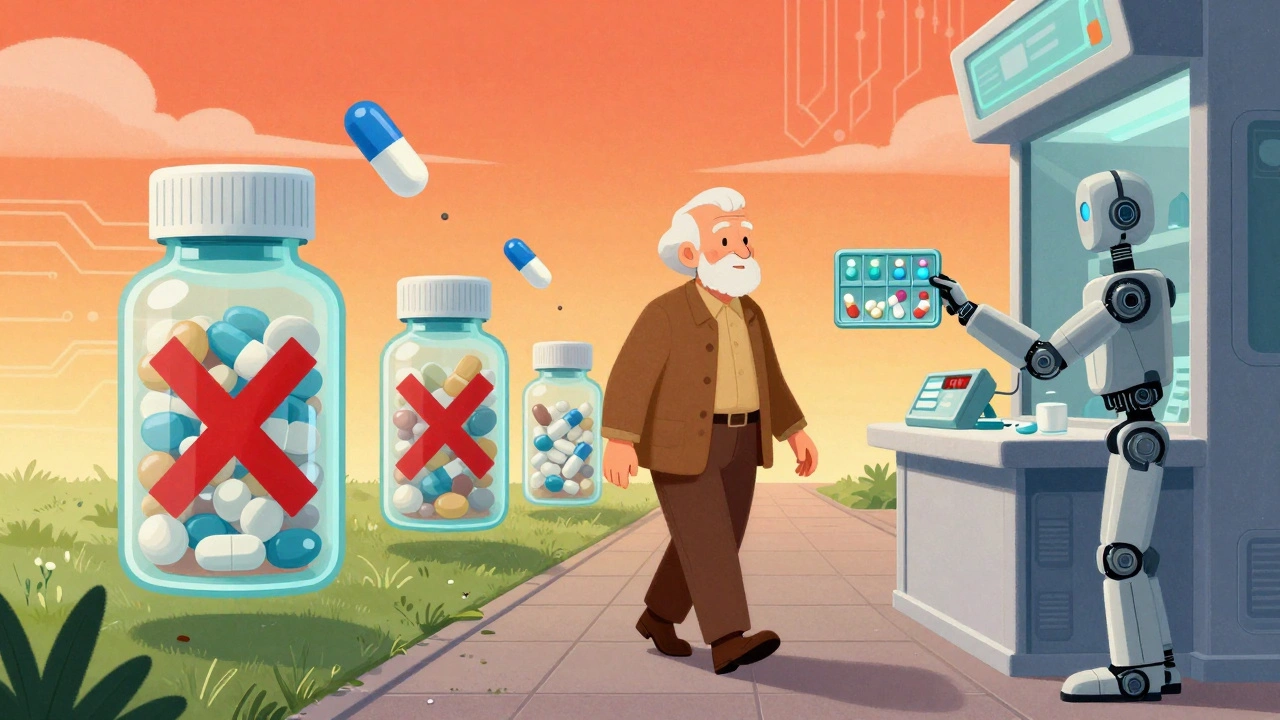
There are proven tools that work:- The Brown Bag Review: Bring every pill, supplement, and OTC med you take to your appointment. Pharmacists see things doctors miss-like five different painkillers or three sleep aids.
- Electronic Alerts: Many clinics now use EHR systems that flag when a dose is too high for low kidney function. These cut errors by 53%.
- Pharmacist-Led Care: Studies show pharmacist-led reviews reduce hospital stays by 22%. They’re trained to spot interactions, adjust doses, and simplify regimens.
- Family Involvement: When a family member helps manage meds, adherence improves by 37%. A simple checklist or pill organizer makes a huge difference.
What You Can Do Today
You don’t need to wait for a doctor’s appointment to protect yourself:- Ask your doctor: "Is this dose right for my kidney and liver function?"
- Request a creatinine clearance test if you’re over 65 and on any chronic medication.
- Review your list of meds every six months. Are you still taking something you started for a short-term issue?
- Never stop a drug cold turkey-especially blood pressure, antidepressants, or steroids. Ask for a taper plan.
- Use a pill organizer with alarms. Many seniors miss doses because they forget, not because they don’t want to take them.
The Future Is Personalized
The next big shift isn’t just about age-it’s about function. A 70-year-old who walks fast, remembers names, and lives independently might need a higher dose than a 65-year-old who struggles to climb stairs or gets confused easily. New tools like the Timed Up and Go test (measuring how long it takes to stand, walk, and sit) are being added to dosing guidelines. AI tools are also emerging. One pilot at Johns Hopkins cut dosing errors by 47% using software that cross-references kidney function, other meds, and age. The NIH is investing $127 million to build better models for predicting how drugs behave in older bodies. By 2030, experts predict that 70% of high-risk medications will be dosed using individualized data-not just age or weight. That’s the goal: the right drug, at the right dose, for your body-not your birth year.Final Thought: It’s Not About Cutting Doses-It’s About Getting It Right
Reducing a dose isn’t a downgrade. It’s precision medicine. A lower dose of a well-chosen drug can mean better sleep, fewer falls, clearer thinking, and more independence. It’s not about being frail. It’s about being smart. The system isn’t perfect. Doctors are rushed. Pharmacies are busy. But you have power. Ask questions. Bring your meds. Push for tests. Your body has changed. Your meds should too.Why can’t seniors just take the same dose as younger adults?
Because aging changes how the body handles drugs. Kidneys filter less, liver breaks down meds slower, body fat increases, and muscle mass decreases. These changes cause drugs to build up in the system, raising the risk of side effects like confusion, falls, or internal bleeding-even with "normal" doses.
What’s the most common mistake with senior medication dosing?
Prescribing the same dose as for younger adults without checking kidney or liver function. Many doctors rely on standard labels, not real-world physiology. This leads to overmedication, especially with drugs cleared by the kidneys like gabapentin, metformin, or antibiotics.
How do I know if my dose is too high?
Watch for new symptoms: dizziness, confusion, memory lapses, unexplained bruising, falls, extreme fatigue, or nausea. These often appear within days or weeks of a new dose or new medication. If you notice them, talk to your doctor or pharmacist. Don’t wait for your next scheduled visit.
Should I stop taking a medication if I’m worried?
Never stop suddenly. Some medications, like blood pressure pills or antidepressants, can cause dangerous rebound effects. Instead, ask your doctor for a review. Bring all your meds in a bag to your appointment. A pharmacist can help determine if it’s safe to reduce or stop.
Are over-the-counter drugs safe for seniors?
Not always. Many OTC painkillers (NSAIDs like ibuprofen) raise the risk of stomach bleeding by 300% in older adults. Sleep aids and cold medicines often contain anticholinergics, which can worsen memory and increase dementia risk. Always check with a pharmacist before taking any OTC drug-even if it’s "natural" or "non-prescription."
Can a pharmacist help with medication adjustments?
Yes-especially pharmacists trained in geriatrics. They review all your meds for interactions, check kidney and liver function, suggest safer alternatives, and help simplify regimens. Studies show pharmacist-led reviews reduce hospitalizations by 22% and cut medication errors by 67% in older adults.


nina nakamura
December 12, 2025 AT 19:58Stop prescribing standard doses like we're all 30. Kidney function drops 8 mL/min per decade? That's not a suggestion, it's a damn fact. If your doctor doesn't check creatinine clearance before writing a script for gabapentin or metformin, they're not caring for you-they're gambling with your life. I've seen 78-year-olds on 300mg gabapentin because the system doesn't care. It's negligence dressed as protocol.
Alvin Montanez
December 13, 2025 AT 08:09Let me tell you something about this whole "start low, go slow" thing-it's not just about kidneys and liver, it's about the entire medical-industrial complex being built for profit, not people. Drug companies design trials with 25-year-olds because they're cheaper to study, and then they sell the same pills to octogenarians with zero adjustment. The FDA knows this. The AMA knows this. But nobody changes it because changing it means losing billions in sales. And now we're stuck with a generation of seniors on five different meds that should've been halved or replaced decades ago. It's not aging that's the problem-it's the system that refuses to age with us.
Lara Tobin
December 13, 2025 AT 21:27This hit me so hard. My mom was on ibuprofen for years and never knew it was raising her risk of internal bleeding. She just thought her stomach felt "off." When we switched her to acetaminophen and got her kidney numbers checked, her dizziness disappeared in two weeks. I'm so glad someone finally said this out loud. 🙏
Bruno Janssen
December 13, 2025 AT 23:47I read this. I didn't say anything. I just stared at my pill organizer. Seven pills. Three of them I don't even remember being prescribed. I think I'm okay. Maybe. I don't know anymore.
Scott Butler
December 15, 2025 AT 06:40Why are we letting foreigners and bureaucrats dictate how Americans take medicine? This whole "Cockcroft-Gault" nonsense? We used to trust our doctors. Now we're being told to bring a brown bag to every appointment like we're criminals? This is socialism creeping into healthcare. If you're old, you should just accept the consequences. Don't make everyone else pay for your mistakes.
Emma Sbarge
December 17, 2025 AT 06:01My husband’s cardiologist finally listened after I brought his meds in a shoebox. We found three overlapping NSAIDs, a sleep aid with anticholinergic properties, and a blood thinner at double the recommended dose for his creatinine clearance. They adjusted everything. He hasn’t fallen in eight months. This isn’t radical. It’s basic. Why is this even a conversation?
Michael Gardner
December 18, 2025 AT 15:58Actually, the real problem is that younger people are taking way too much too young. I'm 42 and I've seen three of my friends on gabapentin for "anxiety"-they’re not even 60 yet. The whole system is overmedicating everyone. Maybe the real solution isn't adjusting for age, it's stopping prescriptions altogether until you absolutely need them.
Willie Onst
December 20, 2025 AT 11:13Man, this is the kind of stuff I wish my grandpa had known. He took that same dose of digoxin for 15 years, never got his levels checked, and ended up in the hospital with confusion and heart rhythm issues. He thought it was just "getting old." But you're right-it wasn't aging. It was neglect. I'm sharing this with my whole family. We need to stop treating meds like candy. Your body changes. Your pills should too. Thanks for saying this clearly.
Ronan Lansbury
December 21, 2025 AT 12:13Of course they’re not testing drugs on people over 75. The elite know that the elderly are expendable. The NIH’s $127 million? That’s just PR. The real power players-Big Pharma, the AMA, the FDA-they all belong to the same club. They want you docile, dosed, and dependent. AI tools? They’re just algorithms designed to make you feel safe while they quietly optimize profit margins. Wake up. This isn’t medicine. It’s social engineering.