
Medication Interaction Checker
Check for Medication Interactions
Enter the medications you're currently taking to see potential interactions. This tool helps you identify possible risks before your annual medication review with a pharmacist.
Note: This is not a substitute for professional medical advice. Always consult with your pharmacist or doctor before making changes to your medications.
Every year, thousands of people end up in the hospital not because their condition got worse, but because of a side effect from a medicine they were taking. Sometimes it’s a sleep aid that makes them dizzy. Other times, it’s a blood pressure pill that causes muscle cramps. Or maybe they’re taking two different drugs that shouldn’t be mixed - and they didn’t even know it. These aren’t rare mistakes. They’re common, preventable, and often missed during a 10-minute doctor’s visit.
That’s where an annual medication review with a pharmacist comes in. It’s not a luxury. It’s a safety check-up for your pills. And if you’re taking four or more medications regularly - especially if you’re over 65 - this review could be one of the most important health decisions you make this year.
What Happens During an Annual Medication Review?
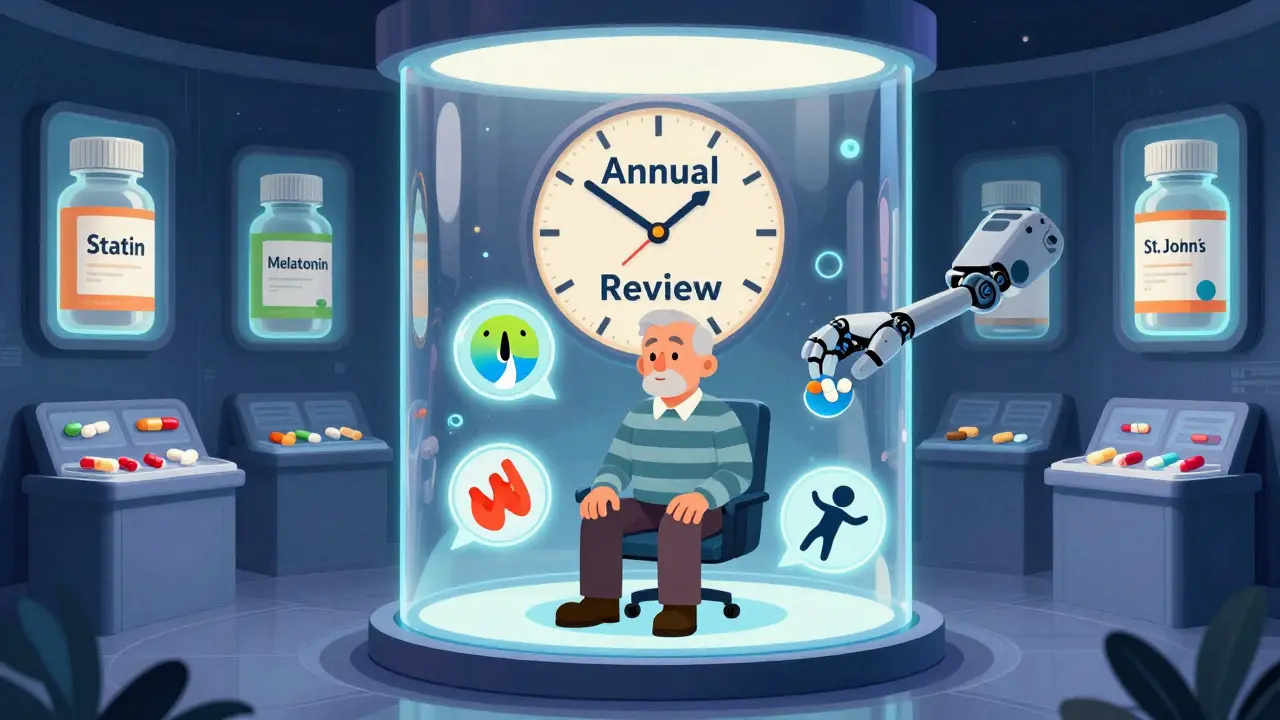
An annual medication review isn’t just a quick chat about your prescriptions. It’s a full audit of everything you’re taking. That means prescription drugs, over-the-counter painkillers, vitamins, herbal supplements, even eye drops or skin creams you use daily. Pharmacists don’t just look at the labels - they ask why you’re taking each one, whether it’s still helping, and if it’s causing any hidden problems.
Here’s how it typically works:
- You bring all your medications in a bag or box - no exceptions. This includes that fish oil you take because your friend said it’s good for joints, or the melatonin you started last winter for sleep.
- The pharmacist sits down with you and goes through each item. They check the dose, the timing, and whether it’s still necessary. They look for overlaps - like two different drugs for high blood pressure that shouldn’t be taken together.
- They ask you how you’re feeling. Are you more tired than usual? Dizzy in the morning? Having stomach issues? These aren’t just side effects - they might be red flags.
- They compare your list to what your doctor prescribed. Sometimes, a medication was stopped months ago but you kept taking it because you forgot to ask.
- Finally, they give you a clear, written plan: what to keep, what to stop, what to change, and what to watch for.
This process usually takes 20 to 30 minutes. No rush. No interruptions. You get to ask the questions you didn’t feel comfortable asking your doctor.
Why Pharmacists Are Better at This Than Doctors
Doctors are experts at diagnosing illness. Pharmacists are experts at understanding how drugs work - together, in the body, and over time.
Think about it: a doctor might see 20 patients in a day. A pharmacist spends 30 minutes with one. That time matters. Pharmacists know that ibuprofen can raise blood pressure in someone already on a diuretic. They know that St. John’s Wort can cancel out the effect of antidepressants. They know that a common sleep aid can make someone over 70 more likely to fall.
A study from the National Institutes of Health found that medication-related problems cause up to 20% of hospital admissions in older adults. Most of those cases involved drugs that were either unnecessary, incorrectly dosed, or interacting dangerously. Pharmacists catch these issues because they’re trained to spot them - not just treat symptoms.
And they’re everywhere. About 90% of Americans live within five miles of a pharmacy. You don’t need an appointment months in advance. You can walk in after picking up your refill.
Who Benefits Most From This Review?
This isn’t for everyone - but it’s critical for some.
Seniors on multiple medications: If you’re taking five or more long-term drugs, you’re at high risk for side effects and interactions. About 40% of adults over 65 in the U.S. are on four or more medications. That’s polypharmacy - and it’s the biggest risk factor for preventable hospital visits.
People with chronic conditions: Diabetes, heart disease, arthritis, depression - each often requires multiple drugs. The more conditions you have, the higher the chance one medicine is making another worse.
Anyone feeling “off” for no clear reason: If you’ve been more tired, confused, or achy lately - and your doctor says “it’s just aging” - that’s a red flag. Many side effects are blamed on getting older when they’re actually caused by a drug you’ve been taking for years.
People who take supplements: Many people don’t tell their doctors about vitamins or herbs. But garlic supplements can thin your blood. Calcium can interfere with thyroid meds. Ginkgo can raise bleeding risk if you’re on aspirin. Pharmacists know these hidden risks.
If you’re on just one or two simple meds - like a single blood pressure pill or a daily thyroid tablet - you might not need a full review. But even then, it’s worth asking your pharmacist: “Is this still right for me?”
What You’ll Get Out of It
People who get an annual medication review don’t just avoid side effects - they feel better.
One woman in her 70s came in because she was always exhausted. She was taking a sleep aid, a painkiller, a blood pressure pill, a statin, and a daily multivitamin. The pharmacist found she was taking two different drugs for the same type of pain - one prescription, one OTC. Stopping the duplicate cut her fatigue in half.
An older man was taking a heart medication that caused dry mouth and dizziness. His pharmacist suggested a different pill with the same effect but fewer side effects. He stopped falling. He started walking again.
Another patient was taking a cholesterol drug that was making her muscles sore. The pharmacist noticed her doctor had prescribed a different statin two years ago - but she never got the new prescription filled. She was still on the old one, which was less effective and harder on her body.
These aren’t rare cases. They’re standard outcomes. Studies show that after a medication review, patients are less likely to be hospitalized, take fewer unnecessary pills, and report higher confidence in managing their health.
How to Prepare for Your Review
Don’t just show up. Get ready.
- Collect every pill bottle, box, or blister pack you take - even if you haven’t used them in months.
- Write down what each one is for. If you don’t know, write “don’t know.” That’s okay.
- Bring a list of all supplements, vitamins, and herbal remedies. Don’t leave anything out.
- Write down any new symptoms you’ve had - even small ones. “I’ve been dizzy when I stand up” or “My stomach feels weird after dinner.”
- Ask yourself: “Am I still taking this because my doctor said so - or because I just never stopped?”
Some pharmacies offer free medication organizers - blister packs or pill boxes that sort your meds by day and time. Ask if they have them. They can help you stay on track after the review.

What to Do After the Review
The review doesn’t end when you walk out. You need to act.
First, get a printed copy of the updated list. Make sure it shows what to stop, what to change, and what to keep. Keep it with your other health records.
Second, share it with your doctor. Not all pharmacists automatically send notes to your doctor - so don’t assume they did. Call your doctor’s office and ask them to update your file.
Third, follow up. If you’re stopping a medication, watch for changes. If you’re starting a new one, note how you feel after a week. Call your pharmacist if something feels off.
Finally, schedule your next review. Don’t wait for a problem to happen. Make it a yearly habit - like a dental check-up.
Common Myths About Medication Reviews
Some people think:
- “My doctor already checks my meds.” Not really. Most doctors have 10 minutes per patient. They can’t catch every interaction.
- “I don’t take enough meds to worry about.” Even two or three can interact. One woman was taking a blood thinner and a common cold medicine - together, they raised her risk of bleeding. She didn’t know until her pharmacist pointed it out.
- “I’m too young for this.” Polypharmacy isn’t just for seniors. People with multiple chronic conditions - even in their 40s or 50s - can benefit.
- “It’s too expensive.” In New Zealand and the U.S., Medicare and many private insurers cover this service for eligible patients. Many community pharmacies offer it for free as part of their care program.
What’s Next for Medication Safety?
The system is getting better. More pharmacies are using digital tools to flag dangerous interactions before you even pick up your prescription. Some are linking directly to electronic health records so your doctor sees the pharmacist’s notes in real time.
Telehealth reviews are also growing. If you can’t get to the pharmacy, you can do a video call with a pharmacist - just make sure you have all your meds handy.
But the biggest change isn’t technology. It’s mindset. More people are starting to see their pharmacist not as someone who just hands out pills - but as a key part of their healthcare team.
By 2030, nearly all baby boomers will be over 65. That means millions more people will be on multiple medications. The need for annual reviews won’t go away - it will grow.
The good news? You don’t have to wait for the system to catch up. You can take control today.
Go to your local pharmacy. Ask for an annual medication review. Bring your pills. Ask the questions. Get the answers. And don’t let another year go by wondering if your meds are helping - or hurting you.
Is an annual medication review covered by insurance?
In the U.S., Medicare Part D requires insurers to offer free Comprehensive Medication Reviews to eligible beneficiaries - usually those on multiple chronic conditions and medications. Many private insurers now cover it too. In New Zealand, some community pharmacies offer the service at no cost as part of their public health role. Always ask your pharmacy if there’s a fee - most don’t charge for this review.
Can I do this review remotely or over the phone?
Yes, many pharmacies now offer virtual medication reviews via video call. But you still need to have all your medications on hand - pills, bottles, or photos of labels - so the pharmacist can see what you’re taking. Text or phone-only reviews aren’t enough because they can’t verify what you’re actually using.
What if I’m taking something my doctor didn’t prescribe?
That’s exactly why the review matters. Many people take OTC drugs, supplements, or herbal remedies without telling their doctor. But these can interact dangerously with prescriptions. Your pharmacist will ask you about them - and won’t judge. The goal is safety, not blame. Full honesty is the only way to make the review work.
How often should I get a medication review?
At least once a year. But if you’ve had a major health change - like a new diagnosis, hospital stay, or surgery - or if you’ve started or stopped any medications, schedule a review right away. Don’t wait for your annual date.
What if the pharmacist says to stop a medication - but my doctor prescribed it?
The pharmacist won’t tell you to stop something on their own. They’ll make a recommendation and send it to your doctor. You’ll be asked to follow up with your doctor to discuss the change. Never stop a prescribed medication without talking to your doctor first - even if your pharmacist suggests it.




Harriet Hollingsworth
January 1, 2026 AT 05:29This is exactly why people die from 'natural causes'-because no one checks what’s in their medicine cabinet. I know a woman who took ibuprofen with her blood thinner for years and almost bled out. No one told her. Not her doctor. Not her pharmacist. Until she collapsed. And now she’s mad at everyone but herself. This post? It’s a wake-up call. Stop being lazy. Bring your pills.
Deepika D
January 1, 2026 AT 05:34Oh my goodness, this is so important!! I’ve been telling my elderly neighbors for years to bring their meds to the pharmacy-they think it’s just about refills, but nooo, it’s a full health audit!! I helped my aunt last month-she was taking four different painkillers, two sleep aids, and a 'miracle' turmeric supplement that was making her liver go haywire. The pharmacist found THREE duplicates and one interaction that could’ve caused a stroke. She cried happy tears. And now she’s walking again! Please, everyone, do this. It’s free. It’s easy. It saves lives. 💪❤️
Bennett Ryynanen
January 2, 2026 AT 02:20Listen up, folks. If you’re over 50 and on more than two pills, you’re playing Russian roulette with your body. I’ve seen it too many times-grandma taking aspirin with fish oil, then falling and breaking her hip. The pharmacy isn’t just a place to get your Zoloft. It’s your last line of defense. Stop trusting your doctor to catch everything. They’re rushed. They’re tired. They’re not pharmacists. Walk in. Bring your shit. Ask. Demand. Do it now.
Chandreson Chandreas
January 3, 2026 AT 22:11Life’s funny, right? We spend hours researching the best yoga mat or the perfect avocado toast-but never think to ask what’s actually happening inside our bodies when we swallow those little pills. I used to think supplements were harmless. Then I found out my ginkgo was messing with my blood pressure med. My pharmacist didn’t judge. Just said, 'Hey, let’s fix this.' That moment changed how I see healthcare. It’s not about doctors. It’s about teams. And pharmacists? They’re the quiet heroes. 🙏
Darren Pearson
January 5, 2026 AT 13:35The structural inefficiencies in pharmaceutical care delivery are alarming. While the anecdotal evidence presented herein is compelling, one must consider the broader systemic context: physician-pharmacist interoperability remains fragmented across U.S. states, and reimbursement models for Comprehensive Medication Reviews are inconsistent. Until standardized EHR integration and mandatory CPT billing codes are implemented, such interventions remain sporadic and inequitable. This post, while well-intentioned, lacks critical policy context.
Urvi Patel
January 7, 2026 AT 01:52Why are we making this so complicated I take three pills and I’m fine why do you think everyone needs a lecture every year people are not stupid just because they’re old doesn’t mean they don’t know what they’re taking
anggit marga
January 8, 2026 AT 13:38This is American medical nonsense why do you need a pharmacist to tell you not to mix pills your grandmas in Nigeria take ten herbs and three pills and still walk ten miles a day and never go to hospital you people are too dependent on systems stop being weak
Joy Nickles
January 8, 2026 AT 19:16Okay so I’m gonna be real-I took my mom to get this review last year and I didn’t tell her I was there the whole time because I was scared she’d be mad. But the pharmacist found a blood pressure med she was taking for 7 years that was totally outdated-her doctor had switched her to a better one in 2020 but she never got the refill. She was still taking the old one. And she had been dizzy for 3 years. She cried. I cried. And now I check my dad’s meds every month. Like… every. Single. Month. I even have a spreadsheet. I’m not proud. I’m just terrified.
Emma Hooper
January 8, 2026 AT 21:29Let me tell you something-this isn’t just about pills. It’s about dignity. I watched my uncle go from sharp, funny, and independent to a foggy, shaky mess because his doctor kept adding meds for every little thing. He didn’t have dementia-he had polypharmacy. The pharmacist took one look at his bag and said, 'You’re taking four different things for anxiety.' Four. He cried. We all cried. And then he got better. Not because of a new drug. Because they took some away. Sometimes less is more. And sometimes, the real healing is just… stopping.
Martin Viau
January 9, 2026 AT 21:39The literature on polypharmacy in aging populations is well-established, yet the implementation of pharmacist-led interventions remains suboptimal due to regulatory fragmentation and lack of reimbursement incentives. While the post presents a compelling narrative, it lacks methodological rigor. The cited NIH study (2018) was observational and did not control for confounding variables such as socioeconomic status or adherence. Furthermore, the assumption that pharmacists are inherently superior to physicians in medication management is reductionist and ignores the cognitive load of primary care providers. Until we address systemic disincentives, this remains performative healthcare.
Marilyn Ferrera
January 9, 2026 AT 22:15Bring your pills. Write down your symptoms. Ask questions. That’s it. No magic. No drama. Just care. I did this last year. Stopped two things. Changed one. Now I sleep. I walk. I don’t feel like a ghost. Simple. Done. You can too.
Robb Rice
January 10, 2026 AT 05:22Thank you for this thoughtful and necessary reminder. As someone who manages chronic conditions, I can attest that even minor medication adjustments-guided by a pharmacist-can yield profound improvements in quality of life. While I appreciate the emphasis on patient agency, I would gently note that follow-up with the prescribing physician remains essential. Coordination of care is not optional-it is foundational to safety and continuity. I encourage all readers to request a written summary and share it with their primary care team. Thank you again for raising awareness.
Lisa Dore
January 11, 2026 AT 22:59I just did this last week and it was the best 30 minutes of my health journey. I thought I was fine. Turns out I was taking two different heart meds that canceled each other out. My pharmacist didn’t just fix it-she hugged me and said, 'You’re not alone.' I cried. Then I made my mom do it too. And my neighbor. And now my whole block is talking about meds. It’s weird. It’s beautiful. And it’s changing lives. You don’t need to be sick to do this. You just need to care. Go. Do it. Now.