
When someone with Parkinson’s disease starts seeing things that aren’t there-voices, shadows, people in the room-the instinct is to treat it. But giving them a standard antipsychotic can make their shaking worse, their movements slower, and their balance worse. It’s a cruel trade-off: fix the hallucinations, break the ability to walk. This isn’t a rare problem. Parkinson’s disease psychosis affects nearly a quarter of all hospital admissions in this population, according to the Parkinson’s Foundation. And too often, the solution makes the problem worse.
Why Antipsychotics Make Parkinson’s Worse
Parkinson’s is caused by the loss of dopamine-producing cells in the brain. Dopamine isn’t just about mood-it’s the fuel for smooth, controlled movement. Without it, people develop tremors, stiffness, and slow motion. Antipsychotics, on the other hand, work by blocking dopamine receptors, especially the D2 subtype. They’re designed to quiet overactive dopamine signals in schizophrenia. But in Parkinson’s, dopamine is already in short supply. Blocking what’s left is like turning off the last few lights in a dark room. The problem isn’t just theory. It’s been documented since the 1970s. First-generation antipsychotics like haloperidol, fluphenazine, and chlorpromazine bind so tightly to D2 receptors that they occupy 90% or more of them at standard doses. In Parkinson’s patients, even tiny amounts-0.25 mg of haloperidol-can trigger severe stiffness, freezing, or falls. Studies show up to 80% of Parkinson’s patients given haloperidol develop sudden, dramatic worsening of motor symptoms. For many, it’s irreversible.Not All Antipsychotics Are Created Equal
Some antipsychotics are far less dangerous than others. The key difference lies in how strongly they bind to dopamine receptors and whether they also act on serotonin receptors. Second-generation antipsychotics like risperidone and olanzapine were once thought to be safer-but they’re not. A 2005 double-blind trial found that while risperidone worked as well as clozapine to reduce hallucinations, it made motor symptoms 4 times worse. One patient’s Unified Parkinson’s Disease Rating Scale (UPDRS-III) score jumped by 7.2 points. That’s the difference between walking unassisted and needing a wheelchair. Olanzapine? In one study, 75% of Parkinson’s patients saw their psychosis improve-but 75% also got significantly worse at moving. Half had to stop the drug because they couldn’t walk. Risperidone? One 1997 study found every single patient had worse motor control. Even low doses of risperidone (0.5 mg) carried a 2.5 times higher risk of death compared to no antipsychotic use, according to a 2013 Canadian study.The Two Antipsychotics That Don’t Usually Make Things Worse
There are two exceptions: clozapine and quetiapine. These drugs have much weaker D2 receptor binding-only 40% to 60% occupancy-and they also affect serotonin receptors, which helps protect movement. Clozapine is the gold standard. It’s FDA-approved for Parkinson’s psychosis since 2016. In clinical trials, it reduces hallucinations without worsening tremors or stiffness. One study showed a 49% improvement in psychotic symptoms with just a 1.8-point increase on the UPDRS-III motor scale. That’s barely noticeable. But clozapine comes with a serious risk: agranulocytosis, a dangerous drop in white blood cells. That’s why patients on clozapine need weekly blood tests. If the neutrophil count falls below 1,500 cells/μL, the drug must be stopped immediately. The risk is low-about 0.8%-but it’s real. Still, for many, it’s worth it. Quetiapine is used off-label and doesn’t require blood monitoring. It works faster than clozapine, often showing results in 1 to 2 weeks. But its effectiveness is debated. A 2017 study found it performed no better than a placebo in reducing hallucinations. Still, many doctors use it because it’s safer and easier to manage. For patients who can’t tolerate clozapine, it’s often the only practical option.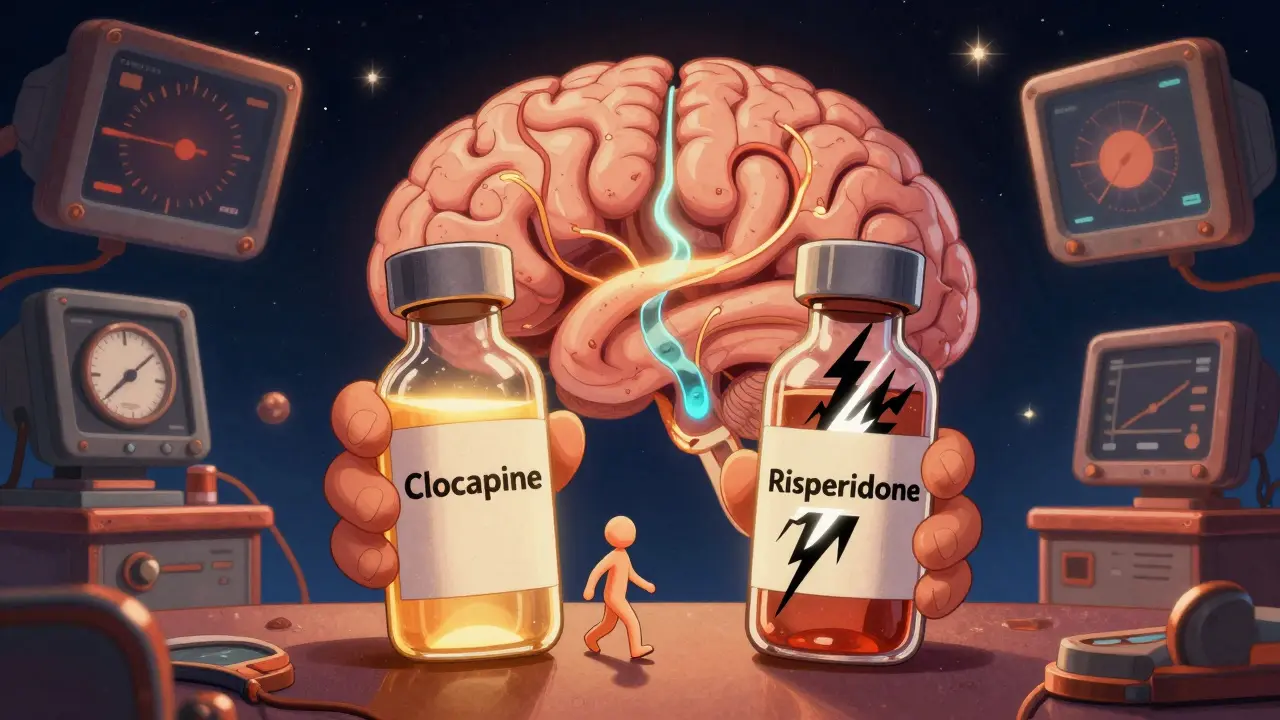
There’s a Better Way: Fix the Cause, Not the Symptom
Before reaching for any antipsychotic, doctors should try adjusting Parkinson’s medications. Many hallucinations aren’t caused by brain changes-they’re caused by too much levodopa, dopamine agonists, or anticholinergics. A 2018 study found that 62% of Parkinson’s patients with psychosis improved simply by reducing or eliminating one of these drugs. Sometimes, cutting a dopamine agonist in half eliminates hallucinations without hurting movement. The process is methodical: first, reduce anticholinergics (like trihexyphenidyl), then MAO-B inhibitors, then amantadine, then dopamine agonists, then COMT inhibitors, and finally, adjust levodopa. This isn’t guesswork. It’s protocol. And it works more often than people think.The New Hope: Pimavanserin and Lumateperone
In 2022, the FDA approved pimavanserin (Nuplazid), the first antipsychotic for Parkinson’s psychosis that doesn’t block dopamine at all. It works by targeting serotonin 5-HT2A receptors. In trials, it improved hallucinations without worsening motor symptoms. But post-marketing data showed a 1.7-fold increase in death risk, leading to a black box warning. It’s still used, but only when other options fail. The most promising new drug is lumateperone. The HARMONY trial, expected to finish in early 2024, showed a 3.4-point improvement in hallucinations with no motor decline after 42 weeks. If confirmed, it could become the safest option yet. Unlike clozapine, it doesn’t need blood tests. Unlike pimavanserin, it doesn’t carry a death risk. And unlike quetiapine, it actually works.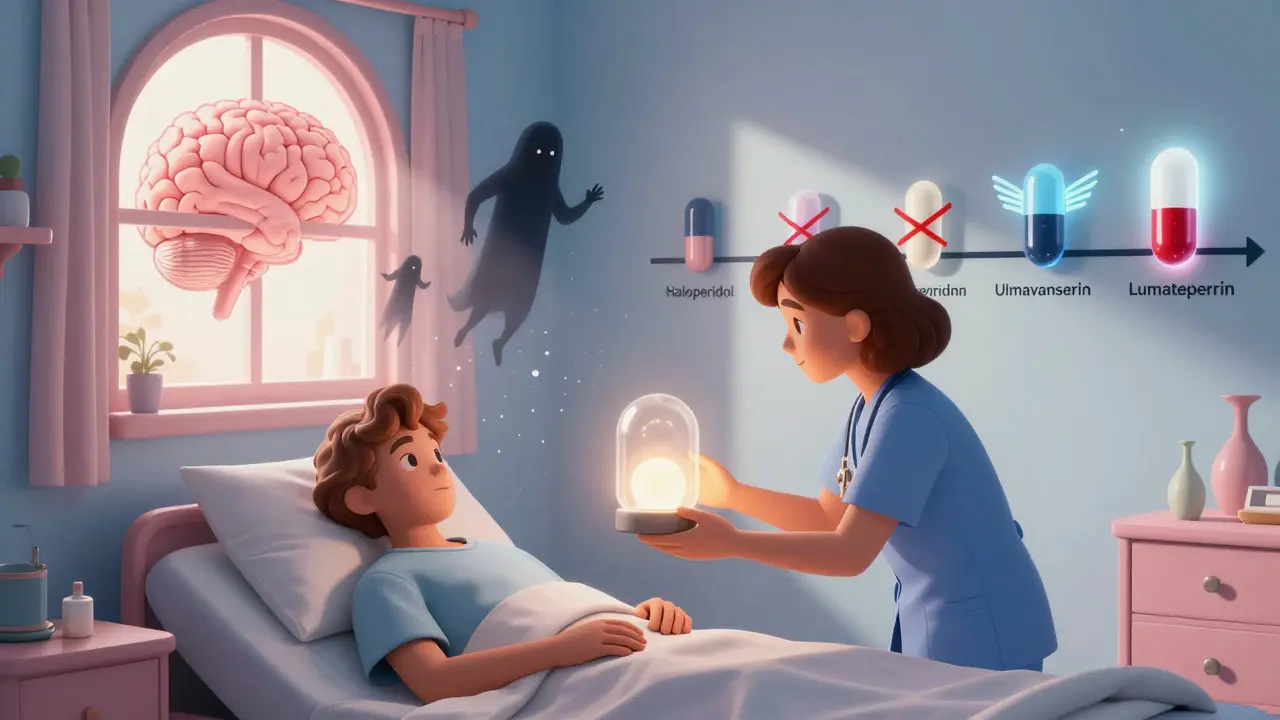
What Doctors Should Do
The guidelines are clear. The American Academy of Neurology gives clozapine Level B evidence (strong support) for treating Parkinson’s psychosis. Quetiapine has Level C (moderate support). First-generation antipsychotics? Avoid entirely. Risperidone? Don’t use. Olanzapine? Don’t use. Haloperidol? Never. Start with non-drug strategies: improve lighting, reduce nighttime confusion, add caregiver support. Then, adjust Parkinson’s meds. If psychosis persists, start with clozapine at 6.25 mg at night, increase slowly over 4 to 6 weeks, and check blood counts weekly. If clozapine isn’t possible, try quetiapine at 12.5 mg, and increase to 25-100 mg if needed. Monitor motor function every two weeks. If UPDRS-III scores rise by more than 30%, stop the drug.It’s Not Just About Medication
Parkinson’s psychosis isn’t just a brain chemistry issue. It’s tied to sleep problems, dementia, loneliness, and sensory overload. A patient who’s isolated, poorly lit, and confused at night is more likely to hallucinate. Simple changes-installing nightlights, using a daily calendar, having someone sit with them in the evening-can cut hallucinations by half. And caregivers need support too. Many patients hide their symptoms because they’re embarrassed. Families need to know: hallucinations aren’t “crazy behavior.” They’re a medical symptom, like tremors. Treating them the wrong way can cost someone their independence.Bottom Line
Antipsychotics aren’t the enemy. But using the wrong ones can be devastating. For Parkinson’s patients, motor stability isn’t optional-it’s survival. Choosing an antipsychotic isn’t about finding the strongest one. It’s about finding the one that doesn’t steal movement to fix vision. Clozapine is the safest bet. Quetiapine is the fallback. Everything else? Avoid. And always, always try adjusting Parkinson’s meds first. The goal isn’t to eliminate every hallucination. It’s to keep the person walking, talking, and living.Can antipsychotics cause Parkinson’s disease?
No, antipsychotics don’t cause Parkinson’s disease. But they can trigger drug-induced parkinsonism, which looks identical to Parkinson’s-tremors, stiffness, slow movement. This happens because they block dopamine receptors. The difference is, drug-induced parkinsonism usually improves when the medication is stopped. True Parkinson’s is caused by nerve cell death and doesn’t reverse.
Is risperidone ever safe for Parkinson’s patients?
No. Risperidone consistently worsens motor symptoms in Parkinson’s patients and increases the risk of death. Multiple studies show it causes severe movement decline and carries a hazard ratio of 2.46 for mortality. It is not recommended by any major Parkinson’s organization and should be avoided entirely.
Why is clozapine not used more often if it’s the best option?
Clozapine requires weekly blood tests to monitor for agranulocytosis, a rare but life-threatening drop in white blood cells. Many doctors and patients avoid it because of the burden of monitoring. Also, it takes weeks to work, and some patients don’t tolerate the side effects like sedation or weight gain. But for those who can use it safely, it’s the most effective and safest antipsychotic for Parkinson’s psychosis.
Can quetiapine make Parkinson’s symptoms worse?
Quetiapine is much less likely to worsen motor symptoms than other antipsychotics. Some studies show no significant change in movement, while others report mild worsening at higher doses. It’s considered the second-line option after clozapine. If motor symptoms start to decline after starting quetiapine, the dose should be lowered or stopped.
What should I do if a loved one with Parkinson’s starts hallucinating?
Don’t rush to give an antipsychotic. First, check their medication list-many hallucinations come from too much levodopa or dopamine agonists. Reduce those under a doctor’s guidance. Improve lighting, reduce noise, and ensure they’re not isolated. If symptoms persist, ask for a referral to a neurologist who specializes in movement disorders. Never start an antipsychotic without expert input.





Cheryl Griffith
January 17, 2026 AT 03:10My dad had Parkinson’s and started seeing his dead brother in the living room. We were terrified. The neurologist immediately said, 'Don’t touch antipsychotics.' We cut his dopamine agonist in half, and within a week, the visions were gone. No drugs, no hospitalizations. Just smart adjustments. It’s not magic-it’s medicine.
Corey Sawchuk
January 18, 2026 AT 18:52Had a cousin on risperidone for 'psychosis' after a stroke. Turned into a statue. Couldn’t walk. Couldn’t talk. Took months to recover. Never again. If you’re thinking about antipsychotics for Parkinson’s, just stop. Read the post. Then call a specialist.
Christina Bilotti
January 19, 2026 AT 22:35Oh wow, so you’re telling me doctors still don’t know how to treat hallucinations without turning people into lawn ornaments? I’m shocked. Truly. Maybe if they stopped treating Parkinson’s like a garage sale of drugs they’d get somewhere.
Nicholas Gabriel
January 20, 2026 AT 16:21Let me just say this: the fact that clozapine requires weekly blood draws is the single biggest barrier to care in this country. It’s not the drug-it’s the bureaucracy. My brother’s neurologist refused to prescribe it because the lab wouldn’t do the tests on weekends. So he got quetiapine. And it didn’t work. And now he’s in a nursing home. This isn’t a medical issue-it’s a systemic failure.
We need to make clozapine accessible. Not just for Parkinson’s, but for every patient who needs it. Weekly labs shouldn’t be a privilege. They should be standard. And insurance companies? They need to stop treating life-saving monitoring like a luxury add-on.
And while we’re at it-why isn’t there a home-based blood testing option? Why does someone have to drive across town, sit in a waiting room, and risk exposure just to keep from turning into a statue? This isn’t 1985. We have telehealth, at-home phlebotomy, digital health platforms. Use them.
The real tragedy isn’t the disease. It’s that we have safe solutions, and we let red tape kill people slowly.
evelyn wellding
January 21, 2026 AT 18:33Just had to put my mom on quetiapine last month. She’s been sleeping better, and the voices are quieter. She still walks to the mailbox every day. I’m so glad we didn’t go with the scary stuff. 💕
john Mccoskey
January 23, 2026 AT 13:43It’s not complicated. The entire psychiatric establishment is built on dopamine suppression as a default solution. They treat Parkinson’s psychosis like it’s schizophrenia with a side of tremors. But it’s not. It’s a neurodegenerative cascade with secondary psychosis. The fact that we’re still debating risperidone in 2024 is a testament to how little the field has evolved. You don’t fix a broken engine by removing the fuel line-you fix the engine. And yet, we keep prescribing antipsychotics like they’re aspirin. It’s not ignorance-it’s institutional arrogance.
Clozapine is the gold standard because it doesn’t just block dopamine-it modulates serotonin-dopamine interplay. That’s why it works. Risperidone? It’s a blunt instrument. Olanzapine? A sledgehammer. Pimavanserin? A band-aid with a death risk. Lumateperone might be the first real answer, but we’re still decades behind where we should be in neuropharmacology.
And don’t get me started on the fact that we’re still using UPDRS-III scores like they’re gospel. They’re subjective, inconsistent, and don’t capture functional mobility. We need wearable sensors, gait analysis, AI-driven tremor detection. But no-let’s keep using pen-and-paper scales from the 1980s while people fall in their bathrooms.
This isn’t medicine. It’s trial and error with a side of malpractice.
Melodie Lesesne
January 25, 2026 AT 07:03I’m a nurse in a long-term care unit, and this post saved my job last year. We had a patient who was getting haloperidol every night. She’d freeze up, couldn’t eat, couldn’t talk. I read this and pushed for a med review. We pulled the antipsychotic, lowered her levodopa, added nightlights and a caregiver during evening hours. Within 10 days, she was singing in the dining room again. No meds needed. Just human care.
It’s not always about drugs. Sometimes it’s just about seeing the person, not the diagnosis.
Ryan Hutchison
January 26, 2026 AT 05:20America’s healthcare system is a joke. We have a drug that works better than anything else-clozapine-but we make it harder to use than getting a gun permit. Meanwhile, we let people die because some bureaucrat thinks weekly blood tests are ‘too burdensome.’ This is why other countries laugh at us. We have the science. We just don’t have the will.
Travis Craw
January 28, 2026 AT 03:14my grandma was on olanzapine for like 3 months and she just stopped walking. no one told us it could do that. we thought she was just getting worse from parkinsons. turns out it was the drug. we stopped it and she got better. why is this not common knowledge?
Corey Chrisinger
January 29, 2026 AT 17:25There’s a deeper truth here: we treat symptoms like enemies, not signals. Hallucinations in Parkinson’s aren’t ‘madness’-they’re the brain’s last cry for balance. We rush to silence them instead of asking: why now? Why this patient? What’s out of rhythm? The real solution isn’t a new drug-it’s a new mindset. Medicine should listen, not suppress.
And yet, we keep reaching for the scalpel when what we need is the tuning fork.
Bianca Leonhardt
January 30, 2026 AT 01:18If you’re still prescribing quetiapine for Parkinson’s psychosis, you’re not a doctor-you’re a gambler. And your patient is the chip.